
Description
ABSTRACT
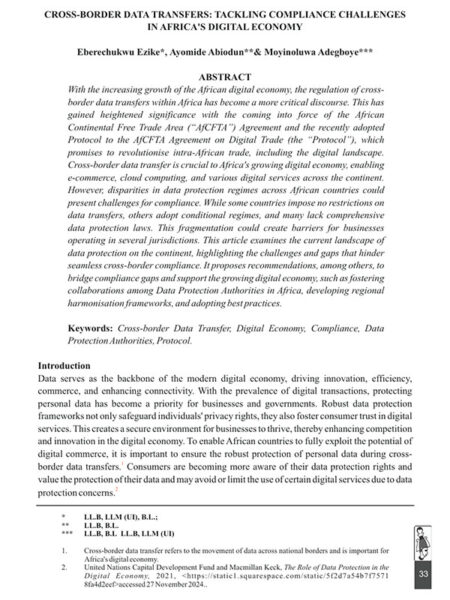
Cross-Border Data Transfers: Tackling Compliance Challenges in Africa’s Digital Economy
Eberechukwu Ezike*, Ayomide Abiodun**& Moyinoluwa Adegboye***
With the increasing growth of the African digital economy, the regulation of cross border data transfers within Africa has become a more critical discourse. This has gained heightened significance with the coming into force of the African Continental Free Trade Area (“AfCFTA”) Agreement and the recently adopted Protocol to the AfCFTA Agreement on Digital Trade (the “Protocol”), which promises to revolutionise intra-African trade, including the digital landscape. Cross-border data transfer is crucial to Africa’s growing digital economy, enabling e-commerce, cloud computing, and various digital services across the continent. However, disparities in data protection regimes across African countries could present challenges for compliance. While some countries impose no restrictions on data transfers, others adopt conditional regimes, and many lack comprehensive data protection laws. This fragmentation could create barriers for businesses operating in several jurisdictions. This article examines the current landscape of data protection on the continent, highlighting the challenges and gaps that hinder seamless cross-border compliance. It proposes recommendations, among others, to bridge compliance gaps and support the growing digital economy, such as fostering collaborations among Data Protection Authorities in Africa, developing regional harmonisation frameworks, and adopting best practices.
Keywords: Cross-border Data Transfer, Digital Economy, Compliance, Data Protection Authorities, Protocol.
INTRODUCTION
Data serves as the backbone of the modern digital economy, driving innovation, efficiency, commerce, and enhancing connectivity. With the prevalence of digital transactions, protecting personal data has become a priority for businesses and governments. Robust data protection frameworks not only safeguard individuals’ privacy rights, they also foster consumer trust in digital services. This creates a secure environment for businesses to thrive, thereby enhancing competition and innovation in the digital economy. To enable African countries to fully exploit the potential of digital commerce, it is important to ensure the robust protection of personal data during cross border data transfers.1 Consumers are becoming more aware of their data protection rights and value the protection of their data and may avoid or limit the use of certain digital services due to data protection concerns.2
*LL.B, LLM (UI), B.L.;
**LL.B, B.L.
***LL.B, B.L LL.B, LLM (UI)
- Cross-border data transfer refers to the movement of data across national borders and is important for
Africa’s digital economy. - United Nations Capital Development Fund and Macmillan Keck, The Role of Data Protection in the
Digital Economy, 2021, accessed 27 November 2024..


Reviews
There are no reviews yet.