
Description
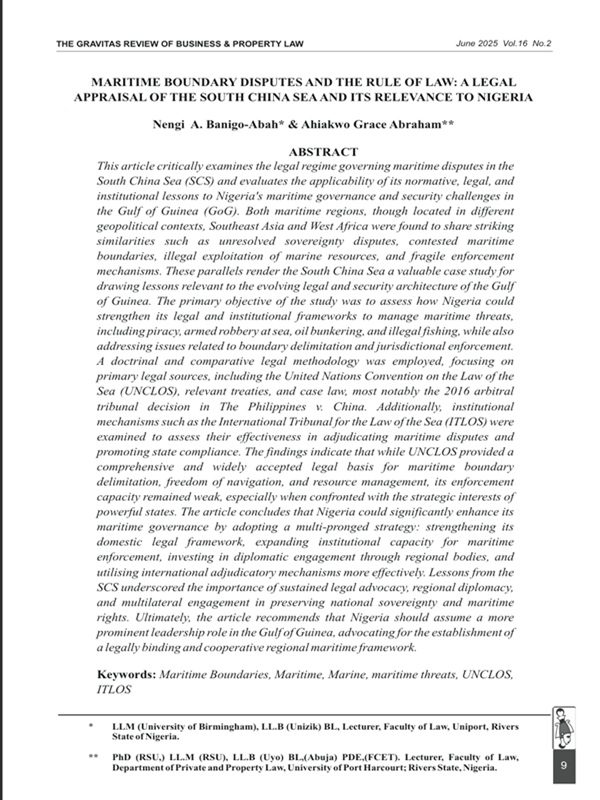
ABSTRACT
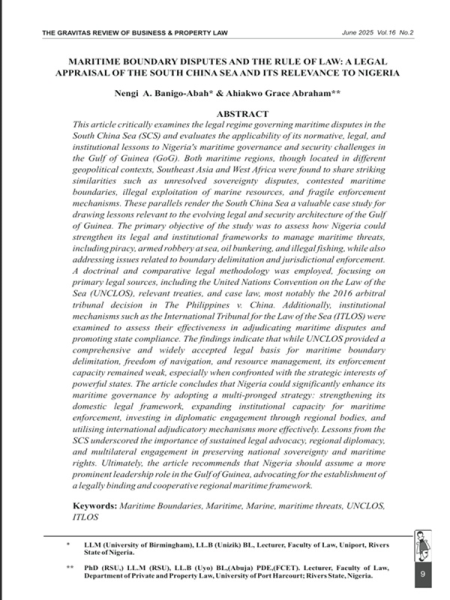
Maritime Boundary Disputes and the Rule of Law: A Legal Appraisal of the South China Sea and its Relevance to Nigeria
Nengi A. Banigo-Abah* & Ahiakwo Grace Abraham**
This article critically examines the legal regime governing maritime disputes in the South China Sea (SCS) and evaluates the applicability of its normative, legal, and institutional lessons to Nigeria’s maritime governance and security challenges in the Gulf of Guinea (GoG). Both maritime regions, though located in different geopolitical contexts, Southeast Asia and West Africa were found to share striking similarities such as unresolved sovereignty disputes, contested maritime boundaries, illegal exploitation of marine resources, and fragile enforcement mechanisms. These parallels render the South China Sea a valuable case study for drawing lessons relevant to the evolving legal and security architecture of the Gulf of Guinea. The primary objective of the study was to assess how Nigeria could strengthen its legal and institutional frameworks to manage maritime threats, including piracy, armed robbery at sea, oil bunkering, and illegal fishing, while also addressing issues related to boundary delimitation and jurisdictional enforcement. A doctrinal and comparative legal methodology was employed, focusing on primary legal sources, including the United Nations Convention on the Law of the Sea (UNCLOS), relevant treaties, and case law, most notably the 2016 arbitral tribunal decision in The Philippines v. China. Additionally, institutional mechanisms such as the International Tribunal for the Law of the Sea (ITLOS) were examined to assess their effectiveness in adjudicating maritime disputes and promoting state compliance. The findings indicate that while UNCLOS provided a comprehensive and widely accepted legal basis for maritime boundary delimitation, freedom of navigation, and resource management, its enforcement capacity remained weak, especially when confronted with the strategic interests of powerful states. The article concludes that Nigeria could significantly enhance its maritime governance by adopting a multi-pronged strategy: strengthening its domestic legal framework, expanding institutional capacity for maritime enforcement, investing in diplomatic engagement through regional bodies, and utilising international adjudicatory mechanisms more effectively. Lessons from the SCS underscored the importance of sustained legal advocacy, regional diplomacy, and multilateral engagement in preserving national sovereignty and maritime rights. Ultimately, the article recommends that Nigeria should assume a more prominent leadership role in the Gulf of Guinea, advocating for the establishment of a legally binding and cooperative regional maritime framework.
Keywords: Maritime Boundaries, Maritime, Marine, maritime threats, UNCLOS, ITLOS
*LLM (University of Birmingham), LL.B (Unizik) BL, Lecturer, Faculty of Law, Uniport, Rivers State of Nigeria.
**PhD (RSU,) LL.M (RSU), LL.B (Uyo) BL,(Abuja) PDE,(FCET). Lecturer, Faculty of Law, Department of Private and Property Law, University of Port Harcourt; Rivers State, Nigeria.

Reviews
There are no reviews yet.