
Description
ABSTRACT
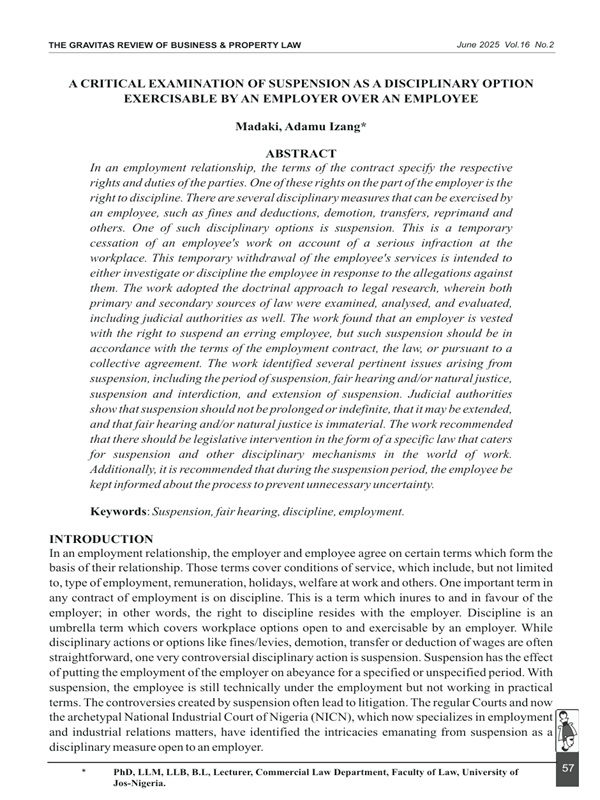
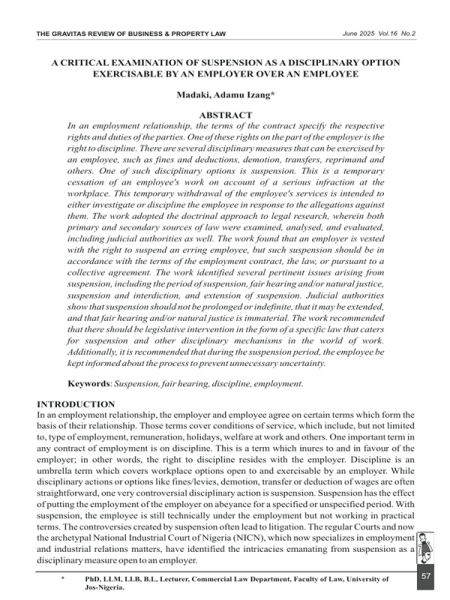
A Critical Examination of Suspension as a Disciplinary Option Exercisable by an Employer over an Employee
Madaki, Adamu Izang*
ABSTRACT
In an employment relationship, the terms of the contract specify the respective rights and duties of the parties. One of these rights on the part of the employer is the right to discipline. There are several disciplinary measures that can be exercised by an employee, such as fines and deductions, demotion, transfers, reprimand and others. One of such disciplinary options is suspension. This is a temporary cessation of an employee’s work on account of a serious infraction at the workplace. This temporary withdrawal of the employee’s services is intended to either investigate or discipline the employee in response to the allegations against them. The work adopted the doctrinal approach to legal research, wherein both primary and secondary sources of law were examined, analysed, and evaluated, including judicial authorities as well. The work found that an employer is vested with right to suspend an erring employee, but such suspension should be in accordance with the terms of the employment contract, the law, or pursuant to a collective agreement. The work identified several pertinent issues arising from suspension, including the period of suspension, fair hearing and/or natural justice, suspension and interdiction, and extension of suspension. Judicial authorities show that suspension should not be prolonged or indefinite, that it may be extended, and that fair hearing and/or natural justice is immaterial. The work recommended that there should be legislative intervention in the form of a specific law that caters for suspension and other disciplinary mechanisms in the world of work. Additionally, it is recommended that during the suspension period, the employee be kept informed about the process to prevent unnecessary uncertainty.
Keywords: Suspension, fair hearing, discipline, employment.
INTRODUCTION
In an employment relationship, the employer and employee agree on certain terms which form the basis of their relationship. Those terms cover conditions of service, which include, but not limited to, type of employment, remuneration, holidays, welfare at work and others. One important term in any contract of employment is on discipline. This is a term which inures to and in favour of the employer; in other words, the right to discipline resides with the employer. Discipline is an umbrella term which covers workplace options open to and exercisable by an employer. While disciplinary actions or options like fines/levies, demotion, transfer or deduction of wages are often straightforward, one very controversial disciplinary action is suspension. Suspension has the effect of putting the employment of the employer on abeyance for a specified or unspecified period. With suspension, the employee is still technically under the employment but not working in practical terms. The controversies created by suspension often lead to litigation. The regular Courts and now the archetypal National Industrial Court of Nigeria (NICN), which now specializes in employment and industrial relations matters, have identified the intricacies emanating from suspension as a disciplinary measure open to an employer.
*PhD, LLM, LLB, B.L, Lecturer, Commercial Law Department, Faculty of Law, University of
Jos-Nigeria.

Reviews
There are no reviews yet.