
Description
ABSTRACT
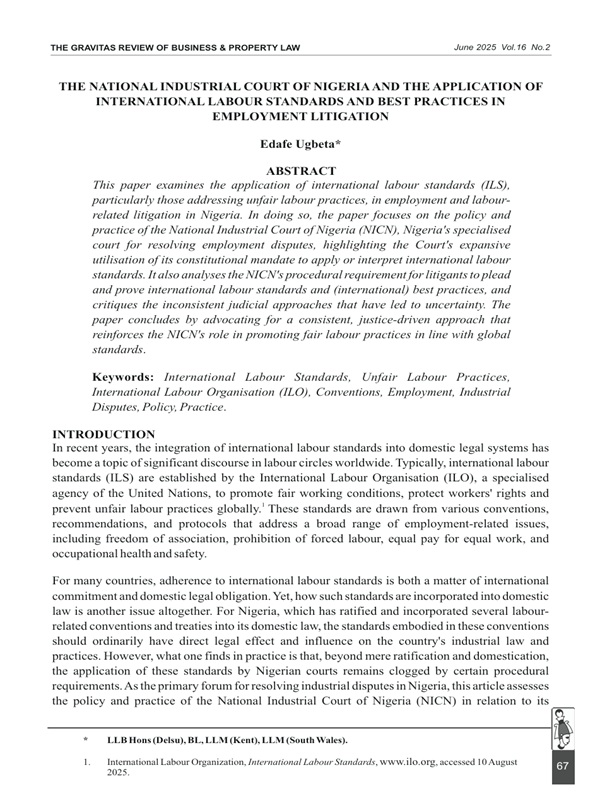
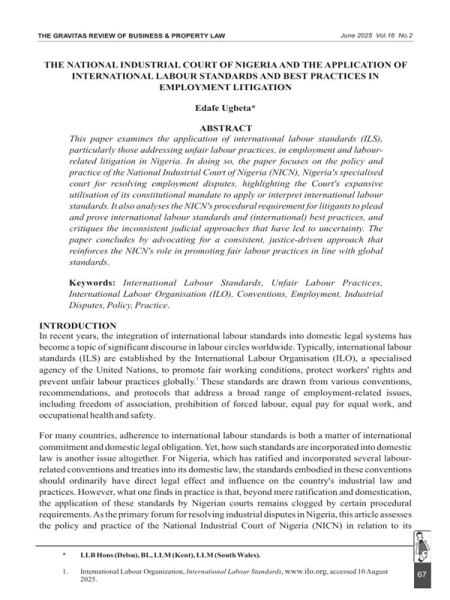
The National Industrial Court of Nigeria and the Application of International Labour Standards and Best Practices in Employment Litigation
Edafe Ugbeta*
ABSTRACT
This paper examines the application of international labour standards (ILS), particularly those addressing unfair labour practices, in employment and labour related litigation in Nigeria. In doing so, the paper focuses on the policy and practice of the National Industrial Court of Nigeria (NICN), Nigeria’s specialised court for resolving employment disputes, highlighting the Court’s expansive utilisation of its constitutional mandate to apply or interpret international labour standards. It also analyses the NICN’s procedural requirement for litigants to plead and prove international labour standards and (international) best practices, and critiques the inconsistent judicial approaches that have led to uncertainty. The paper concludes by advocating for a consistent, justice-driven approach that reinforces the NICN’s role in promoting fair labour practices in line with global standards.
Keywords: International Labour Standards, Unfair Labour Practices, International Labour Organisation (ILO), Conventions, Employment, Industrial Disputes, Policy, Practice.
INTRODUCTION
In recent years, the integration of international labour standards into domestic legal systems has become a topic of significant discourse in labour circles worldwide. Typically, international labour standards (ILS) are established by the International Labour Organisation (ILO), a specialised agency of the United Nations, to promote fair working conditions, protect workers’ rights and prevent unfair labour practices globally.1 These standards are drawn from various conventions, recommendations, and protocols that address a broad range of employment-related issues, including freedom of association, prohibition of forced labour, equal pay for equal work, and occupational health and safety.
For many countries, adherence to international labour standards is both a matter of international commitment and domestic legal obligation. Yet, how such standards are incorporated into domestic law is another issue altogether. For Nigeria, which has ratified and incorporated several labour related conventions and treaties into its domestic law, the standards embodied in these conventions should ordinarily have direct legal effect and influence on the country’s industrial law and practices. However, what one finds in practice is that, beyond mere ratification and domestication, the application of these standards by Nigerian courts remains clogged by certain procedural requirements. As the primary forum for resolving industrial disputes in Nigeria, this article assesses the policy and practice of the National Industrial Court of Nigeria (NICN) in relation to its
*LLB Hons (Delsu), BL, LLM (Kent), LLM (South Wales).
- International Labour Organization, International Labour Standards, accessed 10 August 2025.

Reviews
There are no reviews yet.