
Description
ABSTRACT
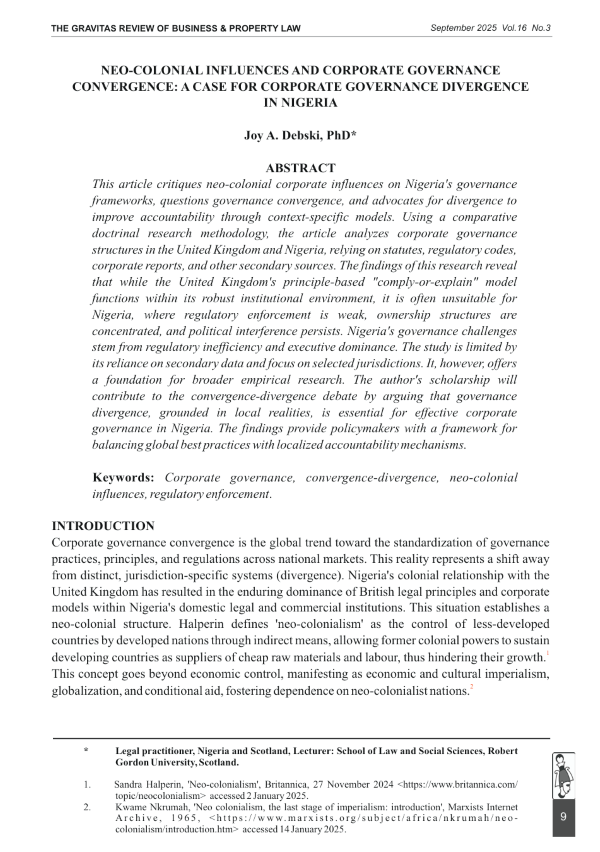
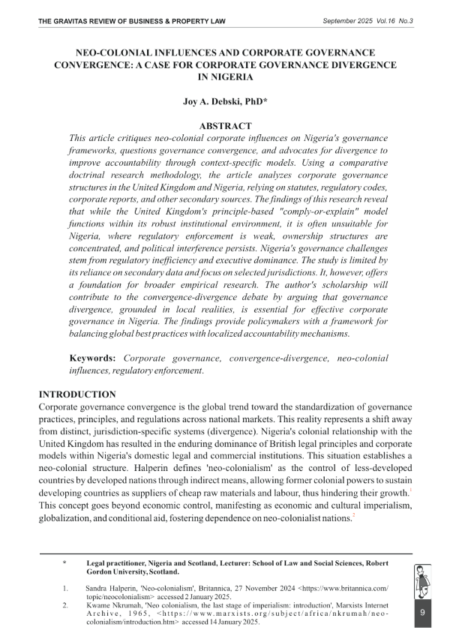
Neo-Colonial Influences and Corporate Governance Emergence: A Case for Corporate Governance Divergence
Joy A. Debski, PhD *
This article critiques neo-colonial corporate influences on Nigeria’s governance frameworks, questions governance convergence, and advocates for divergence to improve accountability through context-specific models. Using a comparative doctrinal research methodology, the article analyzes corporate governance structures in the United Kingdom and Nigeria, relying on statutes, regulatory codes, corporate reports, and other secondary sources. The findings of this research reveal that while the United Kingdom’s principle-based “comply-or-explain” model functions within its robust institutional environment, it is often unsuitable for Nigeria, where regulatory enforcement is weak, ownership structures are concentrated, and political interference persists. Nigeria’s governance challenges stem from regulatory inefficiency and executive dominance. The study is limited by its reliance on secondary data and focus on selected jurisdictions. It, however, offers a foundation for broader empirical research. The author’s scholarship will contribute to the convergence-divergence debate by arguing that governance divergence, grounded in local realities, is essential for effective corporate governance in Nigeria. The findings provide policymakers with a framework for balancing global best practices with localized accountability mechanisms.
Keywords: Corporate governance, convergence-divergence, neo-colonial influences, regulatory enforcement.
INTRODUCTION
Corporate governance convergence is the global trend toward the standardization of governance practices, principles, and regulations across national markets. This reality represents a shift away from distinct, jurisdiction-specific systems (divergence). Nigeria’s colonial relationship with the United Kingdom has resulted in the enduring dominance of British legal principles and corporate models within Nigeria’s domestic legal and commercial institutions. This situation establishes a neo-colonial structure. Halperin defines ‘neo-colonialism’ as the control of less-developed countries by developed nations through indirect means, allowing former colonial powers to sustain developing countries as suppliers of cheap raw materials and labour, thus hindering their growth.1 This concept goes beyond economic control, manifesting as economic and cultural imperialism,
globalization, and conditional aid, fostering dependence on neo-colonialist nations.2
*Legal practitioner, Nigeria and Scotland, Lecturer: School of Law and Social Sciences, Robert
Gordon University, Scotland.
- Sandra Halperin, ‘Neo-colonialism‘, Britannica, 27 November 2024 accessed 2 January 2025.
- Kwame Nkrumah, ‘Neo colonialism, the last stage of imperialism: introduction’, Marxists Internet
Archive, 1965, accessed 14 January 2025.

Reviews
There are no reviews yet.