
Description
ABSTRACT
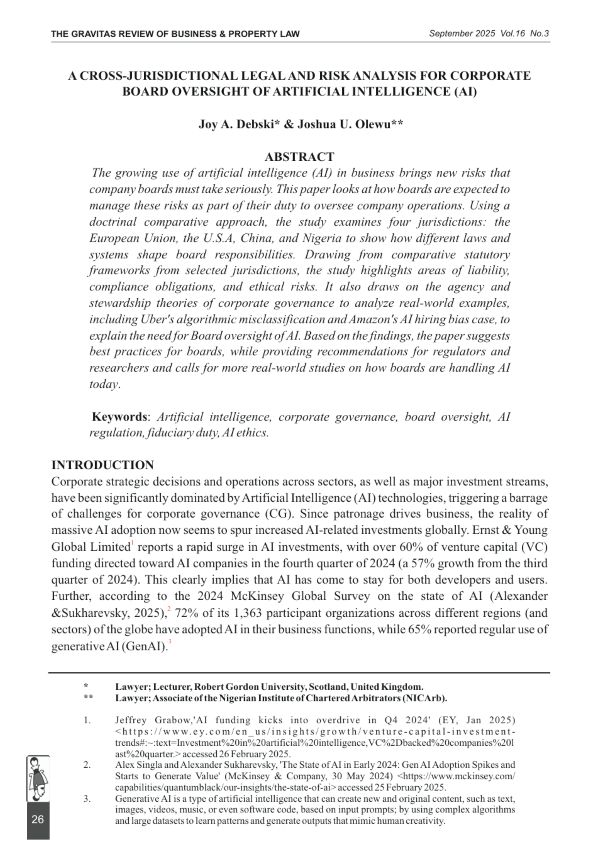
A Cross-Jurisdictional Legal and Risk Analysis for Corporate Board Oversight of Artificial Intelligence
Joy A. Debski* & Joshua U. Olewu**
The growing use of artificial intelligence (AI) in business brings new risks that company boards must take seriously. This paper looks at how boards are expected to manage these risks as part of their duty to oversee company operations. Using a doctrinal comparative approach, the study examines four jurisdictions: the European Union, the U.S.A, China, and Nigeria to show how different laws and systems shape board responsibilities. Drawing from comparative statutory frameworks from selected jurisdictions, the study highlights areas of liability, compliance obligations, and ethical risks. It also draws on the agency and stewardship theories of corporate governance to analyze real-world examples, including Uber’s algorithmic misclassification and Amazon’s AI hiring bias case, to explain the need for Board oversight of AI. Based on the findings, the paper suggests best practices for boards, while providing recommendations for regulators and researchers and calls for more real-world studies on how boards are handling AI today.
Keywords: Artificial intelligence, corporate governance, board oversight, AI regulation, fiduciary duty, AI ethics
INTRODUCTION
Corporate strategic decisions and operations across sectors, as well as major investment streams, have been significantly dominated by Artificial Intelligence (AI) technologies, triggering a barrage of challenges for corporate governance (CG). Since patronage drives business, the reality of massive AI adoption now seems to spur increased AI-related investments globally. Ernst & Young Global Limited1 reports a rapid surge in AI investments, with over 60% of venture capital (VC) funding directed toward AI companies in the fourth quarter of 2024 (a 57% growth from the third quarter of 2024). This clearly implies that AI has come to stay for both developers and users. Further, according to the 2024 McKinsey Global Survey on the state of AI (Alexander & Sukharevsky, 2025)2, 72% of its 1,363 participant organizations across different regions (and sectors) of the globe have adopted AI in their business functions, while 65% reported regular use of generative AI (GenAI).3
*Lawyer; Lecturer, Robert Gordon University, Scotland, United Kingdom.
**Lawyer; Associate of the Nigerian Institute of Chartered Arbitrators (NICArb).
- Jeffrey Grabow,‘AI funding kicks into overdrive in Q4 2024’ (EY, Jan 2025) accessed 26 February 2025.
- Alex Singla and Alexander Sukharevsky, ‘The State of AI in Early 2024: Gen AI Adoption Spikes and Starts to Generate Value’ (McKinsey & Company, 30 May 2024) accessed 25 February 2025.
- Generative AI is a type of artificial intelligence that can create new and original content, such as text, images, videos, music, or even software code, based on input prompts; by using complex algorithms and large datasets to learn patterns and generate outputs that mimic human creativity



Reviews
There are no reviews yet.