
Description
ABSTRACT
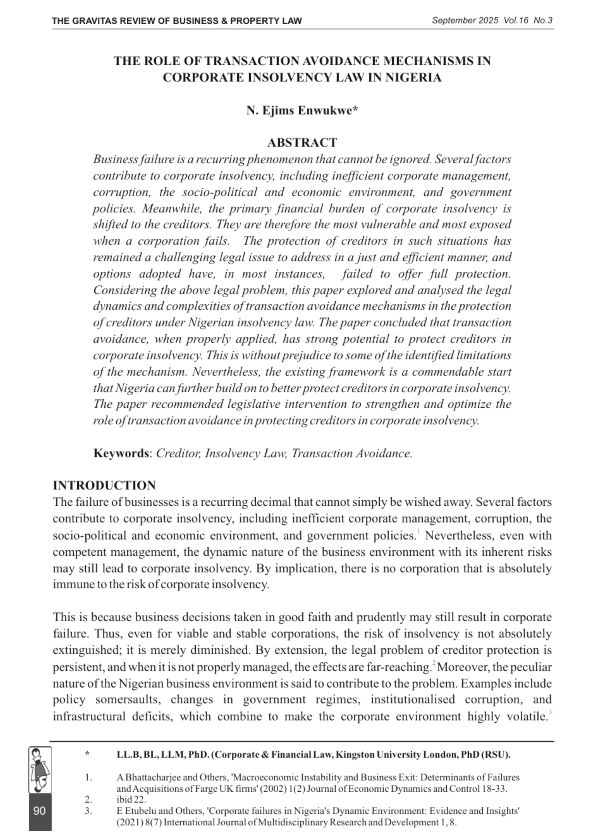
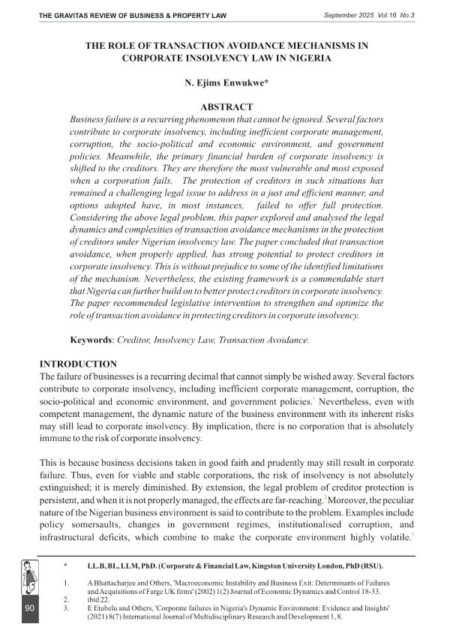
The Role of Transaction Avoidance Mechanisms in Corporate Insolvency Law in Nigeria
N. Ejims Enwukwe*
Business failure is a recurring phenomenon that cannot be ignored. Several factors contribute to corporate insolvency, including inefficient corporate management, corruption, the socio-political and economic environment, and government policies. Meanwhile, the primary financial burden of corporate insolvency is shifted to the creditors. They are therefore the most vulnerable and most exposed when a corporation fails. The protection of creditors in such situations has remained a challenging legal issue to address in a just and efficient manner, and options adopted have, in most instances, failed to offer full protection. Considering the above legal problem, this paper explored and analysed the legal dynamics and complexities of transaction avoidance mechanisms in the protection of creditors under Nigerian insolvency law. The paper concluded that transaction avoidance, when properly applied, has strong potential to protect creditors in corporate insolvency. This is without prejudice to some of the identified limitations of the mechanism. Nevertheless, the existing framework is a commendable start that Nigeria can further build on to better protect creditors in corporate insolvency. The paper recommended legislative intervention to strengthen and optimize the role of transaction avoidance in protecting creditors in corporate insolvency.
Keywords: Creditor, Insolvency Law, Transaction Avoidance.
INTRODUCTION
The failure of businesses is a recurring decimal that cannot simply be wished away. Several factors contribute to corporate insolvency, including inefficient corporate management, corruption, the socio-political and economic environment, and government policies.1 Nevertheless, even with competent management, the dynamic nature of the business environment with its inherent risks may still lead to corporate insolvency. By implication, there is no corporation that is absolutely immune to the risk of corporate insolvency.
This is because business decisions taken in good faith and prudently may still result in corporate failure. Thus, even for viable and stable corporations, the risk of insolvency is not absolutely extinguished; it is merely diminished. By extension, the legal problem of creditor protection is persistent, and when it is not properly managed, the effects are far-reaching.2 Moreover, the peculiar nature of the Nigerian business environment is said to contribute to the problem. Examples include policy somersaults, changes in government regimes, institutionalised corruption, and infrastructural deficits, which combine to make the corporate environment highly volatile.3
* LL.B, BL, LLM, PhD. (Corporate & Financial Law, Kingston University London, PhD (RSU).
- A Bhattacharjee and Others, ‘Macroeconomic Instability and Business Exit: Determinants of Failures and Acquisitions of Farge UK firms’ (2002) 1(2) Journal of Economic Dynamics and Control 18-33.
- ibid 22.
- E Etubelu and Others, ‘Corporate failures in Nigeria’s Dynamic Environment: Evidence and Insights’ (2021) 8(7) International Journal of Multidisciplinary Research and Development 1, 8.

Reviews
There are no reviews yet.