-
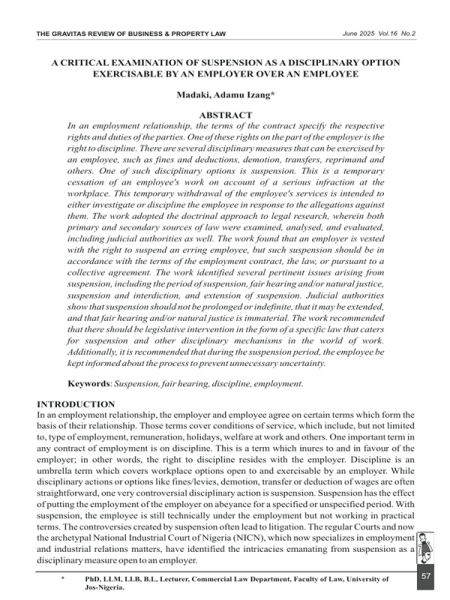
A Critical Examination of Suspension as a Disciplinary Option Exercisable by an Employer over an Employee
0₦2,500.00In an employment relationship, the terms of the contract specify the respective rights and duties of the parties. One of these rights on the part of the employer is the right to discipline. There are several disciplinary measures that can be exercised by an employee, such as fines and deductions, demotion, transfers, reprimand and others. One of such disciplinary options is suspension. This is a temporary cessation of an employee’s work on account of a serious infraction at the workplace. This temporary withdrawal of the employee’s services is intended to either investigate or discipline the employee in response to the allegations against them. Makadi Izang in his article, A Critical Examination of Suspension as a Disciplinary Option Exercisable by an Employer over an Employee, adopts the doctrinal approach to legal research, wherein both primary and secondary sources of law were examined, analysed, and evaluated, including judicial authorities as well. Izang finds that an employer is vested with the right to suspend an erring employee, but such suspension should be in accordance with the terms of the employment contract, the law, or pursuant to a collective agreement. Izang identifies several pertinent issues arising from suspension, including the period of suspension, fair hearing and/or natural justice, suspension and interdiction, and extension of suspension. Judicial authorities show that suspension should not be prolonged or indefinite, that it may be extended, and that fair hearing and/or natural justice is immaterial. Izang recommends that there should be legislative intervention in the form of a specific law that caters for suspension and other disciplinary mechanisms in the world of work. Additionally, it is recommended that during the suspension period, the employee be kept informed about the process to prevent unnecessary uncertainty.
-
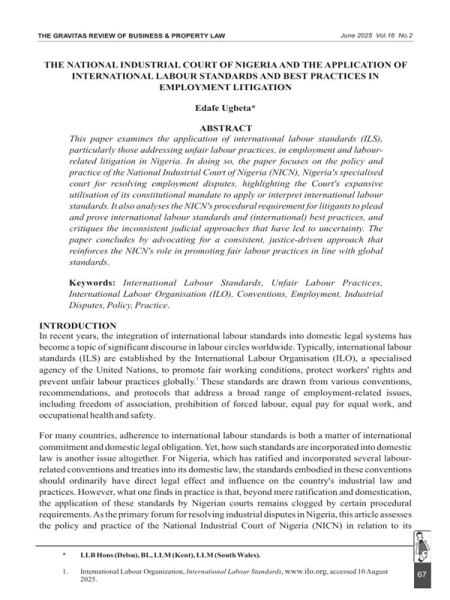
The National Industrial Court of Nigeria and the Application of International Labour Standards and Best Practices in Employment Litigation
0₦2,500.00Edafe Ugbeta in his article, The National Industrial Court of Nigeria and the Application of International Labour Standards and Best Practices in Employment Litigation, examines the application of international labour standards (ILS), particularly those addressing unfair labour practices, in employment and labour-related litigation in Nigeria. In doing so, Ugbeta focuses on the policy and practice of the National Industrial Court of Nigeria (NICN), Nigeria’s specialised court for resolving employment disputes, highlighting the Court’s expansive utilisation of its constitutional mandate to apply or interpret international labour standards. Ugbeta also analyses the NICN’s procedural requirement for litigants to plead and prove international labour standards and (international) best practices, and critiques the inconsistent judicial approaches that have led to uncertainty. Ugbeta concludes by advocating for a consistent, justice-driven approach that reinforces the NICN’s role in promoting fair labour practices in line with global standards.
-
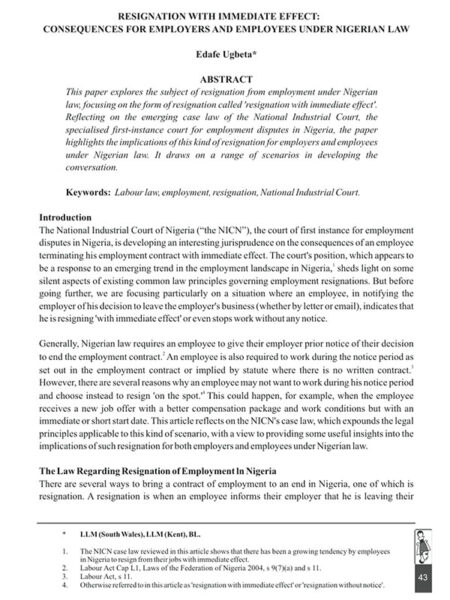
Resignation with Immediate Effect: Consequences for Employers and Employees under Nigerian Law
0₦2,500.00Edafe Ugbeta in his article, Resignation with Immediate Effect: Consequences for Employers and Employees under Nigerian Law, explores the subject of resignation from employment under Nigerian law, focusing on the form of resignation called ‘resignation with immediate effect’. Reflecting on the emerging case law of the National Industrial Court, the specialised first-instance court for employment disputes in Nigeria, Ugbeta highlights the implications of this kind of resignation for employers and employees under Nigerian law. He draws on a range of scenarios in developing the conversation.
-
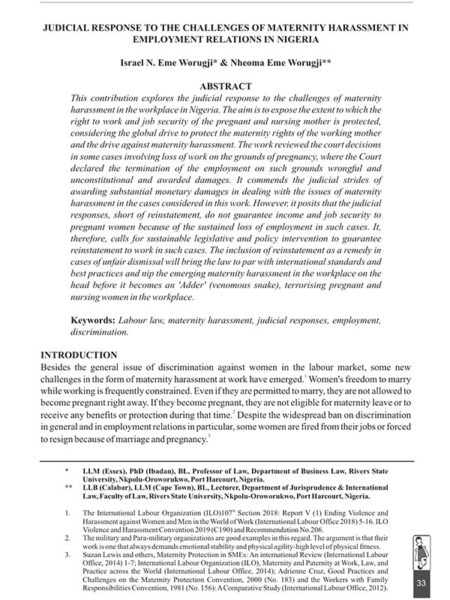
Judicial Response to the Challenges of Maternity Harassment in Employment Relations in Nigeria
0₦2,500.00Professor Israel Worugji & Nheoma Worugji in their article, Judicial Response to the Challenges of Maternity Harassment in Employment Relations in Nigeria, revisit the issues of maternity harassment in the workplace. Their contribution explores the judicial response to the challenges of maternity harassment in the workplace in Nigeria. The aim is to expose the extent to which the right to work and job security of the pregnant and nursing mother is protected, considering the global drive to protect the maternity rights of the working mother and the drive against maternity harassment in particular. The work reviewed the court decisions in some cases involving loss of work on the grounds of pregnancy, where the court declared the termination of the employment on such grounds wrongful and unconstitutional and awarded damages. It commends the judicial strides of awarding substantial monetary damages in dealing with the issues of maternity harassment. However, it posits that the judicial responses, short of reinstatement, do not guarantee income and job security to pregnant women because of the sustained loss of employment in such cases. It, therefore, calls for sustainable legislative and policy intervention to guarantee reinstatement to work in such cases.
-

The Supreme Court of Nigeria Decision in Gbetu V. Itie: Is It a Case of Termination or Dismissal from Employment?
0₦2,500.00Faith Opara and Olasupo Bada in their case review article, The Supreme Court of Nigeria Decision in Gbetu V. Itie: Is It a Case of Termination or Dismissal from Employment? examine the decision of the Supreme Court in Gbedu v. Itie that employees’ whose employment was brought to an end by liquidation were by this token, dismissed from the employ of the liquidated company. Relying on primary and secondary data, they examine the propriety of this decision in the light of the legal connotation of termination and dismissal from employment. Opara and Bada examine the meaning and legal effect of termination and dismissal from employment under Nigerian labour jurisprudence and found that the decision was reached per incuriam. Therefore, lower courts are urged to distinguish and depart from the decision when faced with similar situation while the SCN is urged to overrule itself where the opportunity present itself subsequently.
-
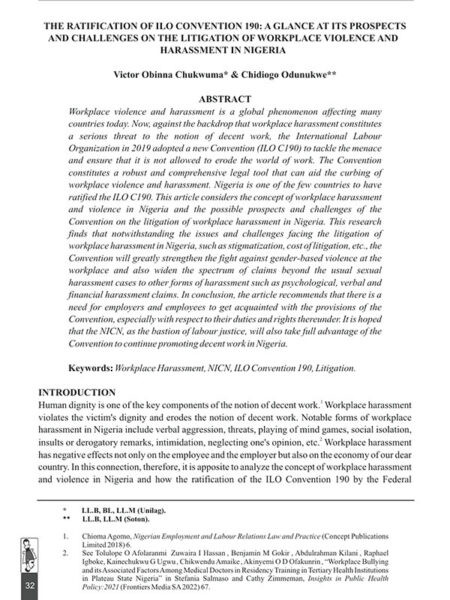
The Ratification of ILO Convention 190: A Glance at its Prospects and Challenges on the Litigation of Workplace Violence and Harassment in Nigeria
0₦2,500.00Victor Chukwuma and Chidiogo Odunukwe in their article, The Ratification of ILO Convention 190: A Glance at its Prospects and Challenges on the Litigation of Workplace Violence and Harassment in Nigeria, explore the ambit of workplace violence and harassment as a global phenomenon and the ILO’s adoption of a new Convention (ILO C190) in 2019 to specifically tackle the menace and to ensure that it is not allowed to erode the world of work. They consider the possible prospects and challenges of the Convention on the litigation of workplace harassment in Nigeria. They find that notwithstanding the issues and challenges facing the litigation of workplace harassment in Nigeria, the Convention will greatly strengthen the fight against gender-based violence at the workplace and also widen the spectrum of claims beyond the usual sexual harassment cases to other forms of harassment. They recommend that there is need for employers and employees to get acquainted with the provisions of the Convention especially with respect to their duties and rights thereunder.
-
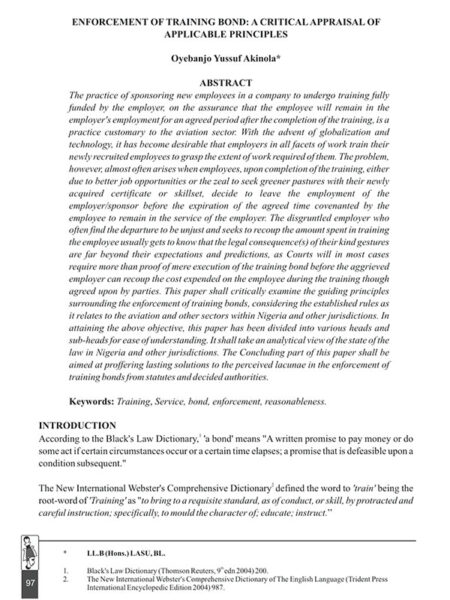
Enforcement of Training Bond: A Critical Appraisal of Applicable Principles
0₦2,500.00Oyebanjo Akinola, in his article, Enforcement of Training Bond: A Critical Appraisal of Applicable Principles, notes that the practice of sponsoring new employees in a company to undergo training fully funded by the employer on the assurance that the employee will remain in the employment of the employer for an agreed period after the completion of the training is a common practice in the workplace. The problem, however, almost often arises when employees, upon completion of the training, either due to better job opportunities or the zeal to seek greener pastures with their newly acquired certificate or skillset, decide to leave the employment of the employer/sponsor before the expiration of the agreed time. The disgruntled employer who often find the departure to be unjust and seeks to recoup the amount spent in training the employee usually gets to know that the legal consequences of their kind gestures are far beyond their expectations and predictions, as Courts will, in most cases require more than proof of mere execution of the training bond before the aggrieved employer can recoup the cost expended on the employee. Akinola critically examines the guiding principles surrounding the enforcement of training bonds, considering the established rules as it relates to aviation and other sectors within Nigeria and other jurisdictions.
-
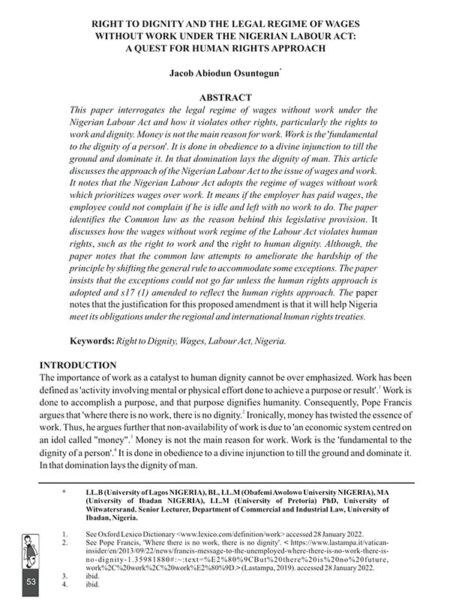
Right to Dignity and the Legal Regime of Wages Without Work Under the Nigerian Labour Act: A Quest for Human Rights Approach
0₦2,500.00Dr Jacob Osuntogun, Senior Lecturer, Department of Commercial and Industrial Law, University of Ibadan Nigeria, in his paper, Right to Dignity and the Legal Regime of Wages Without Work Under the Nigerian Labour Act: A Quest for Human Rights Approach, interrogates the legal regime of wages without work under the Nigerian Labour Act and how it violates other rights, particularly the rights to work and dignity. He argues that ‘money is not the main reason for work’ and work is fundamental to a person’s dignity. Dr Osuntogun notes that the Nigerian Labour Act prioritises the payment of wages. If the employer has paid wages, the employee could not complain if he is idle and left with no work to do. He argues that the wages without work regime of the Labour Act violates human rights and advocates an amendment of the Labour Act for Nigeria to meet its obligations under regional and international human rights treaties.
-
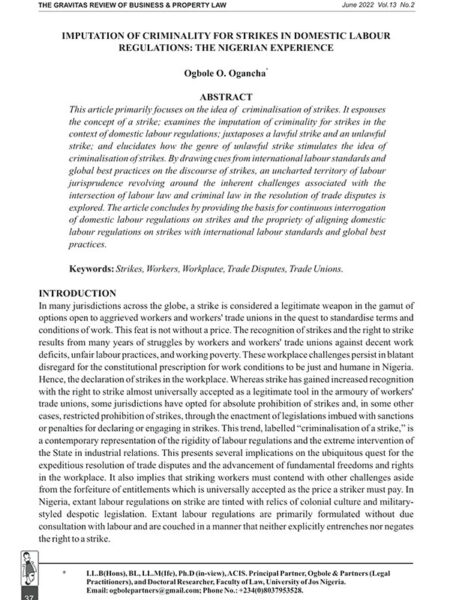
Imputation of Criminality for Strikes in Domestic Labour Regulations: The Nigerian Experience
0₦2,500.00Ogbole Ogancha of Ogbole & Partners, and Doctoral Researcher at the Faculty of Law, University of Jos Nigeria, in his article, Imputation of Criminality for Strikes in Domestic Labour Regulations: The Nigerian Experience, examines the imputation of criminality for strikes in the context of domestic labour regulations. He considers the concept of ‘lawful strikes’ and ‘unlawful strikes’ and argues that ‘unlawful strikes’ stimulate the idea of criminalisation of strikes. Ogancha explores Nigerian laws and regulations on the issue. Drawing cues from international labour standards and global best practices, he concludes that the criminalisation of strikes is not a sufficient or ideal deterrence. A progressive approach lies in the speedy identification of the causes of workers’ discontent.
-
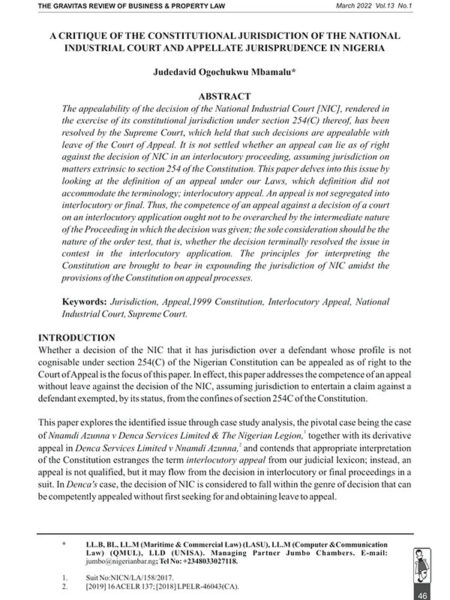
A Critique of the Constitutional Jurisdiction of the National Industrial Court and Appellate Jurisprudence in Nigeria
0₦2,500.00Dr Judedavid Mbamalu, Managing Partner of Jumbo Chambers, in his paper, A Critique of the Constitutional Jurisdiction of the National Industrial Court and Appellate Jurisprudence in Nigeria, argues that while the appealability of the decision of the National Industrial Court (NIC), rendered in the exercise of its jurisdiction under section 254(C) of the 1999 Constitution of Nigeria has been resolved by the Supreme Court, it is not settled whether an appeal can lie as of right against the decision of the NIC in an interlocutory proceeding, assuming jurisdiction on matters extrinsic to section 254. Dr Mbamalu argues that the segregation of appeals into ‘interlocutory’ and ‘final’ is unknown to ‘our Statutes and Rules of Court’, and the competence of an appeal against a decision of a court on an interlocutory application ought not to be overarched by the intermediate nature of the Proceeding in which the decision was given. He elaborates on the principles for interpreting the Constitution in expounding the jurisdiction of the NIC amidst the provisions of the Constitution on appeal processes.
-
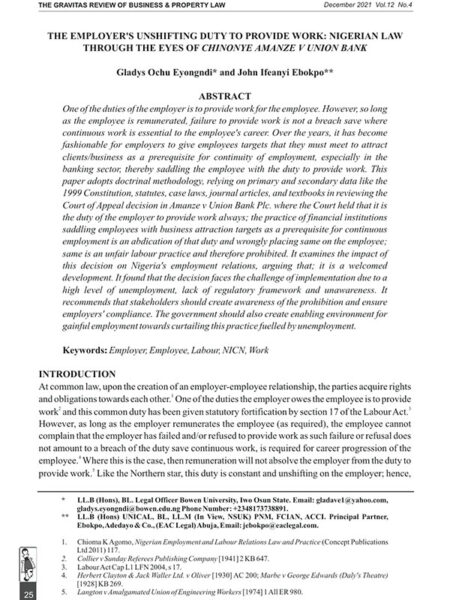
The Employer’s Unshifting Duty to Provide Work: Nigerian Law through the Eyes of Chinonye Amanze v Union Bank
0₦2,500.00Gladys Eyongndi, Legal Officer Bowen University, and John Ebokpo of EAC Legal, in their article, The Employer’s Unshifting Duty to Provide Work: Nigerian Law through the Eyes of Chinonye Amanze v Union Bank, laud the decision of the National Industrial Court that the employer has to provide work always. The practice of financial institutions saddling employees with deposit targets as a prerequisite for continued employment is an abdication of that duty, as the employee never has to go looking for work to sustain the business of the employer. Eyongndi and Ebokpo examine Nigerian law on an employer’s duty to provide work and the challenges facing employees in relation to the employer’s duty.
-
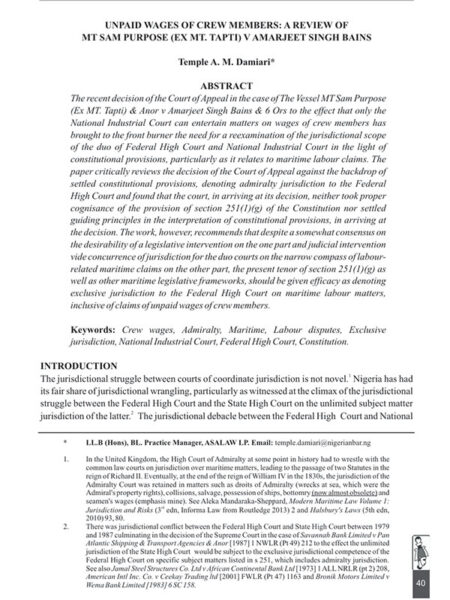
Unpaid Wages of Crew Members: A Review of Mt Sam Purpose (Ex Mt. Tapti) v Amarjeet Singh Bains
0₦2,500.00Temple Damiari of ASALAW LP continues with the exciting debate begun in the last issue of The Gravitas Review on the appropriate court with jurisdiction in wages of ship crew. In his article, Unpaid Wages of Crew Members: A Review of Mt Sam Purpose (Ex Mt. Tapti) v Amarjeet Singh Bains, Damiari critically analyses the decision of the Court of Appeal that only the National Industrial Court can entertain matters on wages of ship crew. He opines that given the settled constitutional provisions denoting admiralty jurisdiction in the Federal High Court, the Court of Appeal in arriving at its decision, neither took proper cognisance of the provision of section 251(1)(g) of the Constitution nor settled guiding principles in the interpretation of constitutional provisions.
The Gravitas Review of Business & Property Law