
Description
ABSTRACT
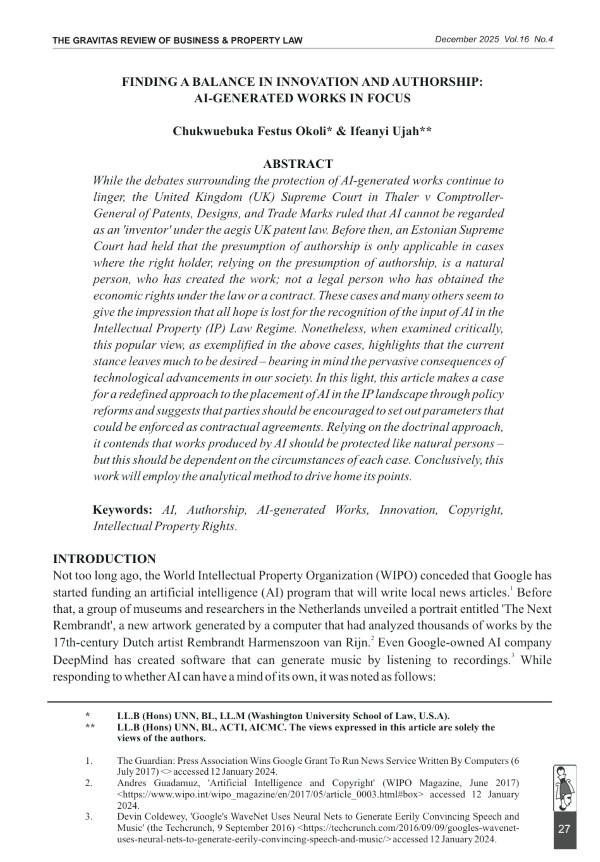
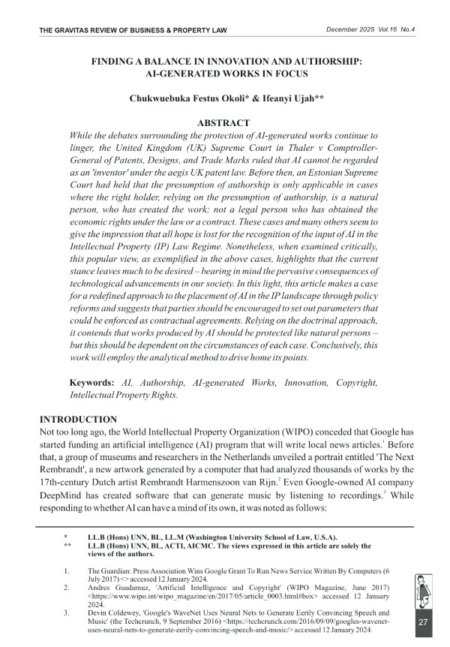
Finding a Balance in Innovation and Authorship: AI-Generated Works in Focus
Chukwuebuka Festus Okoli* & Ifeanyi Ujah**
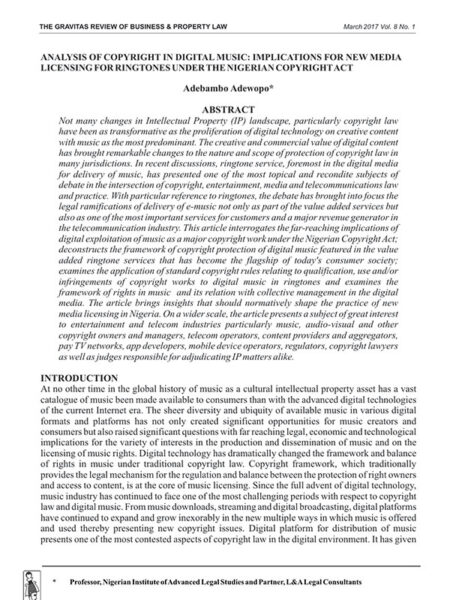
While the debates surrounding the protection of AI-generated works continue to linger, the United Kingdom (UK) Supreme Court in Thaler v Comptroller General of Patents, Designs, and Trade Marks ruled that AI cannot be regarded as an ‘inventor’ under the aegis UK patent law. Before then, an Estonian Supreme Court had held that the presumption of authorship is only applicable in cases where the right holder, relying on the presumption of authorship, is a natural person, who has created the work; not a legal person who has obtained the economic rights under the law or a contract. These cases and many others seem to give the impression that all hope is lost for the recognition of the input of AI in the Intellectual Property (IP) Law Regime. Nonetheless, when examined critically, this popular view, as exemplified in the above cases, highlights that the current stance leaves much to be desired – bearing in mind the pervasive consequences of technological advancements in our society. In this light, this article makes a case for a redefined approach to the placement of AI in the IP landscape through policy reforms and suggests that parties should be encouraged to set out parameters that could be enforced as contractual agreements. Relying on the doctrinal approach, it contends that works produced by AI should be protected like natural persons – but this should be dependent on the circumstances of each case. Conclusively, this work will employ the analytical method to drive home its points.
Keywords: AI, Authorship, AI-generated Works, Innovation, Copyright, Intellectual Property Rights.
INTRODUCTION
Not too long ago, the World Intellectual Property Organization (WIPO) conceded that Google has started funding an artificial intelligence (AI) program that will write local news articles.1 Before that, a group of museums and researchers in the Netherlands unveiled a portrait entitled ‘The Next Rembrandt’, a new artwork generated by a computer that had analyzed thousands of works by the 17th-century Dutch artist Rembrandt Harmenszoon van Rijn.2 Even Google-owned AI company DeepMind has created software that can generate music by listening to recordings.3 While responding to whether AI can have a mind of its own, it was noted as follows:
*LL.B (Hons) UNN, BL, LL.M (Washington University School of Law, U.S.A).
**LL.B (Hons) UNN, BL, ACTI, AICMC. The views expressed in this article are solely the views of the authors.
- The Guardian: Press Association Wins Google Grant To Run News Service Written By Computers (6
July 2017) accessed 12 January 2024. - Andres Guadamuz, ‘Artificial Intelligence and Copyright’ (WIPO Magazine, June 2017) accessed 12 January
2024. - Devin Coldewey, ‘Google’s WaveNet Uses Neural Nets to Generate Eerily Convincing Speech and
Music’ (the Techcrunch, 9 September 2016) accessed 12 January 2024.
THE GRAVITAS REVIEW OF BUSINESS & PROPERTY LAW Vol.16 No.4

Reviews
There are no reviews yet.