
Description
ABSTRACT
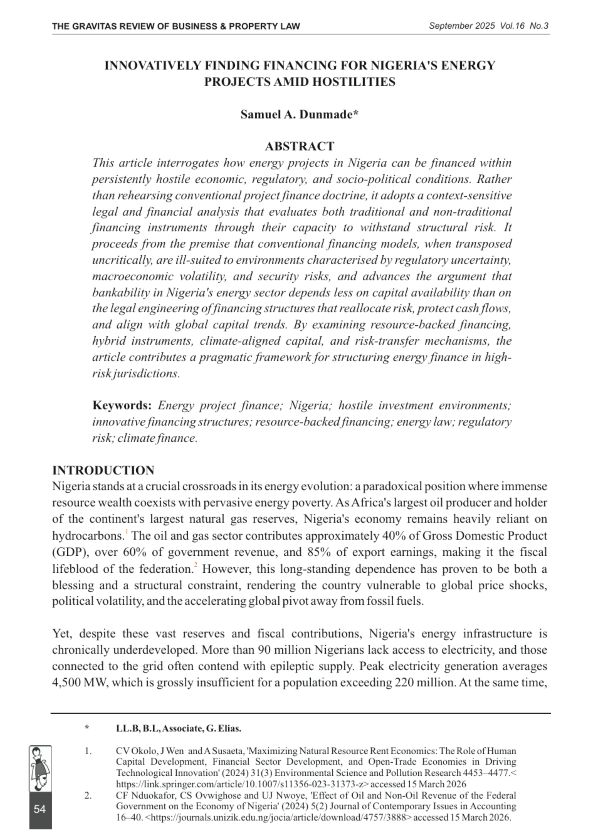
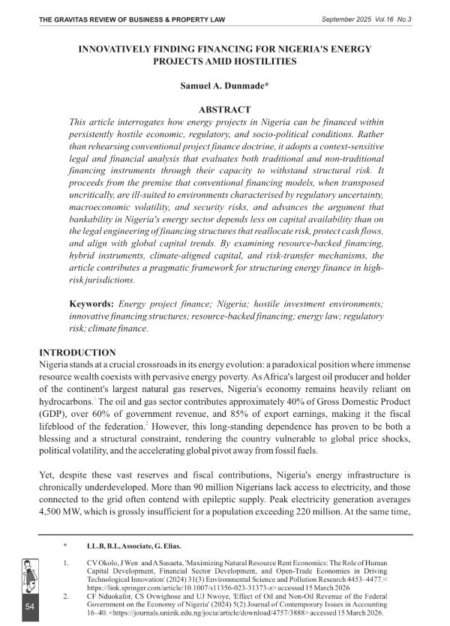
Innovatively Finding Financing For Nigeria’s Energy Projects and Hostilities
Samuel A. Dunmade*
This article interrogates how energy projects in Nigeria can be financed within persistently hostile economic, regulatory, and socio-political conditions. Rather than rehearsing conventional project finance doctrine, it adopts a context-sensitive legal and financial analysis that evaluates both traditional and non-traditional financing instruments through their capacity to withstand structural risk. It proceeds from the premise that conventional financing models, when transposed uncritically, are ill-suited to environments characterised by regulatory uncertainty, macroeconomic volatility, and security risks, and advances the argument that bankability in Nigeria’s energy sector depends less on capital availability than on the legal engineering of financing structures that reallocate risk, protect cash flows, and align with global capital trends. By examining resource-backed financing, hybrid instruments, climate-aligned capital, and risk-transfer mechanisms, the article contributes a pragmatic framework for structuring energy finance in high
risk jurisdictions
Keywords: Energy project finance; Nigeria; hostile investment environments; innovative financing structures; resource-backed financing; energy law; regulatory risk; climate finance.
INTRODUCTION
Nigeria stands at a crucial crossroads in its energy evolution: a paradoxical position where immense resource wealth coexists with pervasive energy poverty. As Africa’s largest oil producer and holder of the continent’s largest natural gas reserves, Nigeria’s economy remains heavily reliant on hydrocarbons.1 The oil and gas sector contributes approximately 40% of Gross Domestic Product (GDP), over 60% of government revenue, and 85% of export earnings, making it the fiscal lifeblood of the federation.2 However, this long-standing dependence has proven to be both a blessing and a structural constraint, rendering the country vulnerable to global price shocks, political volatility, and the accelerating global pivot away from fossil fuels.
Yet, despite these vast reserves and fiscal contributions, Nigeria’s energy infrastructure is chronically underdeveloped. More than 90 million Nigerians lack access to electricity, and those connected to the grid often contend with epileptic supply. Peak electricity generation averages 4,500 MW, which is grossly insufficient for a population exceeding 220 million.
*LL.B, B.L, Associate, G. Elias.
- CV Okolo, J Wen and A Susaeta, ‘Maximizing Natural Resource Rent Economics: The Role of Human Capital Development, Financial Sector Development, and Open-Trade Economies in Driving Technological Innovation’ (2024) 31(3) Environmental Science and Pollution Research 4453–4477. accessed 15 March 2026
- CF Nduokafor, CS Ovwighose and UJ Nwoye, ‘Effect of Oil and Non-Oil Revenue of the Federal Government on the Economy of Nigeria’ (2024) 5(2) Journal of Contemporary Issues in Accounting 16–40 accessed 15 March 2026.

Reviews
There are no reviews yet.