
Description
ABSTRACT
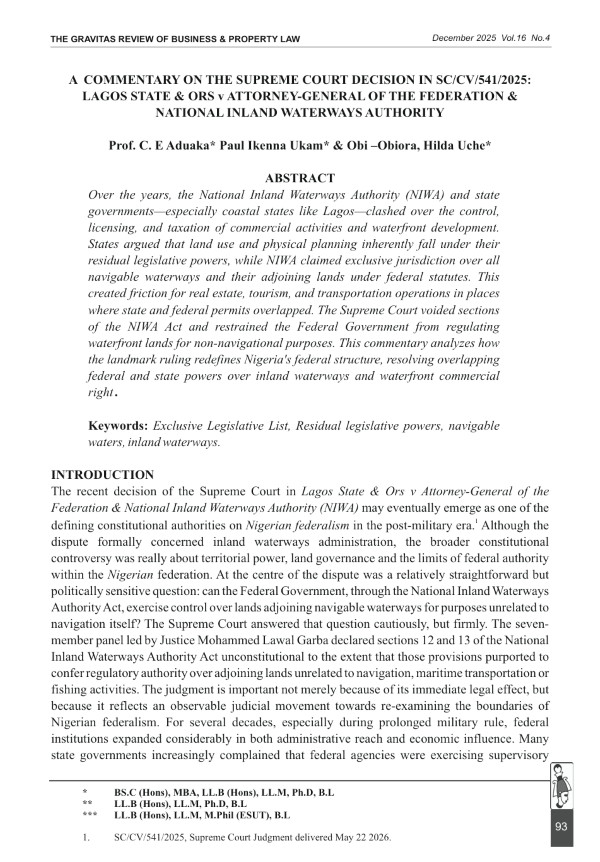
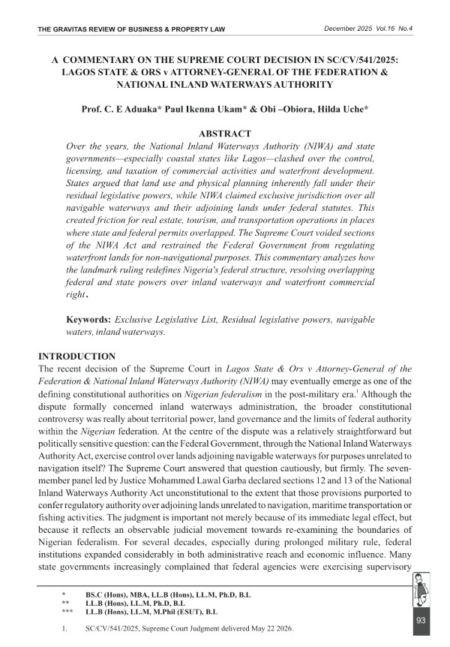
A Commentary on the Supreme court Decision in SC/CV/541/2025: Lagos State & Ors V. Attorney General of the Federation & National Inland Waterways Authority
Prof. C. E Aduaka* Paul Ikenna Ukam** & Uche Hilda Obi–Obiora***
Over the years, the National Inland Waterways Authority (NIWA) and state governments—especially coastal states like Lagos—clashed over the control, licensing, and taxation of commercial activities and waterfront development. States argued that land use and physical planning inherently fall under their residual legislative powers, while NIWA claimed exclusive jurisdiction over all
navigable waterways and their adjoining lands under federal statutes. This created friction for real estate, tourism, and transportation operations in places where state and federal permits overlapped. The Supreme Court voided sections of the NIWA Act and restrained the Federal Government from regulating waterfront lands for non-navigational purposes. This commentary analyzes how the landmark ruling redefines Nigeria’s federal structure, resolving overlapping federal and state powers over inland waterways and waterfront commercial right.
Keywords: Exclusive Legislative List, Residual legislative powers, navigable waters, inland waterways.
INTRODUCTION
The recent decision of the Supreme Court in Lagos State & Ors v Attorney-General of the Federation & National Inland Waterways Authority (NIWA) may eventually emerge as one of the defining constitutional authorities on Nigerian federalism in the post-military era.1 Although the dispute formally concerned inland waterways administration, the broader constitutional controversy was really about territorial power, land governance and the limits of federal authority within the Nigerian federation. At the centre of the dispute was a relatively straightforward but politically sensitive question: can the Federal Government, through the National Inland Waterways Authority Act, exercise control over lands adjoining navigable waterways for purposes unrelated to navigation itself? The Supreme Court answered that question cautiously, but firmly. The seven member panel led by Justice Mohammed Lawal Garba declared sections 12 and 13 of the National Inland Waterways Authority Act unconstitutional to the extent that those provisions purported to confer regulatory authority over adjoining lands unrelated to navigation, maritime transportation or fishing activities. The judgment is important not merely because of its immediate legal effect, but because it reflects an observable judicial movement towards re-examining the boundaries of Nigerian federalism. For several decades, especially during prolonged military rule, federal institutions expanded considerably in both administrative reach and economic influence. Many state governments increasingly complained that federal agencies were exercising supervisory
* BS.C (Hons), MBA, LL.B (Hons), LL.M, Ph.D, B.L
**LL.B (Hons), LL.M, Ph.D, B.L
***LL.B (Hons), LL.M, M.Phil (ESUT), B.L
- SC/CV/541/2025, Supreme Court Judgment delivered May 22 2026

Reviews
There are no reviews yet.