

Description
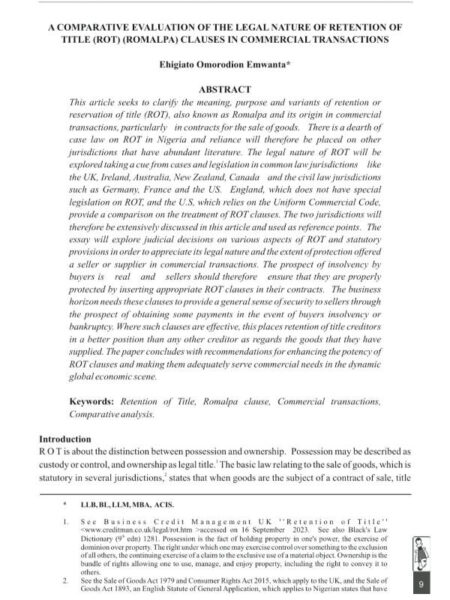
ABSTRACT
A Comparative Evaluation of the Legal Nature of Retention of Title (ROT) (ROMALPA) Clauses in Commercial Transactions
Ehigiato Omorodion Emwanta*
This article seeks to clarify the meaning, purpose and variants of retention or reservation of title (ROT), also known as Romalpa and its origin in commercial transactions, particularly in contracts for the sale of goods. There is a dearth of case law on ROT in Nigeria and reliance will therefore be placed on other jurisdictions that have abundant literature. The legal nature of ROT will be explored taking a cue from cases and legislation in common law jurisdictions like the UK, Ireland, Australia, New Zealand, Canada and the civil law jurisdictions such as Germany, France and the US. England, which does not have special legislation on ROT, and the U.S, which relies on the Uniform Commercial Code, provide a comparison on the treatment of ROT clauses. The two jurisdictions will therefore be extensively discussed in this article and used as reference points. The essay will explore judicial decisions on various aspects of ROT and statutory provisions in order to appreciate its legal nature and the extent of protection offered a seller or supplier in commercial transactions. The prospect of insolvency by buyers is real and sellers should therefore ensure that they are properly protected by inserting appropriate ROT clauses in their contracts. The business horizon needs these clauses to provide a general sense of security to sellers through the prospect of obtaining some payments in the event of buyers insolvency or bankruptcy. Where such clauses are effective, this places retention of title creditors in a better position than any other creditor as regards the goods that they have supplied. The paper concludes with recommendations for enhancing the potency of ROT clauses and making them adequately serve commercial needs in the dynamic global economic scene.
Keywords: Retention of Title, Romalpa clause, Commercial transactions, Comparative analysis.
Introduction
R O T is about the distinction between possession and ownership. Possession may be described as custody or control, and ownership as legal title.1 The basic law relating to the sale of goods, which is statutory in several jurisdictions,2 states that when goods are the subject of a contract of sale, title…
* LLB, BL, LLM, MBA, ACIS
- See Business Credit Management UK ‘ ‘Retention of Title’ ‘ accessed on 16 September 2023. See also Black’s Law Dictionary (9 edn) 1281. Possession is the fact of holding property in one’s power, the exercise of dominion over property. The right under which one may exercise control over something to the exclusion of all others, the continuing exercise of a claim to the exclusive use of a material object. Ownership is the bundle of rights allowing one to use, manage, and enjoy property, including the right to convey it to others.
- See the Sale of Goods Act 1979 and Consumer Rights Act 2015, which apply to the UK, and the Sale of
Goods Act 1893, an English Statute of General Application, which applies to Nigerian states that have
yet to enact their local laws on the subject

Reviews
There are no reviews yet.