Description
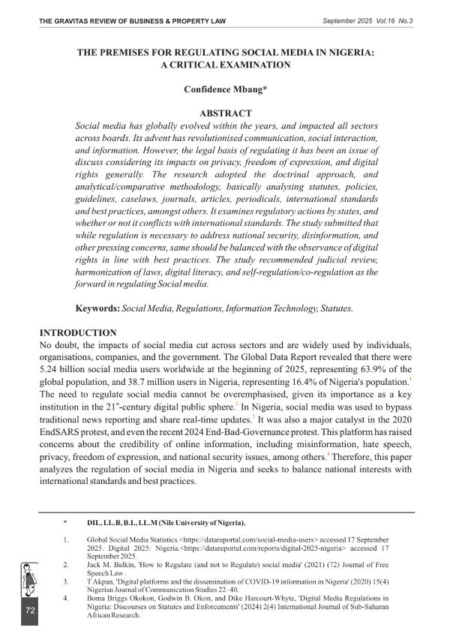
ABSTRACT
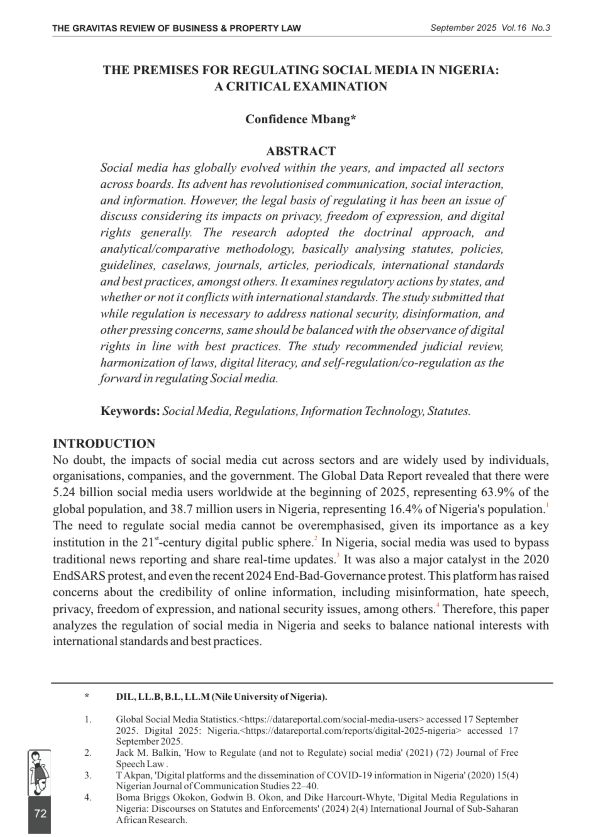
The Premises for Regulating Social Media in Nigeria: A Critical Examination
Confidence Mbang*
Social media has globally evolved within the years, and impacted all sectors across boards. Its advent has revolutionised communication, social interaction, and information. However, the legal basis of regulating it has been an issue of discuss considering its impacts on privacy, freedom of expression, and digital rights generally. The research adopted the doctrinal approach, and analytical/comparative methodology, basically analysing statutes, policies, guidelines, caselaws, journals, articles, periodicals, international standards and best practices, amongst others. It examines regulatory actions by states, and whether or not it conflicts with international standards. The study submitted that while regulation is necessary to address national security, disinformation, and other pressing concerns, same should be balanced with the observance of digital rights in line with best practices. The study recommended judicial review, harmonization of laws, digital literacy, and self-regulation/co-regulation as the forward in regulating Social media.
Keywords: Social Media, Regulations, Information Technology, Statutes.
INTRODUCTION
No doubt, the impacts of social media cut across sectors and are widely used by individuals, organisations, companies, and the government. The Global Data Report revealed that there were 5.24 billion social media users worldwide at the beginning of 2025, representing 63.9% of the global population, and 38.7 million users in Nigeria, representing 16.4% of Nigeria’s population.1 The need to regulate social media cannot be overemphasised, given its importance as a key institution in the 21-century digital public sphere.2 In Nigeria, social media was used to bypass traditional news reporting and share real-time updates.3 It was also a major catalyst in the 2020 EndSARS protest, and even the recent 2024 End-Bad-Governance protest. This platform has raised concerns about the credibility of online information, including misinformation, hate speech, privacy, freedom of expression, and national security issues, among others.4 Therefore, this paper analyzes the regulation of social media in Nigeria and seeks to balance national interests with international standards and best practices.
*DIL, LL.B, B.L, LL.M (Nile University of Nigeria).
- Global Social Media Statistics. accessed 17 September 2025. Digital 2025: Nigeria. accessed 17 September 2025.
- Jack M. Balkin, ‘How to Regulate (and not to Regulate) social media’ (2021) (72) Journal of Free Speech Law .
- T Akpan, ‘Digital platforms and the dissemination of COVID-19 information in Nigeria’ (2020) 15(4) Nigerian Journal of Communication Studies 22–40.
- Boma Briggs Okokon, Godwin B. Okon, and Dike Harcourt-Whyte, ‘Digital Media Regulations in Nigeria: Discourses on Statutes and Enforcements’ (2024) 2(4) International Journal of Sub-Saharan African Research

Reviews
There are no reviews yet.