
Description
ABSTRACT
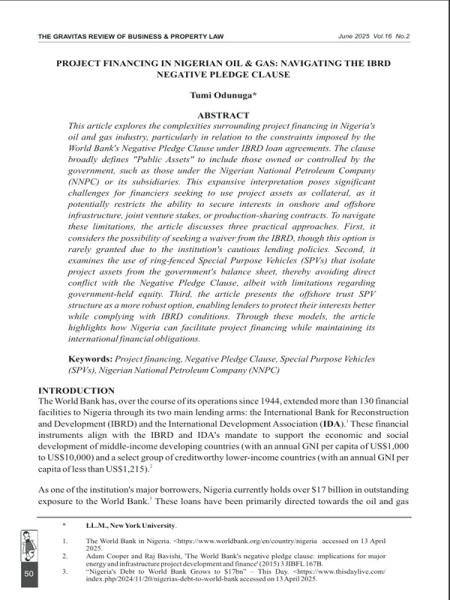
Project Financing in Nigerian Oil & Gas: Navigating the IBRD Clause
Tumi Odunuga*
This article explores the complexities surrounding project financing in Nigeria’s oil and gas industry, particularly in relation to the constraints imposed by the World Bank’s Negative Pledge Clause under IBRD loan agreements. The clause broadly defines “Public Assets” to include those owned or controlled by the
government, such as those under the Nigerian National Petroleum Company (NNPC) or its subsidiaries. This expansive interpretation poses significant challenges for financiers seeking to use project assets as collateral, as it potentially restricts the ability to secure interests in onshore and offshore infrastructure, joint venture stakes, or production-sharing contracts. To navigate these limitations, the article discusses three practical approaches. First, it considers the possibility of seeking a waiver from the IBRD, though this option is rarely granted due to the institution’s cautious lending policies. Second, it examines the use of ring-fenced Special Purpose Vehicles (SPVs) that isolate project assets from the government’s balance sheet, thereby avoiding direct conflict with the Negative Pledge Clause, albeit with limitations regarding government-held equity. Third, the article presents the offshore trust SPV structure as a more robust option, enabling lenders to protect their interests better while complying with IBRD conditions. Through these models, the article highlights how Nigeria can facilitate project financing while maintaining its international financial obligations.
Keywords: Project financing, Negative Pledge Clause, Special Purpose Vehicles (SPVs), Nigerian National Petroleum Company (NNPC)
INTRODUCTION
The World Bank has, over the course of its operations since 1944, extended more than 130 financial facilities to Nigeria through its two main lending arms: the International Bank for Reconstruction and Development (IBRD) and the International Development Association (IDA).1 These financial instruments align with the IBRD and IDA’s mandate to support the economic and social development of middle-income developing countries (with an annual GNI per capita of US$1,000 to US$10,000) and a select group of creditworthy lower-income countries (with an annual GNI per capita of less than US$1,215).2
As one of the institution’s major borrowers, Nigeria currently holds over $17 billion in outstanding exposure to the World Bank.3 These loans have been primarily directed towards the oil and gas
*LL.M., New York University.
- The World Bank in Nigeria. accessed on 13 April 2025.
- Adam Cooper and Raj Bavishi, ‘The World Bank’s negative pledge clause: implications for major energy and infrastructure project development and finance’ (2015) 3 JIBFL 167B.
- “Nigeria’s Debt to World Bank Grows to $17bn” – This Day. accessed on 13 April 2025.

Reviews
There are no reviews yet.