
Description
ABSTRACT
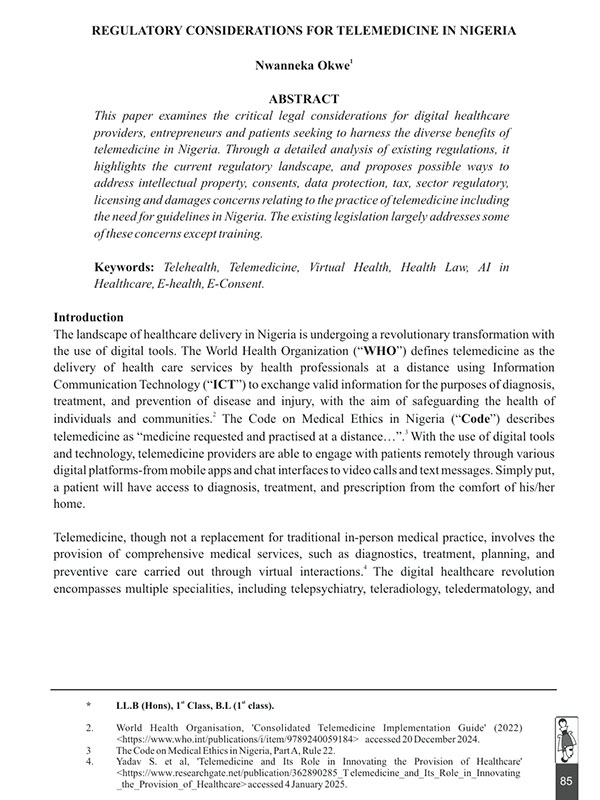
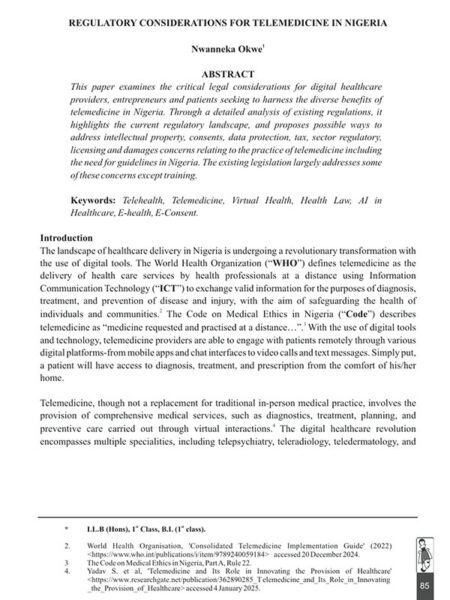
Regulatory Considerations for Telemedicine in Nigeria
Nwanneka Okwe*
ABSTRACT
This paper examines the critical legal considerations for digital healthcare providers, entrepreneurs and patients seeking to harness the diverse benefits of telemedicine in Nigeria. Through a detailed analysis of existing regulations, it highlights the current regulatory landscape, and proposes possible ways to address intellectual property, consents, data protection, tax, sector regulatory, licensing and damages concerns relating to the practice of telemedicine including the need for guidelines in Nigeria. The existing legislation largely addresses some of these concerns except training.
Keywords: Telehealth, Telemedicine, Virtual Health, Health Law, AI in Healthcare, E-health, E-Consent.
INTRODUCTION
The landscape of healthcare delivery in Nigeria is undergoing a revolutionary transformation with the use of digital tools. The World Health Organization (“WHO”) defines telemedicine as the delivery of health care services by health professionals at a distance using Information Communication Technology (“ICT”) to exchange valid information for the purposes of diagnosis, treatment, and prevention of disease and injury, with the aim of safeguarding the health of individuals and communities.1 The Code on Medical Ethics in Nigeria (“Code”) describes telemedicine as “medicine requested and practised at a distance…”.2 With the use of digital tools and technology, telemedicine providers are able to engage with patients remotely through various digital platforms-from mobile apps and chat interfaces to video calls and text messages. Simply put, a patient will have access to diagnosis, treatment, and prescription from the comfort of his/her home.
Telemedicine, though not a replacement for traditional in-person medical practice, involves the provision of comprehensive medical services, such as diagnostics, treatment, planning, and preventive care carried out through virtual interactions.3 The digital healthcare revolution encompasses multiple specialities, including telepsychiatry, teleradiology, teledermatology, and…
*LL.B (Hons), 1 Class, B.L (1 class).
-
- World Health Organisation, ‘Consolidated Telemedicine Implementation Guide’ (2022) accessed 20 December 2024.
- The Code on Medical Ethics in Nigeria, Part A, Rule 22.
- Yadav S. et al, ‘Telemedicine and Its Role in Innovating the Provision of Healthcare’ accessed 4 January 2025.


Reviews
There are no reviews yet.