
Description
ABSTRACT
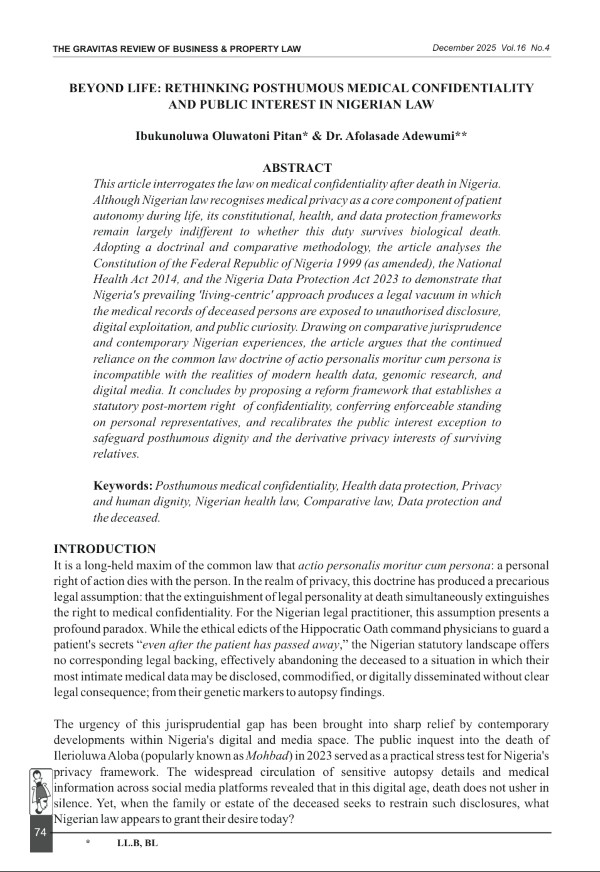
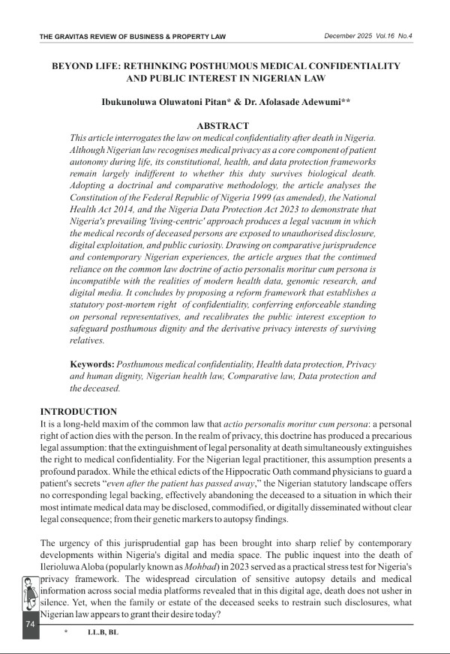
Beyond Life: Rethinking Posthumous Medical Confidentiality and Public Interest in Nigerian Law
Ibukunoluwa Oluwatoni Pitan* & Dr. Afolasade Adewumi**
ABSTRACT
This article interrogates the law on medical confidentiality after death in Nigeria. Although Nigerian law recognises medical privacy as a core component of patient autonomy during life, its constitutional, health, and data protection frameworks remain largely indifferent to whether this duty survives biological death. Adopting a doctrinal and comparative methodology, the article analyses the Constitution of the Federal Republic of Nigeria 1999 (as amended), the National Health Act 2014, and the Nigeria Data Protection Act 2023 to demonstrate that Nigeria’s prevailing ‘living-centric’ approach produces a legal vacuum in which the medical records of deceased persons are exposed to unauthorised disclosure, digital exploitation, and public curiosity. Drawing on comparative jurisprudence and contemporary Nigerian experiences, the article argues that the continued reliance on the common law doctrine of actio personalis moritur cum persona is incompatible with the realities of modern health data, genomic research, and digital media. It concludes by proposing a reform framework that establishes a statutory post-mortem right of confidentiality, conferring enforceable standing on personal representatives, and recalibrates the public interest exception to safeguard posthumous dignity and the derivative privacy interests of surviving relatives.
Keywords: Posthumous medical confidentiality, Health data protection, Privacy and human dignity, Nigerian health law, Comparative law, Data protection and the deceased.
INTRODUCTION
It is a long-held maxim of the common law that actio personalis moritur cum persona: a personal right of action dies with the person. In the realm of privacy, this doctrine has produced a precarious legal assumption: that the extinguishment of legal personality at death simultaneously extinguishes the right to medical confidentiality. For the Nigerian legal practitioner, this assumption presents a profound paradox. While the ethical edicts of the Hippocratic Oath command physicians to guard a patient’s secrets “even after the patient has passed away,” the Nigerian statutory landscape offers no corresponding legal backing, effectively abandoning the deceased to a situation in which their most intimate medical data may be disclosed, commodified, or digitally disseminated without clear legal consequence; from their genetic markers to autopsy findings.
The urgency of this jurisprudential gap has been brought into sharp relief by contemporary developments within Nigeria’s digital and media space. The public inquest into the death of Ilerioluwa Aloba (popularly known as Mohbad) in 2023 served as a practical stress test for Nigeria’s privacy framework. The widespread circulation of sensitive autopsy details and medical information across social media platforms revealed that in this digital age, death does not usher in silence. Yet, when the family or estate of the deceased seeks to restrain such disclosures, what Nigerian law appears to grant their desire today?
*LL.B, BL

Reviews
There are no reviews yet.