
Description
ABSTRACT
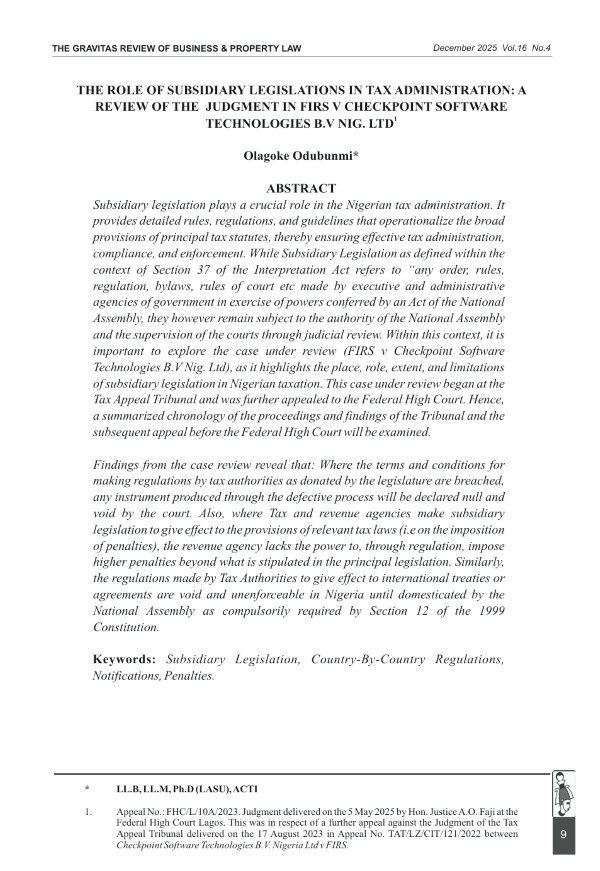
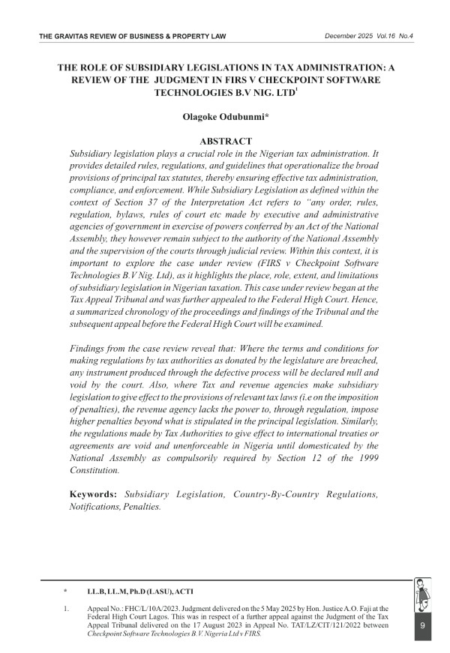
The Role of Subsidiary Legislation in Tax Administration: A Review of the Judgment in FIRS V. Checkpoint Software Technologies B.V. Nig. Ltd
Olagoke Odubunmi*
ABSTRACT
Subsidiary legislation plays a crucial role in the Nigerian tax administration. It provides detailed rules, regulations, and guidelines that operationalize the broad provisions of principal tax statutes, thereby ensuring effective tax administration, compliance, and enforcement. While Subsidiary Legislation as defined within the context of Section 37 of the Interpretation Act refers to “any order, rules, regulation, bylaws, rules of court etc made by executive and administrative agencies of government in exercise of powers conferred by an Act of the National Assembly, they however remain subject to the authority of the National Assembly and the supervision of the courts through judicial review. Within this context, it is important to explore the case under review (FIRS v Checkpoint Software Technologies B.V Nig. Ltd), as it highlights the place, role, extent, and limitations of subsidiary legislation in Nigerian taxation. This case under review began at the Tax Appeal Tribunal and was further appealed to the Federal High Court. Hence, a summarized chronology of the proceedings and findings of the Tribunal and the subsequent appeal before the Federal High Court will be examined.
Findings from the case review reveal that: Where the terms and conditions for making regulations by tax authorities as donated by the legislature are breached, any instrument produced through the defective process will be declared null and void by the court. Also, where Tax and revenue agencies make subsidiary legislation to give effect to the provisions of relevant tax laws (i.e on the imposition of penalties), the revenue agency lacks the power to, through regulation, impose higher penalties beyond what is stipulated in the principal legislation. Similarly, the regulations made by Tax Authorities to give effect to international treaties or
agreements are void and unenforceable in Nigeria until domesticated by the National Assembly as compulsorily required by Section 12 of the 1999 Constitution.
Keywords: Subsidiary Legislation, Country-By-Country Regulations, Notifications, Penalties
* LL.B, LL.M, Ph.D (LASU), ACTI
- Appeal No.: FHC/L/10A/2023. Judgment delivered on the 5 May 2025 by Hon. Justice A.O. Faji at the Federal High Court Lagos. This was in respect of a further appeal against the Judgment of the Tax Appeal Tribunal delivered on the 17 August 2023 in Appeal No. TAT/LZ/CIT/121/2022 between Checkpoint Software Technologies B.V. Nigeria Ltd v FIRS.

Reviews
There are no reviews yet.