
Description
ABSTRACT
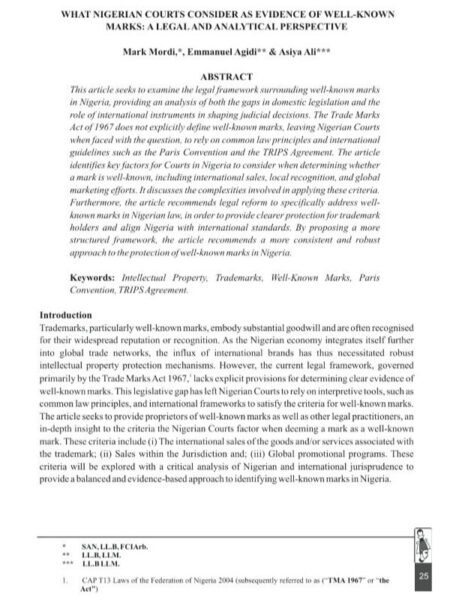
What Nigerian Courts Consider as Evidence of Well-Known Marks: A Legal and Analytical Perspective
Mark Mordi,*, Emmanuel Agidi** & Asiya Ali***
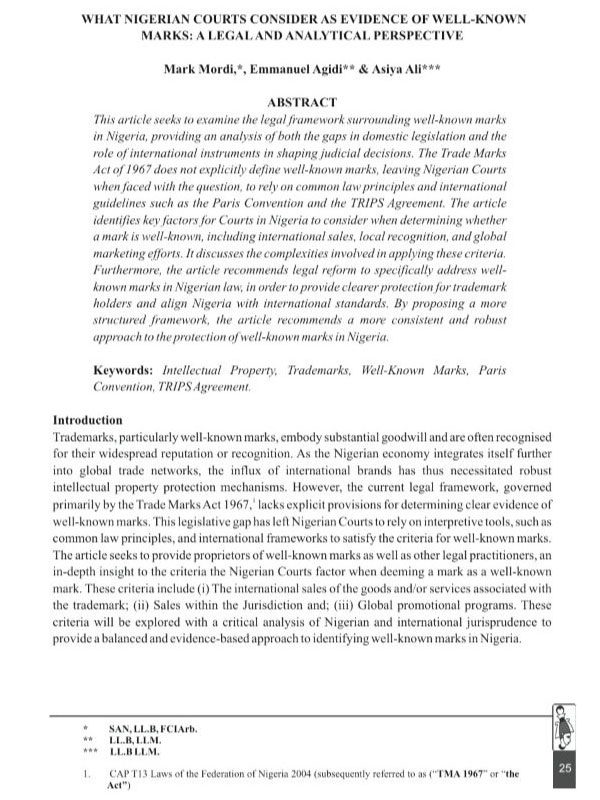
This article seeks to examine the legal framework surrounding well-known marks in Nigeria, providing an analysis of both the gaps in domestic legislation and the role of international instruments in shaping judicial decisions. The Trade Marks Act of 1967 does not explicitly define well-known marks, leaving Nigerian Courts when faced with the question, to rely on common law principles and international guidelines such as the Paris Convention and the TRIPS Agreement. The article identifies key factors for Courts in Nigeria to consider when determining whether a mark is well-known, including international sales, local recognition, and global marketing efforts. It discusses the complexities involved in applying these criteria. Furthermore, the article recommends legal reform to specifically address well known marks in Nigerian law, in order to provide clearer protection for trademark holders and align Nigeria with international standards. By proposing a more structured framework, the article recommends a more consistent and robust approach to the protection of well known marks in Nigeria.
Keywords: Intellectual Property, Trademarks, Well-Known Marks, Paris Convention, TRIPS Agreement.
INTRODUCTION
Trademarks, particularly well-known marks, embody substantial goodwill and are often recognised for their widespread reputation or recognition. As the Nigerian economy integrates itself further into global trade networks, the influx of international brands has thus necessitated robust intellectual property protection mechanisms. However, the current legal framework, governed primarily by the Trade Marks Act 1967,1 lacks explicit provisions for determining clear evidence of well-known marks. This legislative gap has left Nigerian Courts to rely on interpretive tools, such as common law principles, and international frameworks to satisfy the criteria for well-known marks. The article seeks to provide proprietors of well-known marks as well as other legal practitioners, an in-depth insight to the criteria the Nigerian Courts factor when deeming a mark as a well-known mark. These criteria include (i) The international sales of the goods and/or services associated with the trademark; (ii) Sales within the Jurisdiction and; (iii) Global promotional programs. These criteria will be explored with a critical analysis of Nigerian and international jurisprudence to provide a balanced and evidence-based approach to identifying well-known marks in Nigeria.
*SAN, LL.B, FCIArb.
**LL.B, LLM.
*** LL.B LLM.
- CAP T13 Laws of the Federation of Nigeria 2004 (subsequently referred to as (“TMA 1967” or “the Act”)
THE GRAVITAS REVIEW OF BUSINESS & PROPERTY LAW Vol.16 No.1

Reviews
There are no reviews yet.