
Description
ABSTRACT
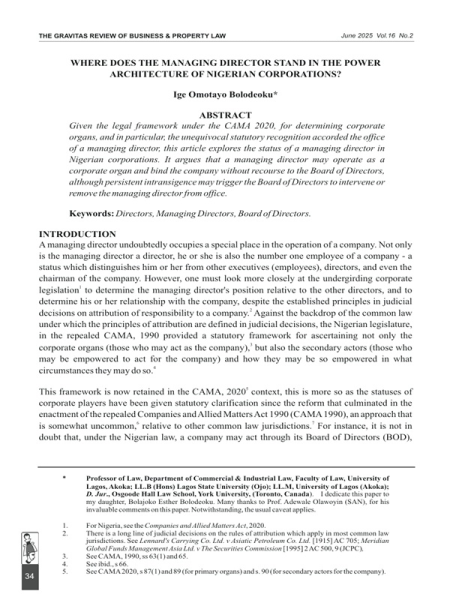
Where Does the Managing Director Stand in the Power Architecture of Nigerian Corporations?
Professor Ige Bolodeoku *
Given the legal framework under the CAMA 2020, for determining corporate organs, and in particular, the unequivocal statutory recognition accorded the office of a managing director, this article explores the status of a managing director in Nigerian corporations. It argues that a managing director may operate as a corporate organ and bind the company without recourse to the Board of Directors, although persistent intransigence may trigger the Board of Directors to intervene or remove the managing director from office.
Keywords: Directors, Managing Directors, Board of Directors.
INTRODUCTION
A managing director undoubtedly occupies a special place in the operation of a company. Not only is the managing director a director, he or she is also the number one employee of a company – a status which distinguishes him or her from other executives (employees), directors, and even the chairman of the company. However, one must look more closely at the undergirding corporate legislation1 to determine the managing director’s position relative to the other directors, and to determine his or her relationship with the company, despite the established principles in judicial decisions on attribution of responsibility to a company.2 Against the backdrop of the common law under which the principles of attribution are defined in judicial decisions, the Nigerian legislature, in the repealed CAMA, 1990 provided a statutory framework for ascertaining not only the corporate organs (those who may act as the company), but also the secondary actors (those who may be empowered to act for the company)3 and how they may be so empowered in what circumstances they may do so.4
This framework is now retained in the CAMA, 20205 context, this is more so as the statuses of corporate players have been given statutory clarification since the reform that culminated in the enactment of the repealed Companies and Allied Matters Act 1990 (CAMA 1990), an approach that is somewhat uncommon,6 relative to other common law jurisdictions.7 For instance, it is not in doubt that, under the Nigerian law, a company may act through its Board of Directors (BOD),
*Professor of Law, Department of Commercial & Industrial Law, Faculty of Law, University of Lagos, Akoka; LL.B (Hons) Lagos State University (Ojo); LL.M, University of Lagos (Akoka); D. Jur., Osgoode Hall Law School, York University, (Toronto, Canada). I dedicate this paper to my daughter, Bolajoko Esther Bolodeoku. Many thanks to Prof. Adewale Olawoyin (SAN), for his invaluable comments on this paper. Notwithstanding, the usual caveat applies
- For Nigeria, see the Companies and Allied Matters Act, 2020.
- There is a long line of judicial decisions on the rules of attribution which apply in most common law jurisdictions. See Lennard’s Carrying Co. Ltd. v Asiatic Petroleum Co. Ltd. [1915] AC 705; Meridian Global Funds Management Asia Ltd. v The Securities Commission [1995] 2 AC 500, 9 (JCPC),
- See CAMA, 1990, ss 63(1) and 65.
- See ibid., s 66.
- See CAMA 2020, s 87(1) and 89 (for primary organs) and s. 90 (for secondary actors for the company)
- The exception to this is Ghana, which not only defined the power relations among the corporate organs, but also recognised the managing directors as an organ which could bind the company civilly and criminally. See Companies Act, 1963 (Ghana), Act 179, ss 137-140. It was this approach that arguably influenced similar reforms Nigerian implemented under the Companies and Allied Matters Act (CAMA), 1990. See ss 63-66. Nigeria retained these provisions in CAMA, 2020, ss. 87-90. Ghana retained the same framework in her Companies Act, 2019, Act 992, Part O, ss. 144-148. See also Australia’s Corporation Act, 2001, s 198.
- In the U.K. Companies Act, 2006, Chapter 46 (CA, 2006), for instance, there is no special focus on the managing director in the Act; reference is to “directors”. See CA, 2006, s. 40. See generally Part 4 of the Act. Under the Model Articles made pursuant to Act, directors are responsible for the management of the company’s business (regulation 3) and may delegate any of their powers to a committee or to any director or person (regulation 5). A managing director has no special mention either in the Act or Model Articles, a shift from the Table A articles under the U.K. 1985 Companies Act. Similar provision applies in New Zealand law. See Companies Act, 1993 (New Zealand), Public Act No. 105, s.130 (delegation by the board of company may be to “a committee of directors, a director or employee of the company, or any other person . . .”). See also Canada Business Corporations Act, RSC 1985, c C-44, s. 102 which confers management powers on the board of directors, and section 115 which empowers the board to delegate any of its powers to the managing directors, with some exceptions. In this respect, the Managing Director does not have the power similar to that conferred on the Managing Director under section 89 of CAMA. For Australia, see Corporations Act, 2001, s. 198 (C)-(D) (management power is conferred on the directors, who may confer any of its power on the managing directors and may revoke the conferral). For India, see the proviso to Companies Act, 2013, the proviso to s. 179(3) (the board may only delegate to a committee, managing director, principal officer any of the clauses stated in s.179(3) (d)-(f).

Reviews
There are no reviews yet.