-
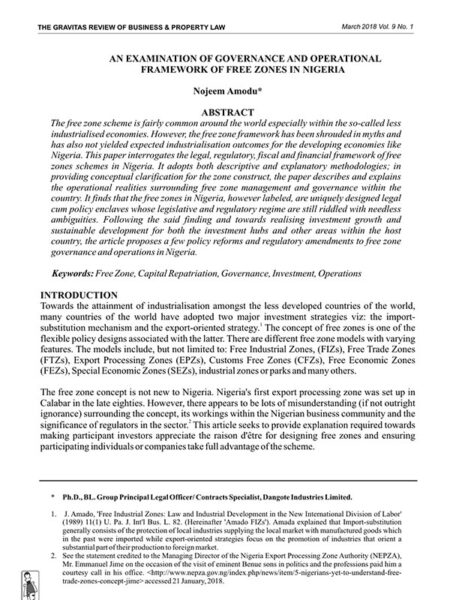
An Examination of Governance and Operational Framework of Free Zones in Nigeria
0₦2,500.00Dr. Nojeem Amodu, Group Principal Legal Officer with Dangote Industries Limited, in “An Examination of Governance and Operational Framework of Free Zones in Nigeria”,interrogates the legal, regulatory, fiscal and financial framework of free zones schemes in Nigeria. He notes different free zone models including Free Industrial Zones, Free Trade Zones, Export Processing Zones, Customs Free Zones, Free Economic Zones, Special Economic Zones among others. He considers the reasons for delineation of zones, licensing and incentive regimes of free zones in Nigeria, registration procedure and examines all sides of the argument in the debate on the conflict between the Nigeria Export Processing Zones Act (NEPZA) and the Oil and Gas Export Free Zone Authority Act (OGEFZA).
-
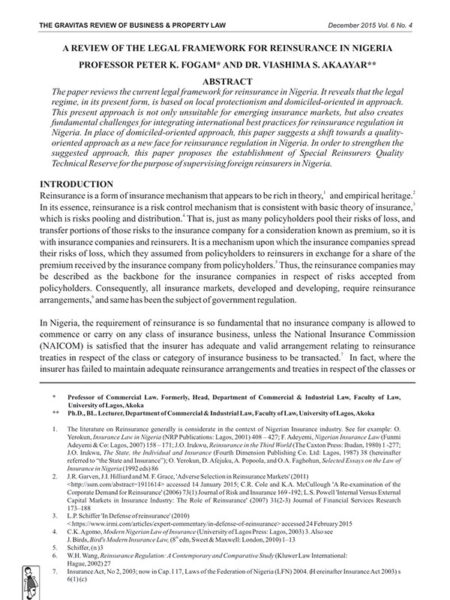
A Review of the Legal Framework for Reinsurance in Nigeria
0₦2,500.00Professor Peter Fogam and Dr. Viashima Akaayar of the Department of Commercial & Industrial Law, University of Lagos in their article, “A Review of the Legal Framework for Reinsurance in Nigeria” examines the 3 main international regulatory approaches to reinsurance. They undertake a comprehensive review of the legal regime regulating reinsurance, arguing that the Nigerian Reinsurance subsector is neither stable nor strong enough to warrant the Domiciled Oriented Regulation (DOR) apparent in several sections of the Insurance Act and other extant laws on reinsurance.
-
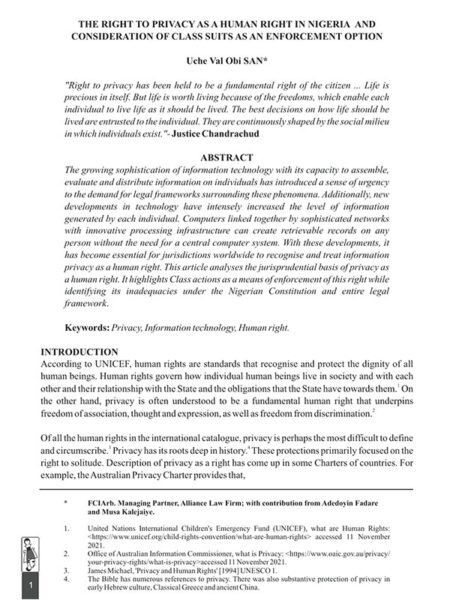
The Right to Privacy as a Human Right in Nigeria and Consideration of Class Suits as an Enforcement Option
0₦2,500.00Uche Val Obi SAN, Managing Partner, Alliance Law Firm, in his article, The Right to Privacy as a Human Right in Nigeria and Consideration of Class Suits as an Enforcement Option, notes that the growing sophistication of information technology with its capacity to assemble, evaluate and distribute information on individuals has introduced a sense of urgency to the demand for legal frameworks surrounding these phenomena. He argues that it has then become essential for jurisdictions worldwide to recognise and treat information privacy as a human right. Val Obi, SAN analyses the jurisprudential basis of privacy as a human right, constitutional and extant legislation on protecting and redressing privacy rights infringement in Nigeria. He highlights Class Action as a means of enforcement of privacy rights while identifying its inadequacies under the Nigerian Constitution and the entire legal framework.
-
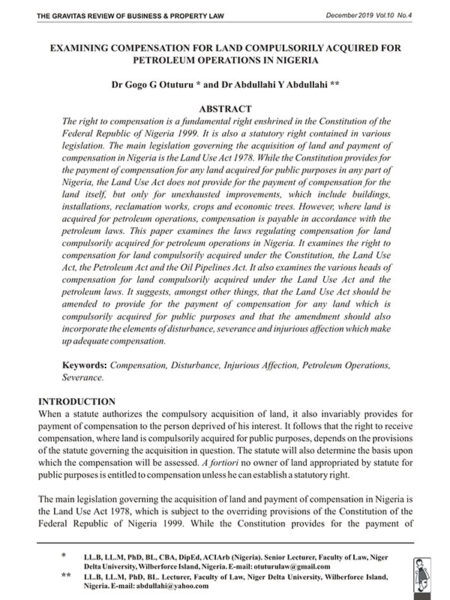
Examining Compensation for Land Compulsorily Acquired for Petroleum Operations in Nigeria
0₦2,500.00Dr Gogo Otuturu and Dr Abdullahi Abdullahi of the Faculty of Law, Niger Delta University, Wilberforce Island Nigeria in their article, note that the right to compensation for land compulsorily acquired is both a constitutional and statutory right. While the Constitution provides for the payment of compensation for any land acquired for public purposes, the Land Use Act provides for compensation, not for the land itself, but for unexhausted improvements. Where the land is acquired for petroleum operations, compensation is payable in accordance with the Petroleum Act and the Oil Pipelines Act. Otuturu and Abdullahi examine the various heads of compensation for land compulsorily acquired under the Land Use Act and the petroleum . They suggest an amendment of the laws to incorporate the elements of disturbance, severance and injurious affection.
-
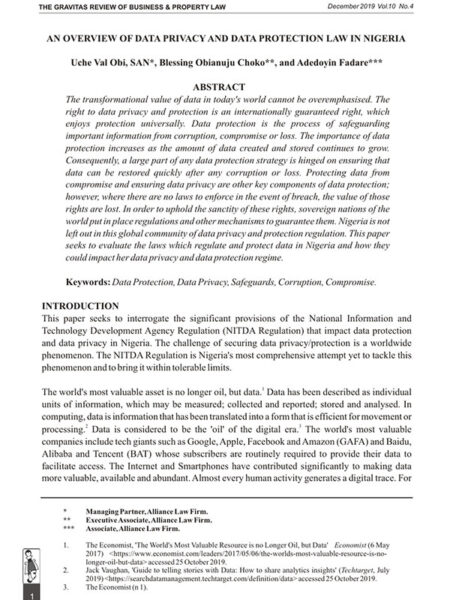
An Overview of Data Privacy and Data Protection Law in Nigeria
0₦2,500.00Uche Val Obi SAN, Blessing Choko and Adedoyin Fadare posit that the right to data privacy and protection is now an internationally guaranteed right and nations of the world, including Nigeria, put in place regulations and other mechanisms to safeguard data from corruption, compromise or loss. Uche Obi et al. comprehensively review Nigerian laws and regulations dealing with data protection and privacy, including the Nigeria Data Protection Regulation 2019 against the backdrop of international best practices.
-
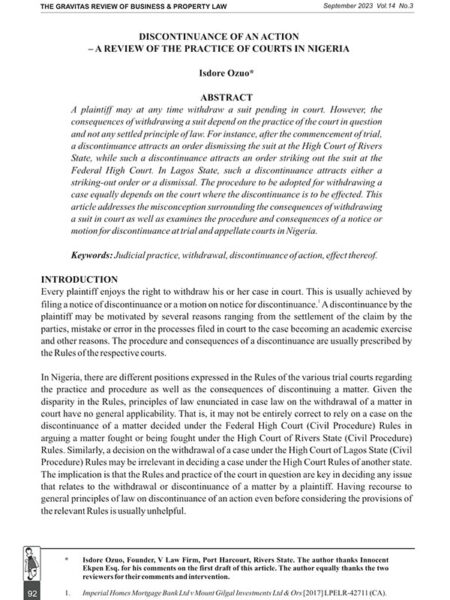
Discontinuance of an Action – A Review of the Practice of Courts in Nigeria
0₦2,500.00Isdore Ozuo, in his article, Discontinuance of an Action – A Review of the Practice of Courts in Nigeria, analyses the legal provisions on the right of a plaintiff to discontinue an action in the different strata of court. A plaintiff may at any time withdraw a suit pending in court. However, the consequences of withdrawing a suit depend on the practice of the court in question and not any settled principle of law. For instance, after the commencement of trial, a discontinuance attracts an order dismissing the suit at the High Court of Rivers State, while such a discontinuance attracts an order striking out the suit at the Federal High Court. In Lagos State, such a discontinuance attracts either a striking out order or a dismissal. The procedure to be adopted for withdrawing a case equally depends on the court where the discontinuance is to be effected. The article addresses the misconception surrounding the consequences of withdrawing a suit in court as well as examines the procedure and consequences of a notice or motion for discontinuance at trial and appellate courts in Nigeria.
-
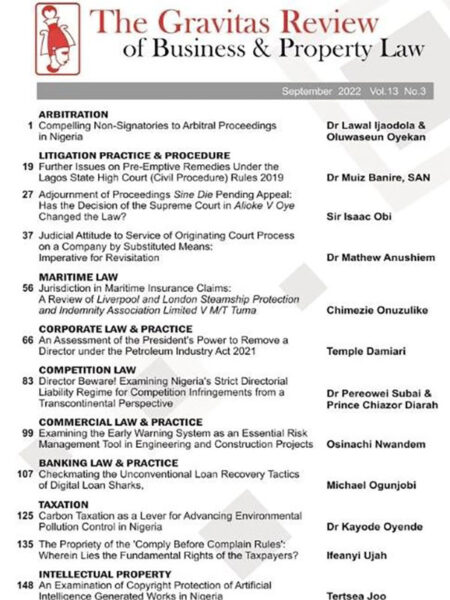
The Gravitas Review of Business & Property Law Vol.13 No.3 – E-Book
0₦5,000.00In this issue of The Gravitas Review of Business & Property Law Vol.13 No.3, there are well researched articles on:
- Arbitration
- Litigation Practice & Procedure
- Maritime Law
- Corporate Law & Practice
- Competition Law
- Commercial Law & Practice
- Banking Law & Practice
- Taxation
- Intellectual Property
-
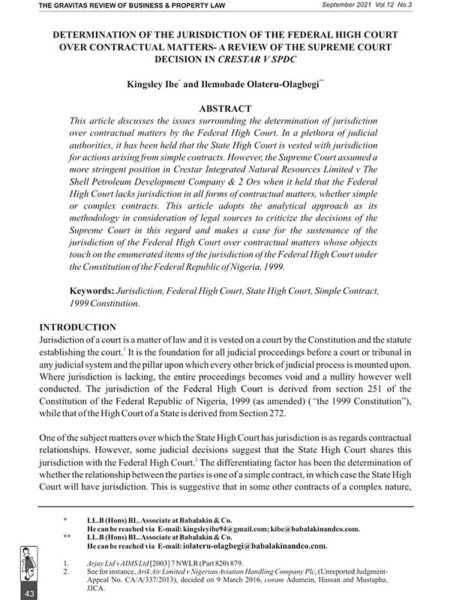
Determination of the Jurisdiction of the Federal High Court Over Contractual Matters- A Review of the Supreme Court Decision in Crestar V SPDC
0₦2,500.00Kingsley Ibe and Ilemobade Olateru-Olagbegi, both of Babalakin & Co, in their article, Determination of the Jurisdiction of the Federal High Court Over Contractual Matters- A Review of the Supreme Court Decision in Crestar V SPDC, examine the incipient confusion over the decision of the Supreme Court that a Federal High Court has no jurisdiction over contractual matters; whether the contract is simple or ‘complex’. They explore the historical jurisdiction of both States and Federal High Court on contracts, and argue that the Federal High Court should still have jurisdiction over contractual matters if the issue pertains to those items enumerated in section 251 of the 1999 Nigerian Constitution.
-
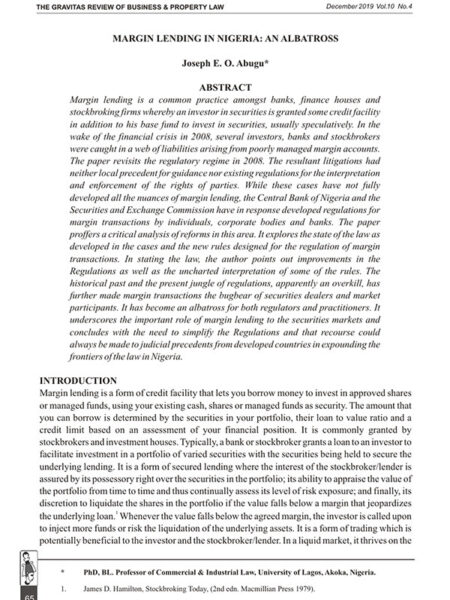
Margin Lending in Nigeria: An Albatross
0₦2,500.00Joseph Abugu, Professor of Commercial & Industrial Law, University of Lagos Akoka Nigeria in his article, Margin Lending in Nigeria: An Albatross, notes that Margin Lending is a common practice amongst banks, finance houses and stockbroking firms whereby an investor in securities is granted credit facility in addition to his base fund to invest in securities, usually speculatively. In the wake of the financial crisis of 2008, several investors, banks and stockbrokers were caught in a web of liabilities arising from poorly managed margin accounts. The resultant litigations had neither local precedent for guidance nor existing regulations for the interpretation and enforcement of rights. While the cases have not fully developed all the nuances of Margin Lending, the Central Bank of Nigeria and the Securities and Exchange Commission have in response developed regulations for margin transactions by individuals, corporate bodies and banks. Professor Abugu, in his usual inimitable style, explores the state of the law as developed in the cases and the new rules designed for the regulation of margin transactions.
-
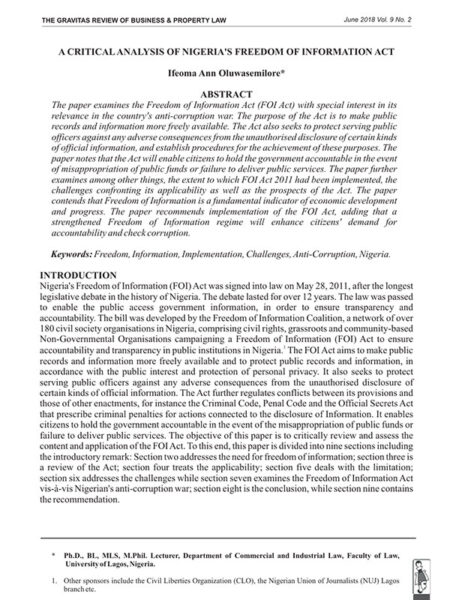
A Critical Analysis of Nigeria’s Freedom of Information Act
0₦2,500.00Dr. Ifeoma Oluwasemilore, Lecturer, Department of Commercial and Industrial Law, Faculty of Law, University of Lagos in her article, A Critical Analysis of Nigeria’s Freedom of Information Act, examines the Freedom of Information Act (FOI Act) with special interest in its relevance in the country’s anti-corruption war. She examines the extent to which FOI Act had been implemented, the challenges confronting its applicability as well as the prospects of the Act. She contends that Freedom of Information is a fundamental indicator of economic development and progress, and recommends a strengthened implementation of the Act, adding that a strong Freedom of Information regime will enhance citizens’ demand for accountability and check corruption.
-
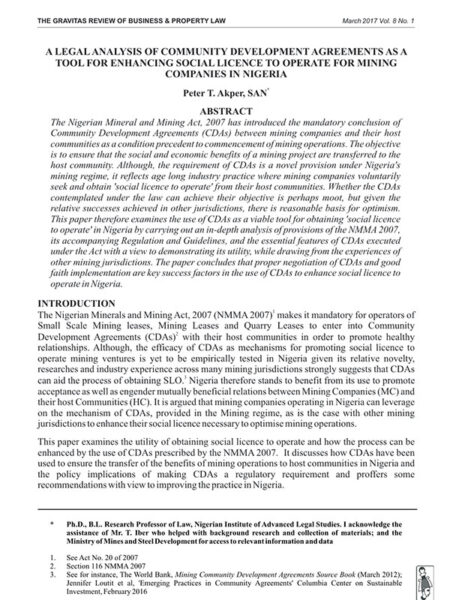
A Legal Analysis of Community Development Agreements as a Tool for Enhancing Social Licence to Operate for Mining Companies in Nigeria
0₦2,500.00Professor Peter Akper, SAN of the Nigerian Institute of Advanced Legal Studies in his article “A Legal Analysis of Community Development Agreements as a Tool for Enhancing Social Licence to Operate for Mining Companies in Nigeria” examines the provision of the Nigerian Mineral and Mining Act 2007 which introduced the mandatory conclusion of Community Development Agreements (CDAs) between mining companies and their host communities as a condition precedent to commencement of mining operations. He examines CDA as a ‘Social Licence to Operate’ , its essential features and enforceability. He concludes by x-raying three typical CDAs concluded by mining companies with Gimbi, Durumi and Piyyakasa communities.
-
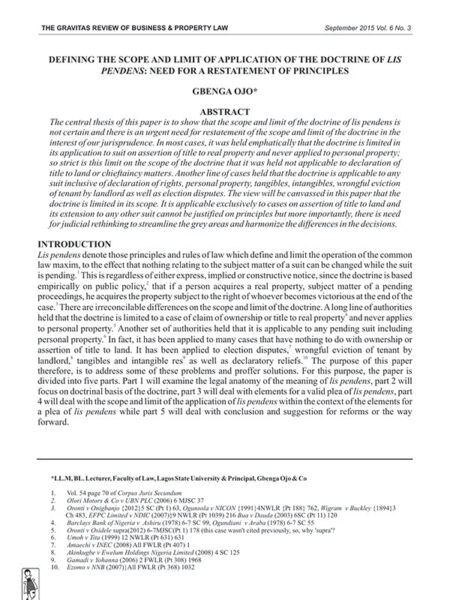
Defining the Scope and Limit of Application of the Doctrine of Lis Pendens: Need for a Restatement of Principles
0₦2,500.00Gbenga Ojo, Lecturer, Lagos State University & Principal, Gbenga Ojo & Co in “Defining the Scope and Limit of Application of the Doctrine of Lis Pendens: Need for a Restatement of Principles” dissects several decided cases on the doctrine of lis pendens and argue that some of them including a Supreme Court case may have been decided per incuriam.
The Gravitas Review of Business & Property Law