-
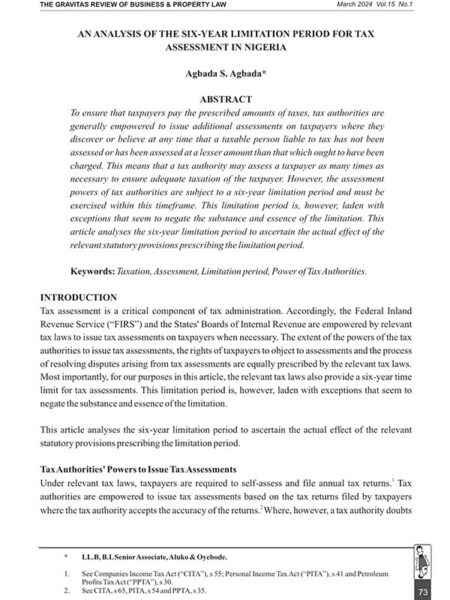
An Analysis of the Six-year Limitation Period for Tax Assessment in Nigeria
0₦2,500.00Agbada S. Agbada, in his article, An Analysis of the Six-year Limitation Period for Tax Assessment in Nigeria, examines the six-year limitation period for tax assessment in Nigeria. To ensure that the prescribed amounts of taxes are paid by taxpayers, tax authorities are generally empowered to issue additional assessments on taxpayers where they discover or are of the opinion at any time that a taxable person liable to tax has not been assessed or has been assessed at a lesser amount than that which ought to have been charged. This means that a tax authority may assess a taxpayer for as many times as may be necessary to ensure an adequate taxation of the taxpayer. However, the assessment powers of tax authorities are subject to a six-year limitation period and are required to be exercised within this timeframe. This limitation period is however laden with exceptions that seem to negate the substance and essence of the limitation. Agbada analyses the six-year limitation period with a view to ascertaining the true effect of the relevant statutory provisions prescribing the limitation period.
-
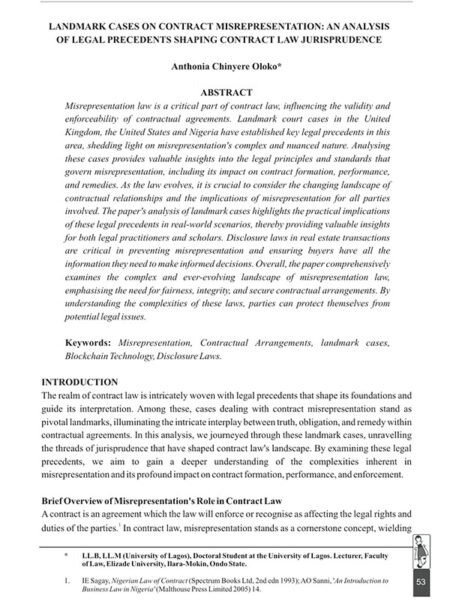
Landmark Cases on Contract Misrepresentation: An Analysis of Legal Precedents Shaping Contract Law Jurisprudence
0₦2,500.00Anthonia Chinyere Oloko, in her article, Landmark Cases on Contract Misrepresentation: An Analysis of Legal Precedents Shaping Contract Law Jurisprudence, visits the law on misrepresentation as a critical part of contract law, influencing the validity and enforceability of contractual agreements. Landmark court cases in the United Kingdom, the United States and Nigeria have established key legal precedents in this area, shedding light on the complex and nuanced nature of misrepresentation. Analysing these cases provides valuable insights into the legal principles and standards that govern misrepresentation, including its impact on contract formation, performance, and remedies. As the law evolves, it is important to consider the changing landscape of contractual relationships and the implications of misrepresentation for all parties involved. The paper’s analysis of landmark cases highlights the practical implications of these legal precedents in real-world scenarios, thereby providing valuable insights for both legal practitioners and scholars. Disclosure laws in the realm of real estate transactions are critical in preventing misrepresentation and ensuring that buyers have all the information they need to make informed decisions. Oloko provides a comprehensive examination of the complex and ever-evolving landscape of misrepresentation law, emphasising the need for fairness, integrity, and secure contractual arrangements. By understanding the complexities of these laws, parties can protect themselves from potential legal issues.
-
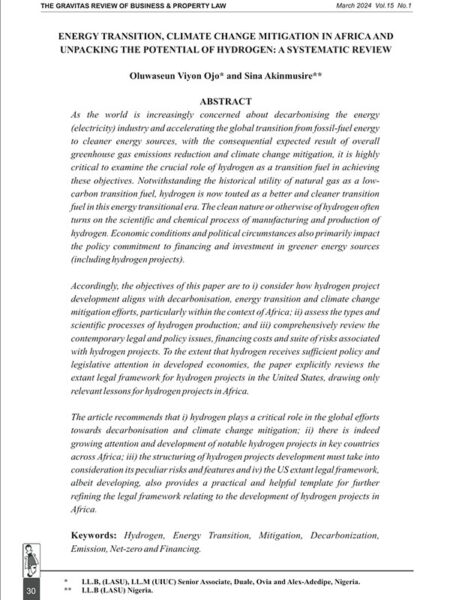
Energy Transition, Climate Change Mitigation in Africa and Unpacking the Potential of Hydrogen: A Systematic Review
0₦2,500.00Oluwaseun Viyon Ojo and Sina Akinmusire, in their article, Energy Transition, Climate Change Mitigation in Africa and Unpacking the Potential of Hydrogen: A Systematic Review, address increasing concerns about decarbonizing the energy (electricity) industry and accelerating the global transition from fossil-fuel energy to cleaner energy sources. With the consequential expected result of overall greenhouse gas emissions reduction and climate change mitigation, it is extremely critical to examine the crucial role of hydrogen as a transition fuel in achieving these objectives. Notwithstanding the historical utility of natural gas as a low-carbon transition fuel, hydrogen is now touted as a better and cleaner transition fuel in this energy transitional era. The clean nature or otherwise of hydrogen often turn on the scientific and chemical process of manufacturing and production of hydrogen. Crucially, economic conditions and political circumstances also largely impact the policy commitment to financing and investment in greener energy sources (including hydrogen projects). Ojo and Akinmusire address a number of cognate issues. They consider how hydrogen project development aligns with decarbonization, energy transition and to the extent that hydrogen is currently receiving sufficient policy and legislative attention in developed economies, the paper specifically reviews the extant legal framework for hydrogen projects in the United States, drawing only relevant lessons for hydrogen projects in Africa..
-
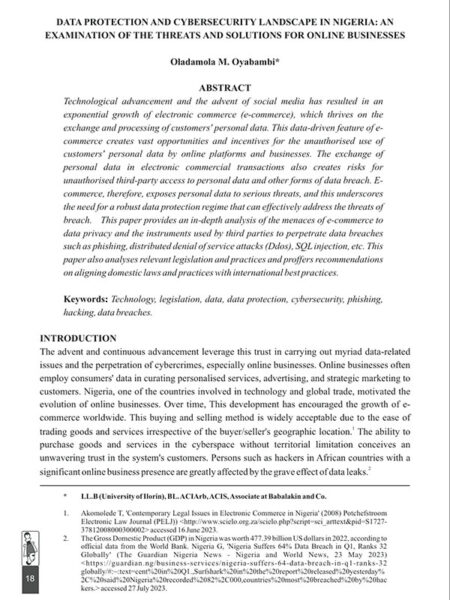
Data Protection and Cybersecurity Landscape in Nigeria: An Examination of the Threats and Solutions for Online Businesses
0₦2,500.00Oladamola M. Oyabambi, in his article, Data Protection and Cybersecurity Landscape in Nigeria: An Examination of the Threats and Solutions for Online Businesses, dwells on technological advancement and the advent of social media on the growth of electronic commerce (e-commerce), which thrives on the exchange and processing of personal data of customers. This data-driven feature of e-commerce creates vast opportunities and incentives for unauthorised use of personal data of customers by online platforms and businesses. The exchange of personal data in electronic commercial transactions also creates risks for unauthorised third-party access to personal data and other forms of data breach. E-commerce therefore exposes personal data to serious threats, and this underscores the need for a strong data protection regime that can effectively address the threats of breach. Oyabambi provides an in-depth analysis of the menaces of e-commerce to data privacy, the instruments used by third parties to perpetrate data breaches such as: phishing, distributed denial of service attacks (Ddos), SQL injection etc. He analyzes relevant legislation and practices, and proffers recommendations on how best to align domestic laws and practices with international best practice.
-
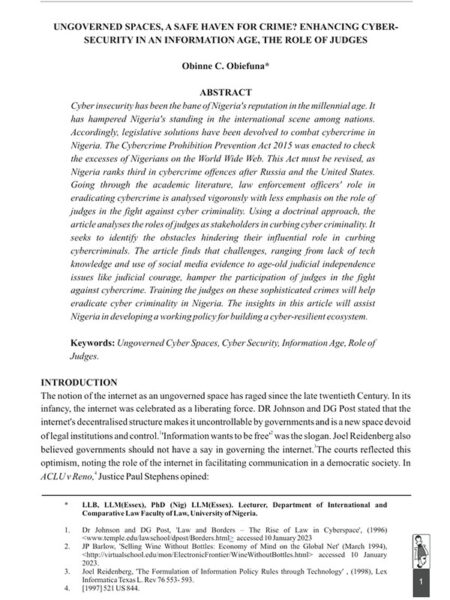
Ungoverned Spaces, a Safe Haven for Crime? Enhancing Cyber-Security in an Information Age, the Role of Judges
0₦2,500.00Dr. Obinne C. Obiefuna, in his article, Ungoverned Spaces a Safe Haven for Crime? Enhancing Cyber-Security in an Information Age, the Role of Judges, explores the problem of cyber-crime, the efficacy of extant legislation and the role of judges in effective regulation of cyber security. Cyber insecurity has been the bane of Nigeria’s reputation in the millennial age. It has hampered Nigeria’s standing in the international scene among nations. The Cybercrime Prohibition Prevention Act 2015 was enacted to check the excesses of Nigerians on the World Wide Web. This Act has been less than effective as Nigeria ranks third in cybercrime offences after Russia and United States. Going through academic literature, the role of law enforcement officers in eradication of cybercrime is analyzed vigorously with less emphasis on the role of judges in the fight against cyber criminality. Using doctrinal approach, Obiefuna analyses the roles of judges as stakeholders in curbing cyber criminality. Obiefuna seeks to identify the obstacles hindering their effective role in curbing cybercriminals. He finds that challenges, ranging from lack of tech knowledge, use of social media, evidence of the age old judicial independence issues like judicial courage hamper the participation of judges in the fight against cybercrime. Obiefuna suggested that emphasis on training the judges on these sophisticated crimes will help to eradicate cyber criminality in Nigeria.
-
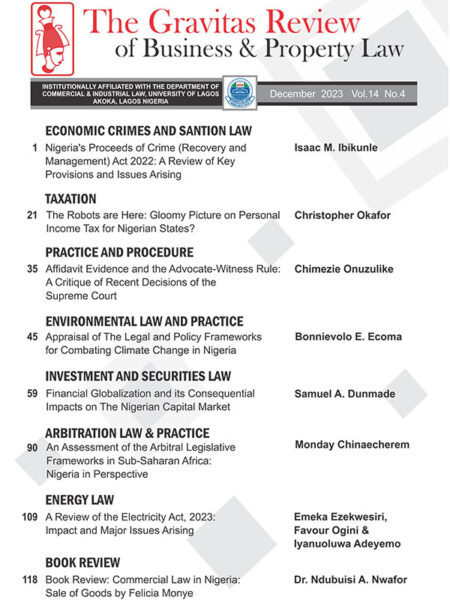
The Gravitas Review of Business & Property Law Vol.14 No.4 – Print
0₦5,000.00In this issue of The Gravitas Review of Business & Property Law Vol.14 No.4, there are well researched articles on:
- Economic Crimes & Sanction
- Taxation
- Litigation Practice & Procedure
- Environmental Law
- Investments & Securities Law
- Arbitration Law & Practice
- Energy Law
- Book Review
-
The Gravitas Review of Business & Property Law Vol.14 No.4 – E-Book
0₦5,000.00In this issue of The Gravitas Review of Business & Property Law Vol.14 No.4, there are well researched articles on:
- Economic Crimes & Sanction
- Taxation
- Litigation Practice & Procedure
- Environmental Law
- Investments & Securities Law
- Arbitration Law & Practice
- Energy Law
- Book Review
-
The Gravitas Review of Business & Property Law Vol.14 No.4
0₦5,000.00In this issue of The Gravitas Review of Business & Property Law Vol.14 No.4, there are well researched articles on:
- Economic Crimes & Sanction
- Taxation
- Litigation Practice & Procedure
- Environmental Law
- Investments & Securities Law
- Arbitration Law & Practice
- Energy Law
- Book Review
-
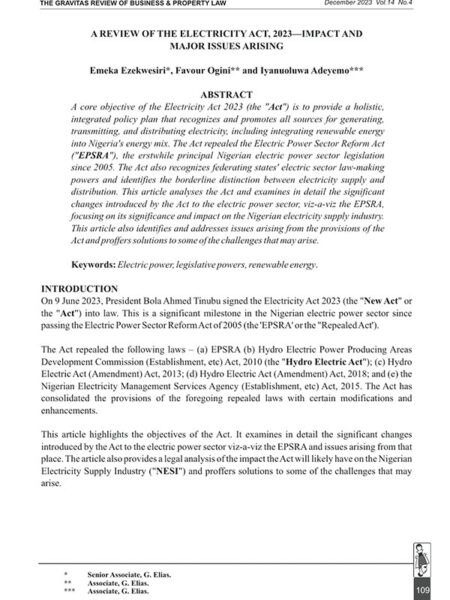
A Review of the Electricity Act, 2023 – Impact and Major Issues Arising
0₦2,500.00Emeka Ezekwesiri, Favour Ogini, and Iyanuoluwa Adeyemo, undertake a review of the Electricity Act 2023, its objectives, content and potential impact on the power regulatory landscape in Nigeria, in their article, A Review of the Electricity Act, 2023 – Impact and Major Issues Arising. The Act provides a holistic integrated policy plan that recognizes and promotes all sources for the generation, transmission, and distribution of electricity, including the integration of renewable energy into Nigeria’s energy mix. The Act repealed the Electric Power Sector Reform Act (the “EPSRA”), the erstwhile principal legislation of the Nigerian electric power sector since 2005. The Act also recognizes the electric sector law making powers of federating states and identifies the border line distinction between electricity supply and distribution. Ezekwesiri et al provide an analysis of the Act and examines in detail the major changes introduced by the Act to the electric power sector viz-a-viz the EPSRA with particular focus on its significance and impact in the Nigerian Electricity Supply Industry.
-
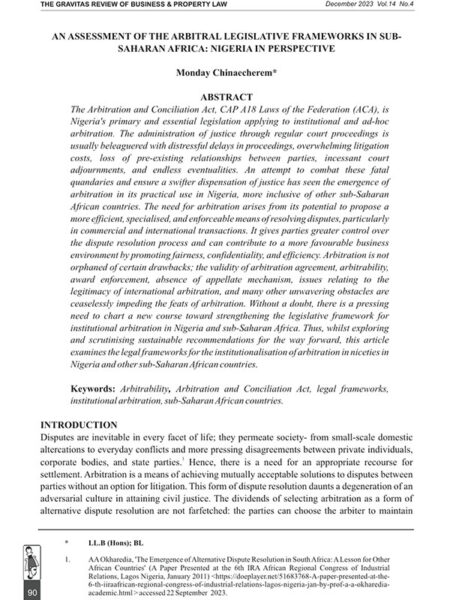
An Assessment of the Arbitral Legislative Frameworks in Sub-Saharan Africa: Nigeria in Perspective
0₦2,500.00Monday Chinaecherem, in his article, An Assessment of the Arbitral Legislative Frameworks in Sub-Saharan Africa: Nigeria in Perspective, undertakes an assessment of the legal framework for arbitral proceedings in sub-saharan Africa. He chronicles arbitral institutions in the region and extant legal reforms designed to increase the availability and choice of African destinations for commercial arbitration. He underscores a pressing need to chart a new course toward strengthening the legislative framework for institutional arbitration in Nigeria and sub-Saharan Africa. Chinaecherem whilst exploring and scrutinizing sustainable recommendations for the way forward examines in niceties, the legal frameworks for the institutionalization of arbitration in Nigeria and other sub-Saharan African countries.
-
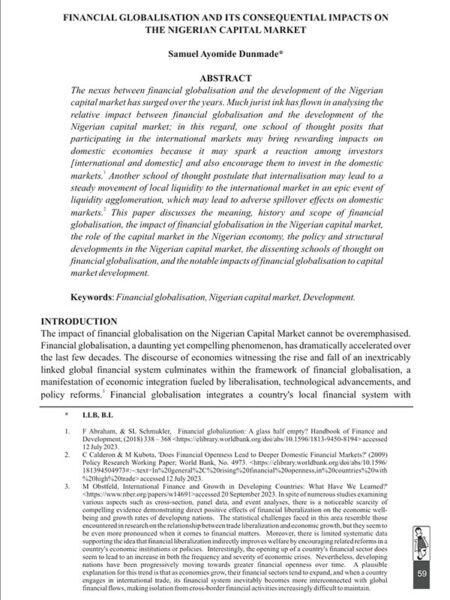
Financial Globalisation and its Consequential Impacts on the Nigerian Capital Market
0₦2,500.00Samuel Dunmade, in his article, Financial Globalisation and its Consequential Impacts on the Nigerian Capital Market, examines the concept of financial globalisation and its impact on the Nigerian capital market. The nexus between financial globalisation and the development of the Nigerian capital market has surged over the years. Much jurist ink has flown in analyzing the relative impact between financial globalisation and the development of the Nigerian capital market; in this regard, one school of thought posits that participating in the international markets may bring rewarding impacts on domestic economies, because it may spark a reaction among investors [international and domestic] and also encourage them to invest in the domestic markets. Another school of thought postulates that the internalization may lead to a steady movement of local liquidity to the international market in an epic event of liquidity agglomeration, which may lead to negative spill-over effects on domestic markets. Dunmade discusses the meaning, history and scope of financial globalization, the impact of financial globalisation in the Nigerian capital market, the role of capital market in the Nigerian economy, the policy and structural developments in the Nigerian capital market, the dissenting schools of thought on financial globalization, and the notable impacts of financial globalisation to capital market development.
-
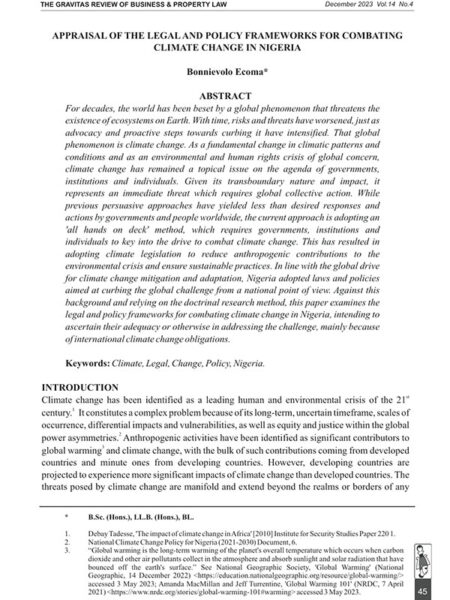
Appraisal of the Legal and Policy Frameworks for Combating Climate Change in Nigeria
0₦2,500.00Bonnievolo Ecoma, in this article, Appraisal of the Legal and Policy Frameworks for Combating Climate Change in Nigeria, appraises the legal and policy frameworks for combating climate change in Nigeria. For decades, the world has been beset by a global phenomenon that threatens the existence of ecosystems on Earth. With time, risks and threats have worsened, just as advocacy and proactive steps towards curbing it have intensified. That global phenomenon is climate change. As a fundamental change in climatic patterns and conditions, and as an environmental and human rights crisis of global concern, climate change has remained a topical issue on the agenda of governments, institutions, and individuals. Given its trans-boundary nature and impact, it represents an immediate threat which requires global collective action. While previous persuasive approaches have yielded less than desired responses and actions by governments and people around the world, the current approach is the adoption of an ‘all hands on deck’ method which requires governments, institutions and individuals to key into the drive to combat climate change. This has resulted in the adoption of climate legislation aimed at reducing anthropogenic contributions to the environmental crisis, and ensuring sustainable practices. In line with the global drive for climate change mitigation and adaptation, Nigeria adopted laws and policies aimed at curbing the global challenge from a national point of view. Against this background and relying on the doctrinal research method, Ecoma examines the legal and policy frameworks for combating climate change in Nigeria, with a view to ascertaining their adequacy or otherwise in addressing the challenge, especially in view of international climate change obligations.
The Gravitas Review of Business & Property Law