-
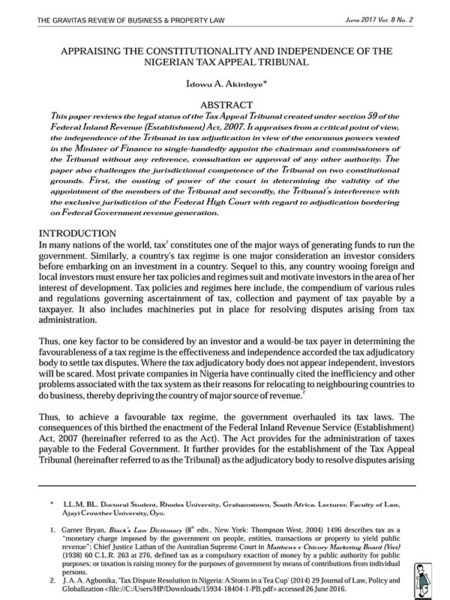
Appraising the Constitutionality and Independence of the Nigerian Tax Appeal Tribunal
0₦2,500.00Idowu Akinloye, of the Faculty of Law, Ajayi Crowther University, Oyo in “Appraising the Constitutionality and Independence of The Nigerian Tax Appeal Tribunal”, examines the jurisdictional competence of the Tax Appeal Tribunal and the constitutionality of its enabling statute, the Federal Inland Revenue Service (Establishment) Act 2007, on several grounds including the likelihood that the appointment of members by the Minister of Finance may not secure the tribunal’s independence and impartiality, ousting of the power of the court in questioning the validity of the appointment of the members offends section 4(8) of the 1999 Constitution, and adjudicating on taxation of companies offends section 251(1) of the Constitution that vests exclusive jurisdiction in such matters in the Federal High Court.
-
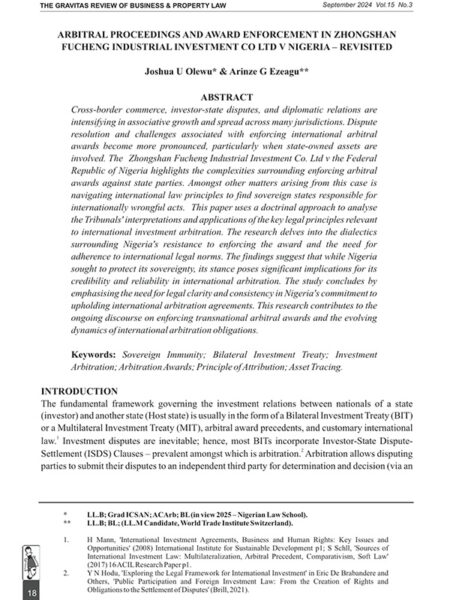
Arbitral Proceedings and Award Enforcement in Zhongshan Fucheng Industrial Investment Co Ltd v Nigeria – Revisited
0₦2,500.00Joshua Olewu and Arinze Ezeagu in their article, Arbitral Proceedings and Award Enforcement in Zhongshan Fucheng Industrial Investment Co Ltd v Nigeria – Revisited, examine jurisdictional issues arising from the enforcement of arbitral award in the celebrated case of Zhongshan Fucheng Industiral investment Co. Ltd v FRN. Cross-border commerce, investor-state disputes, and diplomatic relations are intensifying in associative growth and spread across many jurisdictions. Dispute resolution and challenges associated with enforcing international arbitral awards become more pronounced particularly when state-owned assets are involved. The case of Zhongshan Fucheng Industrial Investment Co. Ltd v Federal Republic of Nigeria highlights the complexities surrounding the enforcement of arbitral awards against state-parties. Amongst other matters arising from this case, is the navigation of international law principles to find sovereign states responsible for internationally wrongful acts. Using a doctrinal approach, Olewu and Ezeagu analyze the Tribunals’ interpretations and applications of the key legal principles relevant to international investment arbitration. The research delves into the dialectics surrounding Nigeria’s resistance to the enforcement of the award and the need for adherence to international legal norms. The findings suggest that while Nigeria sought to protect its sovereignty, its stance poses significant implications for its credibility and reliability in international arbitration. The study concludes by emphasizing the need for legal clarity and consistency in Nigeria’s commitment to upholding international arbitration agreements. This research contributes to the ongoing discourse on the enforcement of transnational arbitral awards and the evolving dynamics of international arbitration obligations.
-
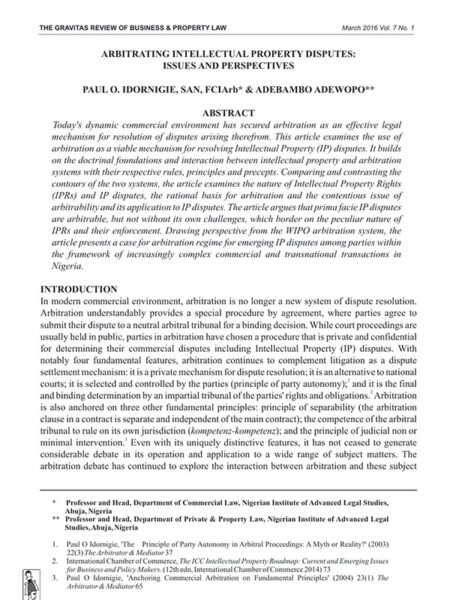
Arbitrating Intellectual Property Disputes: Issues and Perspectives
0₦2,500.00Professor Paul Idornigie, SAN & Professor Adebambo Adewopo, both of the Nigerian Institute of Advanced Legal Studies in their article, “Arbitrating Intellectual Property Disputes: Issues and Perspectives” examines the nature of Intellectual Property Rights (IPRs) and IP disputes, the rational basis for arbitration and the contentious issue of arbitrability and its application to IP disputes. The article argues that prima facie IP disputes are arbitrable, but not without its own challenges, which border on the peculiar nature of IPRs and their enforcement. Drawing perspective from the WIPO arbitration system, the article presents a case for arbitration regime for emerging IP disputes among parties within the framework of increasingly complex commercial and transnational transactions in Nigeria.
-
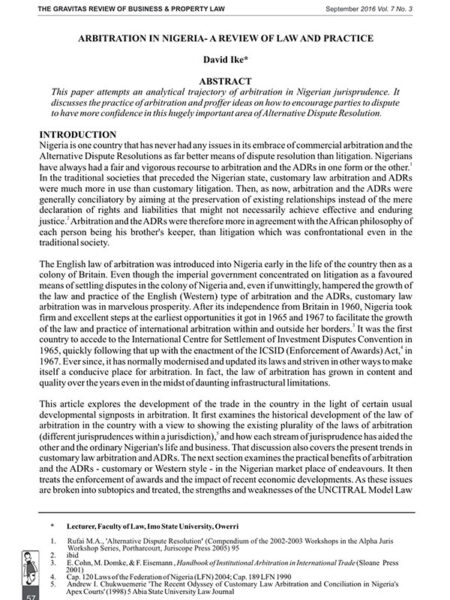
Arbitration in Nigeria – A Review of Law and Practice
0₦2,500.00David Ike, Lecturer, Faculty of Law, Imo State University, Owerri in his article “Arbitration in Nigeria-A Review of Law and Practice” gives an overview of the development of arbitration and its practice in Nigeria. He discusses current issues in arbitration including the constitutionality of section 34 of the Arbitration and Conciliation Act, pre-emptive court proceedings, recognition and enforcement of arbitral awards, and arbitrators’ fees.
-
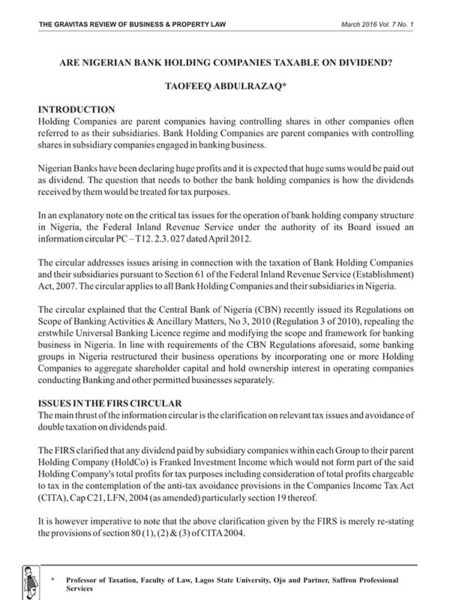
Are Nigerian Bank Holding Companies Taxable on Dividend?
0₦2,500.00Professor Taofeeq Abdulrazaq, Provost, Nigerian Academy of Taxation and Partner, Saffron Professional Services in his article “Are Nigerian Bank Holding Companies Taxable On Dividend?” examines the provisions of the Companies Income Tax Act and FIRS Circulars on Franked Investment Income and the liability of holding companies for tax on dividend paid by their subsidiary companies.
-
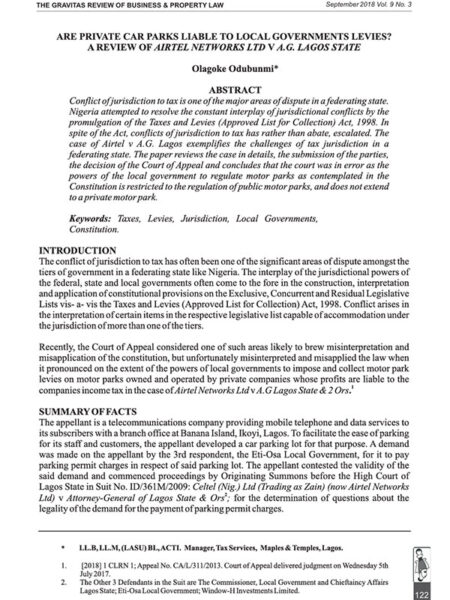
Are Private Car Parks Liable to Local Governments Levies? A Review of Airtel Networks Ltd v A.G. Lagos State
0₦2,500.00Olagoke Odubunmi, Manager Tax Services, Maples and Temples is his article, Are Private Car Parks Liable Local Governments Levies? A Review of Airtel Networks Ltd A.G. Lagos State observes that the conflict of jurisdiction to tax has often been one of the significant areas of dispute amongst the tiers of government in a federating state like Nigeria. The interplay of the jurisdictional powers of the federal, state and local governments often come to the fore in the construction, interpretation and application of constitutional provisions on the legislative powers of each tier. Odubunmi reviews the decision of the Court of Appeal in the Airtel’s case on the extent of the powers of local governments to impose and collect motor park levies on parks owned and operated by private companies for the benefit of their employees.
-
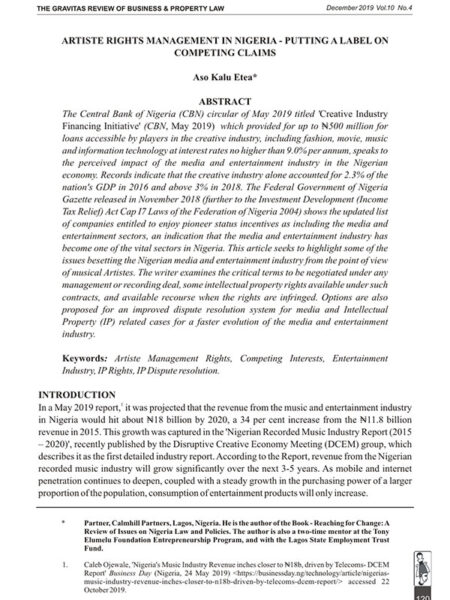
Artiste Rights Management in Nigeria – Putting A Label on Competing Claims
0₦2,500.00Aso Etea, Partner, Calmhill Partners, Lagos Nigeria in his article, Artiste Rights Management in Nigeria – Putting A Label on Competing Claims, reflects on the state of, and issues besetting, the creative industry in Nigeria. He graphically depicts ‘the making and breaking of careers’ of some artistes and what they ought to have done better. Aso examines the critical terms to be negotiated under any management or recording deal, intellectual property rights available under such contracts, and available recourse when the rights are infringed. He proposes an improved dispute resolution system for media and Intellectual Property (IP) related cases for faster evolution of the industry.
-
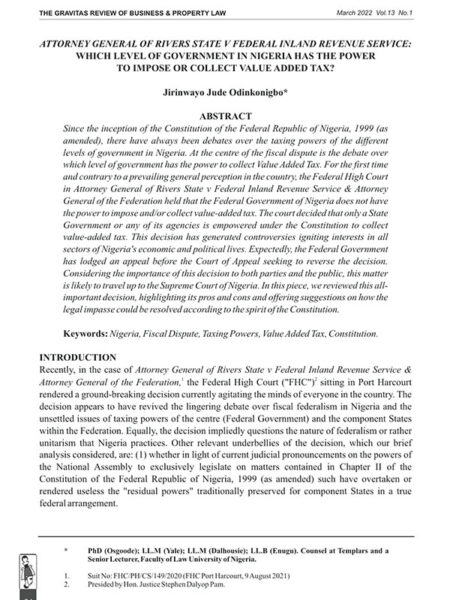
Attorney General of Rivers State v Federal Inland Revenue Service: Which Level of Government in Nigeria Has the Power to Impose or Collect Value Added Tax?
0₦2,500.00Dr Jirinwayo Jude Odinkonigbo of Templars and Faculty of Law University of Nigeria, in his article, Attorney General of Rivers State v Federal Inland Revenue Service: Which Level of Government in Nigeria Has the Power to Impose or Collect Value Added Tax?notes that since the inception of the 1999 Constitution of Nigeria, there have been debates over the taxing powers of the different levels of government, especially with regards to the Value Added Tax (VAT). For the first time and contrary to a prevailing general perception in the country, the Federal High Court in Attorney General of Rivers State v Federal Inland Revenue Service held that the Federal Government does not have the power to impose or collect VAT. The Court decided that only a State Government or its agency is empowered under the Constitution to collect VAT. Dr Odinkonigbo reviews this vital decision, highlighting its pros and cons and offering suggestions on how the legal impasse could be resolved according to the spirit of the Constitution.
-
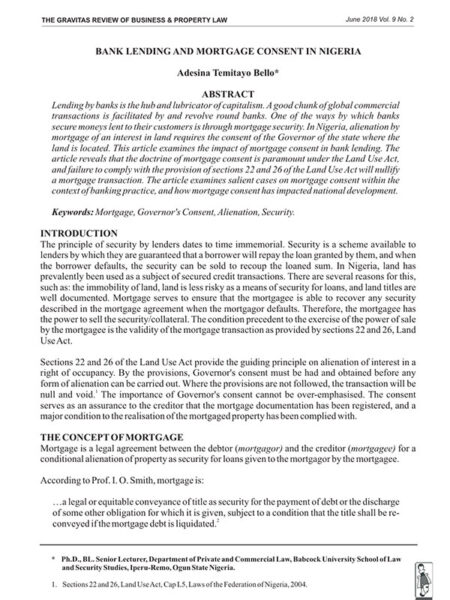
Bank Lending and Mortgage Consent in Nigeria
0₦2,500.00Dr. Adesina Bello, Senior Lecturer, Department of Private and Commercial Law, Babcock University Iperu-Remo in his article, Bank Lending and Mortgage Consent in Nigeria considers the judicial treatment of failure to comply with the provision of sections 22 and 26 of the Land Use Act (LUA) which makes unlawful, and indeed nullifies, any alienation of a right of occupancy without the consent of the Governor first had and obtained. He posits that the restrictive provision of the LUA, and the relative narrow interpretation by the courts may have contributed to the present cumbersome and bureaucratic process of loan documentation, frustration of the concept of securitization, and stifling of the mortgage business in Nigeria.
-
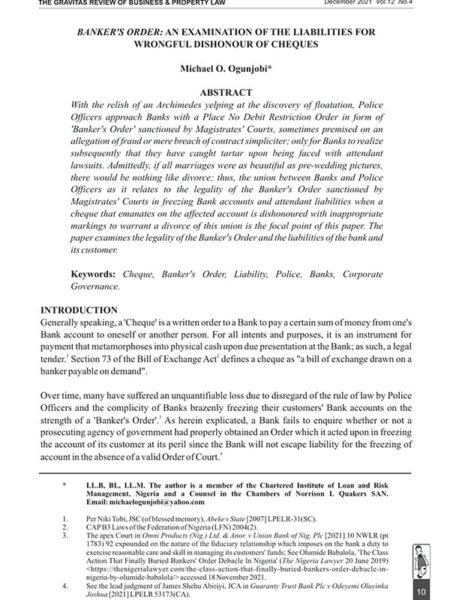
Banker’s Order: An Examination of the Liabilities for Wrongful Dishonour of Cheques
0₦2,500.00Michael Ogunjobi, of the Chambers of Norrison I. Quakers SAN, in his article, Banker’s Order: An Examination of the Liabilities for Wrongful Dishonour of Cheques, flays the practice by which Police Officers ‘freeze’ bank accounts acting on the so-called Banker’s Order’ issued by Magistrates. Ogunjobi examines the legality of the Banker’s Order, the bank’s customer’s liability for a dishonoured cheque and the reliefs the customer may pursue against the bank for a dishonoured cheque.
-
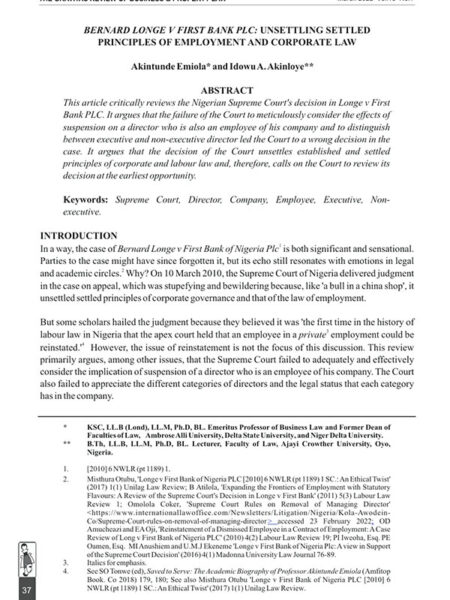
Bernard Longe v First Bank Plc: Unsettling Settled Principles of Employment and Corporate Law
0₦2,500.00Akintunde Emiola, Emeritus Professor of Business Law and Former Dean of Faculties of Law, Ambrose Alli University, Delta State University, and Niger Delta University, and Dr Idowu Akinloye of the Faculty of Law, Ajayi Crowther University, Oyo, Nigeria, in their article, Bernard Longe v First Bank Plc: Unsettling Settled Principles of Employment and Corporate Law, cast a second look at the celebrated Nigerian Supreme Court case. They argue that the failure of the Court to consider the effects of suspension on a director who is also an employee, and to distinguish between an executive and non-executive director led the Court to a wrong decision. Emiola and Akinloye argue that the decision of the Supreme Court unsettles established and settled principles of corporate and labour law and ought to be reviewed at the earliest opportunity.
-
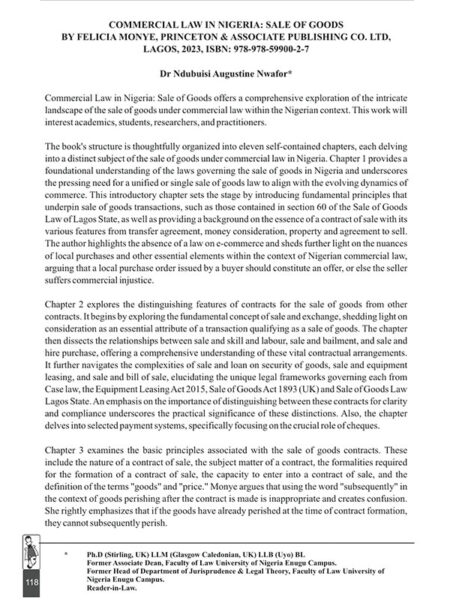
Book Review: Commercial Law in Nigeria: Sale of Goods
0₦2,500.00Dr. Ndubuisi Nwafor offers a comprehensive review of a work by a renowned author on Commercial Law in Nigeria. The Book – Commercial Law in Nigeria: Sale of Goods published in 2023 offers a comprehensive exploration of the intricate landscape of the sale of goods under commercial law within the Nigerian context. Structurally organised in eleven chapters, each delving into a distinct subject of sale of goods, the book offers a source of interesting reading by students, practitioners and members of the judiciary.
The Gravitas Review of Business & Property Law