-
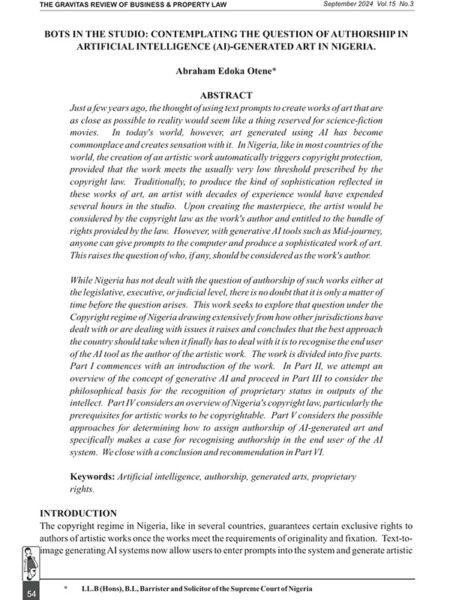
Bots in the Studio: Contemplating the Question of Authorship in Artificial Intelligence (AI)-Generated Art in Nigeria
0₦2,500.00Abraham Edoka Otene in his article, Bots in the Studio: Contemplating the Question of Authorship in Artificial Intelligence (AI)-Generated Art in Nigeria, explores the authorship of AI generated works under the Copyright regime of Nigeria drawing extensively from how other jurisdictions have dealt with or are dealing with issues it raises and concludes that the best approach the country should take when it finally has to deal with it is to recognize the end user of the AI tool as the author of the artistic work. Just a few years ago, the thought of using text prompts to create works of art that are as close as possible to reality would seem like a thing reserved for science-fiction movies. In today’s world, however, art generated using AI has not only become commonplace but is also creating sensation with it. While Nigeria has not dealt with the question of authorship of such works either at the legislative, executive, or judicial level, there is no doubt that it is only a matter of time before the question arises.
-
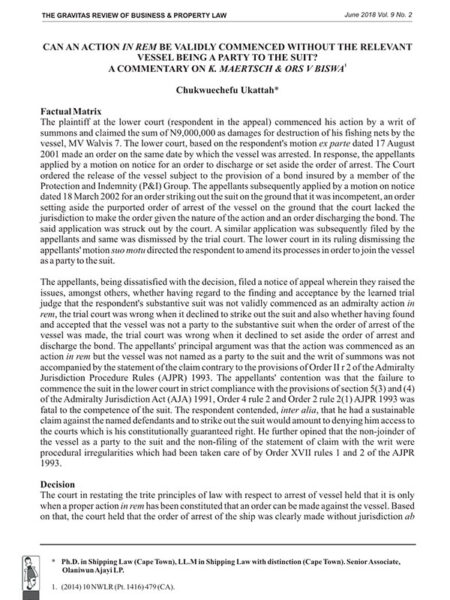
Can an Action In Rem be Validly Commenced Without the Relevant Vessel being A Party to the Suit? A Commentary on K. Maertsch & Ors v Biswa
0₦2,500.00Dr. Chukwuechefu Ukattah, Senior Associate, Olaniwun Ajayi LP asks a pertinent question in: Can an Action in Rem Be Validly Commenced Without The Relevant Vessel Being A Party To The Suit? A Commentary on K. Maertsch & Ors v Biswa. He reviews the decision of the Court of Appeal in the cited case, and using it as a background, explains the different types of admiralty actions and whether a proper action in rem can be constituted without the joinder of the vessel, and whether the non-joinder of the offending vessel in a suit for its arrest, is fatal to the action.
-
Carbon Taxation as a Lever for Advancing Environmental Pollution Control in Nigeria
0₦2,500.00Dr Kayode Oyende, Senior Lecturer, Department of Public and Private Law, Lagos State University, Nigeria in his article, Carbon Taxation as a Lever for Advancing Environmental Pollution Control in Nigeria, explains that a carbon tax is imposed on the price of carbon and its products, which have been established to be responsible for emissions arising from the burning of carbon products, thereby leading to the increase in Green House Gases. Dr Oyende notes that environmental pollution and degradation have arisen because of the indiscriminate destruction of the environment due to the anthropogenic activities of humans in their quest for development. These activities, if not checked, will lead to increased carbon emissions. Carbon taxation is one of the ways of checking this menace by imposing taxes on the production of these carbon-causing substances.
-
Case Scheduling and Management in Nigeria: Between the Rules and Practice – Order 22 of the Court of Appeal Rules in Focus
0₦2,500.00Dr Chukwuma Chinwo and Mondenghe Essien of the Amazing Grace Partners, Port Harcourt, Nigeria, in their article, Case Scheduling and Management in Nigeria: Between the Rules and Practice – Order 22 of the Court of Appeal Rules In Focus, note that the problem of delay in the administration of justice is a universal and age-old one. Many nations and jurisdictions have devised different methods by which they can curb the adverse effects. Chinwo and Essien review the problem in Nigeria, examine the constitutional provisions and identify some factors contributing to delay in the administration of justice. They proffer some solutions by examining Order 22 of the Court of Appeal Rules, 2021, which makes express provisions for case management and scheduling. They conclude that there is a lot to be done by the courts and other stakeholders in the justice delivery chain to attain the essence of the reforms anticipated by the rules.
-
Central Bank of Nigeria 2016 Guidelines for Banking Operations in the Free Zones: Need for Caution
0₦2,500.00Joseph Onele, Legal Practitioner, Olaniwun Ajayi LP in his article “Central Bank of Nigeria 2016 Guidelines for Banking Operations in The Free Zones: Need for Caution”, analyses the CBN Guidelines vis-à-vis the provisions of the Bank and Other Financial Institutions Act (BOFIA), and the Nigeria Export Processing Zones Act. Would branches of a bank with valid banking license be able to operate in the free trade zones or would an existing branch of a bank have to become a subsidiary of the parent bank to be able to operate? Can the CBN by its Guidelines extend the frontiers of BOFIA? Onele in his usual inimitable style considers all sides of the argument and urges a need for caution.
-
Challenges of Section 20 of the Admiralty Jurisdiction Act to International Arbitration Agreements
0₦2,500.00Abdulrazaq Daibu and Lukman Abdulrauf, Lecturers, Faculty of Law, University of Ilorin in “Challenges of Section 20 of the Admiralty Jurisdiction Act to International Arbitration Agreements” considers the interpretation of section 20 AJA by some courts and the challenges such an interpretation poses to parties ‘freedom of contract’ rights and maritime arbitration.
-
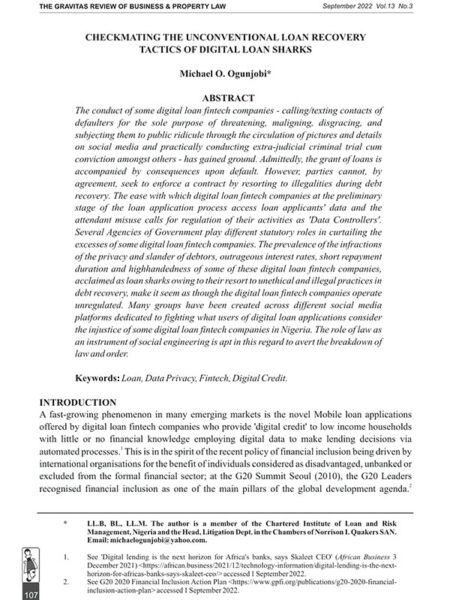
Checkmating the Unconventional Loan Recovery Tactics of Digital Loan Sharks
0₦2,500.00Michael Ogunjobi of the Chambers of Norrison I. Quakers SAN, and member of the Chartered Institute of Loan and Risk Management, Nigeria, in his article, Checkmating the Unconventional Loan Recovery Tactics of Digital Loan Sharks, notes that the conduct of some digital loan fintech companies – calling/texting contacts of defaulters for the sole purpose of threatening, accusing, disgracing, and subjecting them to public ridicule through the circulation of pictures and details on social media and practically conducting extra-judicial criminal trial cum conviction amongst others – has gained ground. Admittedly, the grant of loans is accompanied by consequences upon default. However, parties cannot, by agreement, seek to enforce a contract by resorting to illegalities during debt recovery. Ogunjobi examines the legal and regulatory framework of operation of digital loan fintech companies in Nigeria and steps that can be taken by both the authorities and consumers to checkmate their hideous loan recovery practices.
-
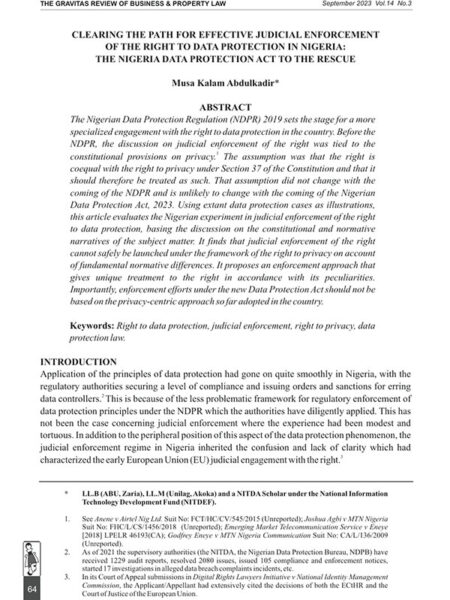
Clearing the Path for Effective Judicial Enforcement of the Right to Data Protection in Nigeria: The Nigeria Data Protection Act to the Rescue
0₦2,500.00Musa Kalam Abdulkadir, in his article, Clearing the Path for Effective Judicial Enforcement of the Right to Data Protection in Nigeria: The Nigeria Data Protection Act to the Rescue, examines the innovations introduced by the Nigerian Data Protection Regulation (NDPR) 2019, which sets the stage for the passing of the Nigerian Data Protection Act 2023. Before the NDPR, discussion on judicial enforcement of the right was tied to the constitutional provision on privacy. The assumption was that the right is co-equal with the right to privacy under Section 37 of the Constitution and that it should therefore be treated as such. That assumption did not change with the coming of the NDPR and is unlikely to change with the coming of the Nigerian Data Protection Act, 2023. Using extant data protection cases as illustration, this article evaluates the Nigerian experiment in judicial enforcement of the right to data protection, basing the discussion in the constitutional and normative narratives of the subject matter. It finds that judicial enforcement of the right cannot safely be launched under the framework of the right to privacy on account of fundamental normative differences. It proposes an enforcement approach that gives unique treatment to the right in accordance with its peculiarities. Importantly, enforcement efforts under the new Data Protection Act should not be based on the privacy-centric approach so far adopted in the country.
-
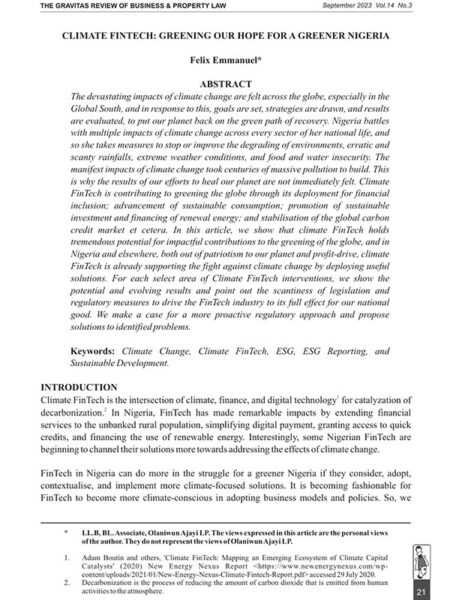
Climate Fintech: Greening Our Hope For A Greener Nigeria
0₦2,500.00Felix Emmanuel, in his article Climate Fintech: Greening Our Hope For A Greener Nigeria, unravels the relationship between the activities of fintechs and climate change. It shows that climate FinTech holds tremendous potentials of impactful contributions to the greening of the globe. It underscores the how climate FinTech are already supporting the fight against climate change by deploying useful solutions. For select areas of Climate FinTech interventions, the paper demonstrates the potentials and evolving results and point out the scantiness of legislation and regulatory measures to drive the FinTech industry to its full effect for our national good. Emmanuel makes a case for a more proactive regulatory approach and propose solutions identified problems.
-
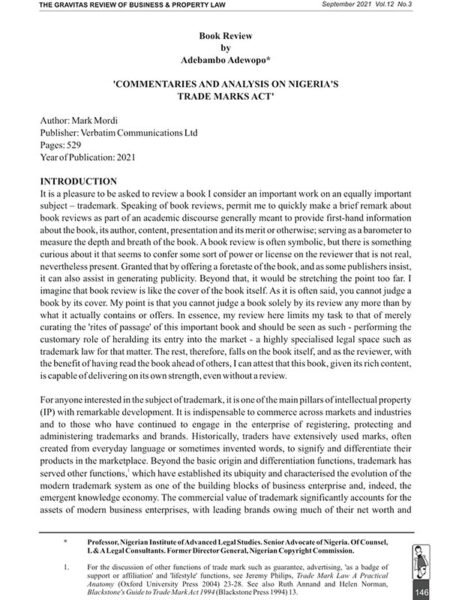
Commentaries and Analysis on Nigeria’s Trade Marks Act
0₦2,500.00Professor Adebambo Adewopo SAN, of the Nigerian Institute of Advanced Legal Studies, and former Director-General, Nigerian Copyright Commission in his brilliant review of Mark Mordi’s new book titled ‘Commentaries and Analysis on Nigeria’s Trade Marks Act’, highlights that the book, a practitioner’s companion, effectively combines the qualitative, quantitative, analytical and conceptual research models to explore the Trade Marks Act landscape.
-
Common Currency for ECOWAS: A Panacea for Regional Economic Development
0₦2,500.00Professor USF Nnabue, pioneer Dean, Faculty of Law, Imo State University and currently a Commissioner in the National Population Commission and Professor Henry Alisigwe of the Faculty of Law, Imo State University Owerri Nigeria, in their article, Common Currency for ECOWAS: A Panacea for Regional Economic Development, note the widespread acclaim that heralded the recent decision to launch a common currency, the ECO, in furtherance of the integrative efforts of the Economic Community of West African States (ECOWAS). They interrogate whether the common currency initiative is the sesame that will lead to enhanced regional economic development among member States of the ECOWAS. They argue that a common currency remains a potent instrument in harnessing the developmental potentials of ECOWAS member States and conclude that breathing life into the ECO currency will help in the mobility of goods and services within the ECOWAS region.
-
Compelling Non-Signatories to Arbitral Proceedings in Nigeria
0₦2,500.00Dr Lawal Ijaodola and Oluwaseun Oyekan, both formerly of G. Elias and now at the University of Oxford and Nottingham Trent University, United Kingdom, respectively, in their article, Compelling Non-Signatories to Arbitral Proceedings in Nigeria, note that the basis of any arbitration in Nigeria is a written agreement between two or more parties to resolve their disputes by arbitration. However, in the case of Metroline (Nig.) Ltd. v Dikko (Metroline), the Court of Appeal held that an arbitral award was binding on a non-signatory to the arbitration agreement. Dr Ijaodola and Oyekan appraise Metroline and conclude that the reasonings of the Court of Appeal are not justified by statutes or judicial precedent. They also examine instances where non-signatories may be compelled to arbitration in Nigeria and found none of them was present in Metroline. However, the authors note that the reasonings in Metroline could be salvaged by three principles which, although alien to Nigerian law, could justify the decision.
The Gravitas Review of Business & Property Law