-
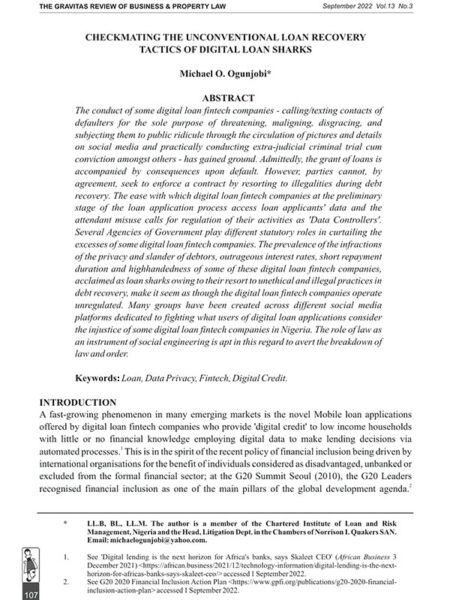
Checkmating the Unconventional Loan Recovery Tactics of Digital Loan Sharks
0₦2,500.00Michael Ogunjobi of the Chambers of Norrison I. Quakers SAN, and member of the Chartered Institute of Loan and Risk Management, Nigeria, in his article, Checkmating the Unconventional Loan Recovery Tactics of Digital Loan Sharks, notes that the conduct of some digital loan fintech companies – calling/texting contacts of defaulters for the sole purpose of threatening, accusing, disgracing, and subjecting them to public ridicule through the circulation of pictures and details on social media and practically conducting extra-judicial criminal trial cum conviction amongst others – has gained ground. Admittedly, the grant of loans is accompanied by consequences upon default. However, parties cannot, by agreement, seek to enforce a contract by resorting to illegalities during debt recovery. Ogunjobi examines the legal and regulatory framework of operation of digital loan fintech companies in Nigeria and steps that can be taken by both the authorities and consumers to checkmate their hideous loan recovery practices.
-
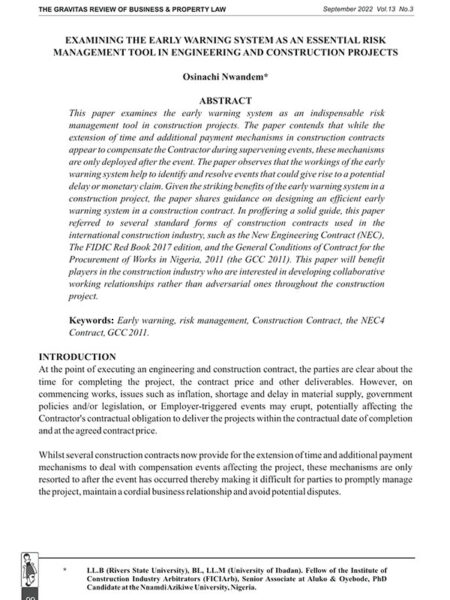
Examining the Early Warning System as an Essential Risk Management Tool in Engineering and Construction Projects
0₦2,500.00Osinachi Nwandem, Senior Associate Aluko & Oyebode and Fellow of the Institute of Construction Industry Arbitrators, in his article, Examining the Early Warning System as an Essential Risk Management Tool in Engineering and Construction Projects, considers the early warning system as an indispensable risk management tool in construction projects. He contends that while the extension of time and additional payment mechanisms in construction contracts appear to compensate the Contractor during supervening events, these mechanisms are only deployed after the event. Nwandem observes that the workings of the early warning system help to identify and resolve events that could give rise to a potential delay or monetary claim. Given the striking benefits of the early warning system in a construction project, he shares guidance on designing an efficient early warning system in a construction contract.
-
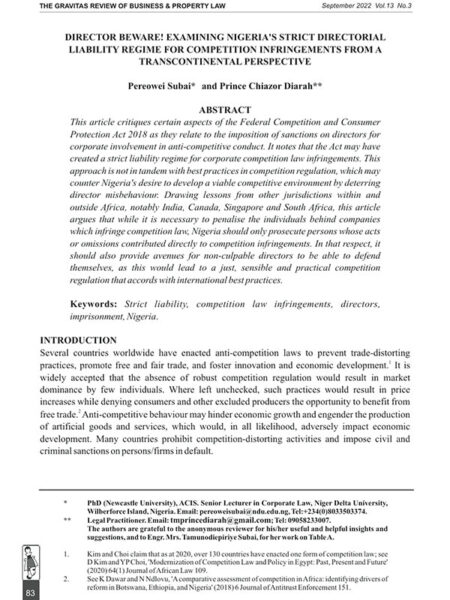
Director Beware! Examining Nigeria’s Strict Directorial Liability Regime for Competition Infringements from a Transcontinental Perspective
0₦2,500.00Dr Pereowei Subai, Senior Lecturer in Corporate Law at the Niger Delta University, Wilberforce Island, Nigeria and Prince Chiazor Diarah in their article, Director Beware! Examining Nigeria’s Strict Directorial Liability Regime for Competition Infringements from a Transcontinental Perspective, critique certain aspects of the Federal Competition and Consumer Protection Act 2018 (FCCPA) as they relate to the imposition of sanctions on directors for corporate involvement in anticompetitive conduct. They note that the FCCPA seems to have created a strict liability regime for corporate competition law infringements. This approach is not in tandem with best practices in competition regulation which may be counterproductive to Nigeria’s desire to develop a viable competitive environment by deterring directors’ misbehaviour. Drawing lessons from other jurisdictions within and outside Africa, the authors argue that while it is necessary to penalise the individuals behind companies which infringe competition law, Nigeria should only prosecute persons whose acts or omissions contributed directly to competition infringements.
-
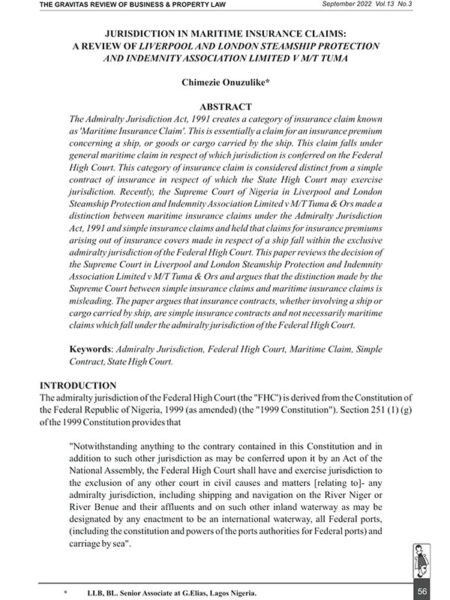
Jurisdiction in Maritime Insurance Claims: A Review of Liverpool and London Steamship Protection and Indemnity Association Limited V M/T Tuma
0₦2,500.00Chimezie Onuzulike, Senior Associate at G. Elias, in his article, Jurisdiction in Maritime Insurance Claims: A Review of Liverpool and London Steamship Protection and Indemnity Association Limited V M/T Tuma, explains that the Admiralty Jurisdiction Act 1991 creates a category of insurance claim known as ‘Maritime Insurance Claim’. This is essentially a claim for an insurance premium concerning a ship, or goods or cargo carried by the ship. This claim falls under general maritime claim in respect of which jurisdiction is conferred on the Federal High Court. This category of insurance claim is considered distinct from a simple contract of insurance in respect of which the State High Court may exercise jurisdiction. Recently, the Supreme Court of Nigeria in Liverpool and London Steamship Protection and Indemnity Association Limited v M/T Tuma made a distinction between maritime insurance claims under the Admiralty Jurisdiction Act 1991 and simple insurance claims and held that claims for insurance premiums arising out of insurance covers made in respect of a ship fall within the exclusive admiralty jurisdiction of the Federal High Court. Chimezie brilliantly reviews the decision of the Supreme Court in that case and argues that the distinction made by the Supreme Court between simple insurance claims and maritime insurance claims is misleading. He argues that insurance contracts, whether involving a ship or cargo carried by a ship, are simple insurance contracts and not necessarily maritime claims which fall under the admiralty jurisdiction of the Federal High Court.
-
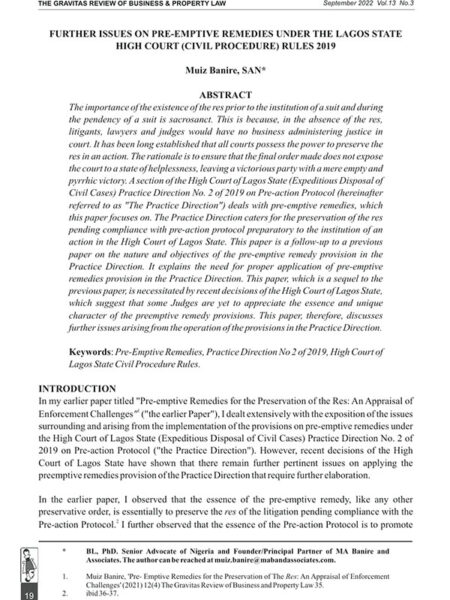
Further Issues on Pre-Emptive Remedies Under the Lagos State High Court (Civil Procedure) Rules 2019
0₦2,500.00Dr Muiz Banire SAN, Principal Partner of MA Banire and Associates, in his article, Further Issues on Pre-Emptive Remedies Under the Lagos State High Court (Civil Procedure) Rules 2019, notes the importance of the existence of the res prior to the institution of a suit and during its pendency. He explains that all courts possess the power to preserve the res in an action. The rationale is to ensure that the final order does not expose the court to a state of helplessness, leaving a victorious party with a mere empty and pyrrhic victory. A section of the High Court of Lagos State (Expeditious Disposal of Civil Cases) Practice Direction No. 2 of 2019 on Pre-action Protocol deals with pre-emptive remedies. Dr Banire, in the article, which is a sequel to the one published by The Gravitas Review in December 2021, explains the need for a proper application of preemptive remedies provision in the Practice Direction. He examines recent decisions of the High Court of Lagos State, which suggest that some Judges are yet to appreciate the essence and unique character of the preemptive remedy provisions.
-
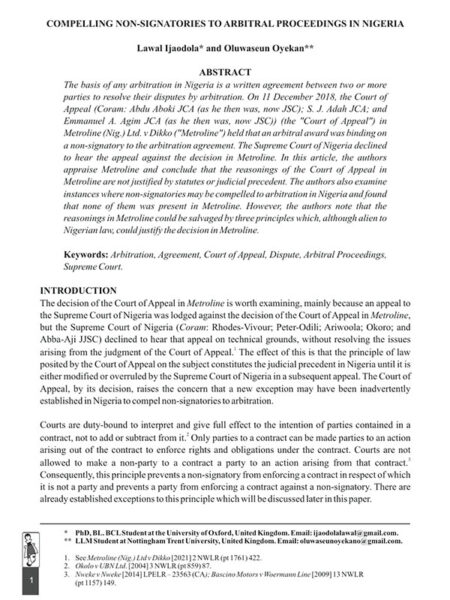
Compelling Non-Signatories to Arbitral Proceedings in Nigeria
0₦2,500.00Dr Lawal Ijaodola and Oluwaseun Oyekan, both formerly of G. Elias and now at the University of Oxford and Nottingham Trent University, United Kingdom, respectively, in their article, Compelling Non-Signatories to Arbitral Proceedings in Nigeria, note that the basis of any arbitration in Nigeria is a written agreement between two or more parties to resolve their disputes by arbitration. However, in the case of Metroline (Nig.) Ltd. v Dikko (Metroline), the Court of Appeal held that an arbitral award was binding on a non-signatory to the arbitration agreement. Dr Ijaodola and Oyekan appraise Metroline and conclude that the reasonings of the Court of Appeal are not justified by statutes or judicial precedent. They also examine instances where non-signatories may be compelled to arbitration in Nigeria and found none of them was present in Metroline. However, the authors note that the reasonings in Metroline could be salvaged by three principles which, although alien to Nigerian law, could justify the decision.
-
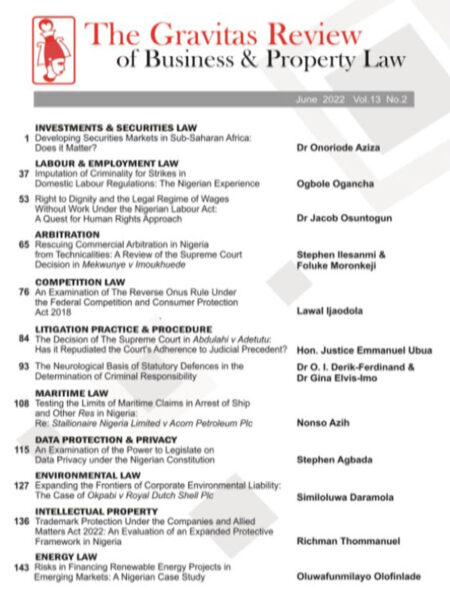
The Gravitas Review of Business & Property Law Vol.13 No.2 – Print
0₦5,000.00In this issue of The Gravitas Review of Business & Property Law Vol.13 No.2, there are well researched articles on:
- Investments & Securities Law
- Arbitration
- Competition Law
- Litigation Practice & Procedure
- Maritime Law
- Data Protection & Privacy
- Environmental Law
- Intellectual Property
- Energy Law
-
The Gravitas Review of Business & Property Law Vol.13 No.2 – E-Book
0₦5,000.00In this issue of The Gravitas Review of Business & Property Law Vol.13 No.2, there are well researched articles on:
- Investments & Securities Law
- Arbitration
- Competition Law
- Litigation Practice & Procedure
- Maritime Law
- Data Protection & Privacy
- Environmental Law
- Intellectual Property
- Energy Law
-
The Gravitas Review of Business & Property Law Vol.13 No.2
0₦5,000.00In this issue of The Gravitas Review of Business & Property Law Vol.13 No.2, there are well researched articles on:
- Investments & Securities Law
- Arbitration
- Competition Law
- Litigation Practice & Procedure
- Maritime Law
- Data Protection & Privacy
- Environmental Law
- Intellectual Property
- Energy Law
-
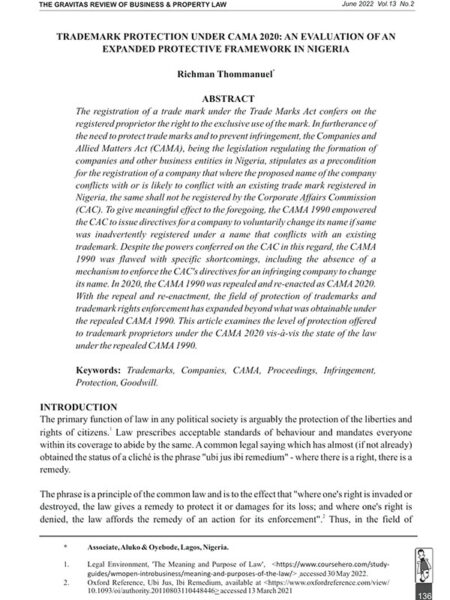
Trademark Protection Under the Companies and Allied Matters Act 2020: An Evaluation of an Expanded Protective Framework in Nigeria
0₦2,500.00Richman Thommanuel, Associate, Aluko & Oyebode, in his article, Trademark Protection Under the Companies and Allied Matters Act 20202: An Evaluation of an Expanded Protective Framework in Nigeria, explains that in furtherance of the need to protect trademarks and prevent infringement, the Companies and Allied Matters Act (CAMA) stipulates as a precondition for the registration of a company, that where the proposed name of the company conflicts with or is likely to conflict with an existing trade mark registered in Nigeria, the name shall not be registered by the Corporate Affairs Commission (CAC). To give meaning to the provision, the CAMA 1990 empowered the CAC to issue directives for a company to voluntarily change its name if the same was inadvertently registered under a name that conflicts with an existing trademark. Despite the powers conferred on the CAC in this regard, the CAMA 1990 was flawed with shortcomings, including the absence of a mechanism to enforce the CAC’s directives for an infringing company to change its name. This lacuna has been addressed by CAMA 2020. Richman examines the expanded protective framework under the re-enacted CAMA.
-
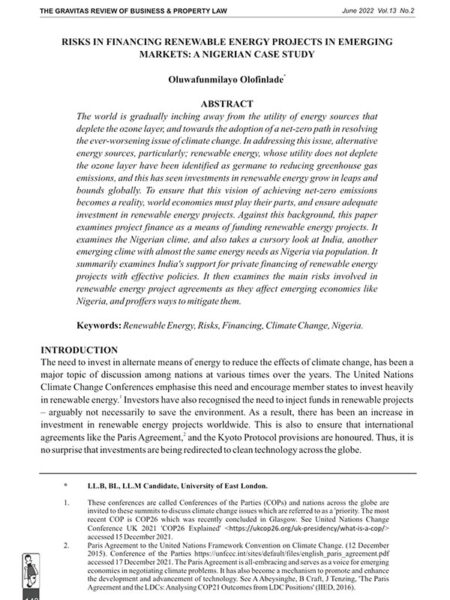
Risks in Financing Renewable Energy Projects in Emerging Markets: A Nigerian Case Study
0₦2,500.00Oluwafunmilayo Olofinlade of the University of East London UK, in her paper, Risks in Financing Renewable Energy Projects in Emerging Markets: A Nigerian Case Study, notes that the world is inching away from the use of energy sources that deplete the ozone layer and towards the adoption of a net-zero path in resolving the ever-worsening issue of climate change. Alternative energy sources whose utility does not deplete the ozone layer have been identified as germane to reducing greenhouse gas emissions. This has seen remarkable investments in renewable energy globally. Oluwafunmilayo examines renewable energy financing in Nigeria. She considers the main risks involved in renewable energy project agreements as they affect emerging economies like Nigeria and proffers ways to mitigate them.
-
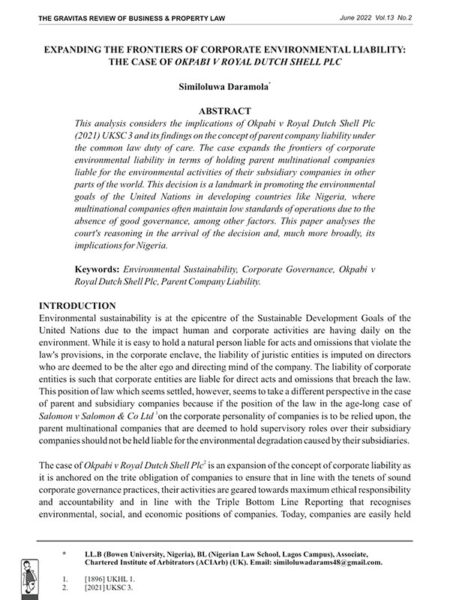
Expanding the Frontiers of Corporate Environmental Liability: The Case of Okpabi v Royal Dutch Shell Plc
0₦2,500.00Similoluwa Daramola, in her paper, Expanding the Frontiers of Corporate Environmental Liability: The Case of Okpabi v Royal Dutch Shell Plc, which reviews the English case, considers the implications of the case and the court’s decision on the concept of the parent company liability under the common law duty of care. The case expands the frontiers of corporate environmental liability in terms of holding parent multinational companies liable for the environmental activities of their subsidiary companies in other parts of the world. Similoluwa argues that the decision is vital in promoting the environmental goals of the United Nations in developing countries like Nigeria, where multinational companies often maintain lower standards of operations.
The Gravitas Review of Business & Property Law