-
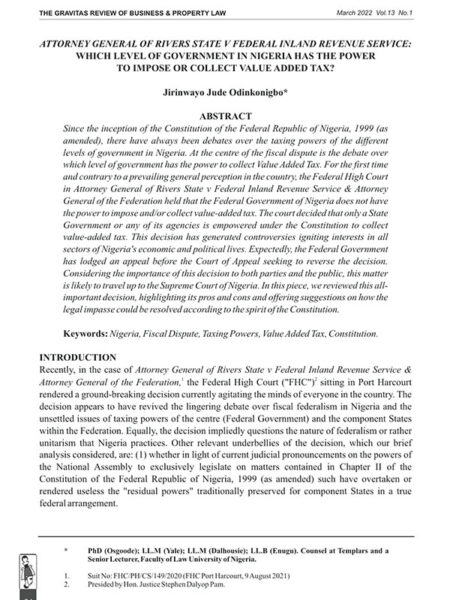
Attorney General of Rivers State v Federal Inland Revenue Service: Which Level of Government in Nigeria Has the Power to Impose or Collect Value Added Tax?
0₦2,500.00Dr Jirinwayo Jude Odinkonigbo of Templars and Faculty of Law University of Nigeria, in his article, Attorney General of Rivers State v Federal Inland Revenue Service: Which Level of Government in Nigeria Has the Power to Impose or Collect Value Added Tax?notes that since the inception of the 1999 Constitution of Nigeria, there have been debates over the taxing powers of the different levels of government, especially with regards to the Value Added Tax (VAT). For the first time and contrary to a prevailing general perception in the country, the Federal High Court in Attorney General of Rivers State v Federal Inland Revenue Service held that the Federal Government does not have the power to impose or collect VAT. The Court decided that only a State Government or its agency is empowered under the Constitution to collect VAT. Dr Odinkonigbo reviews this vital decision, highlighting its pros and cons and offering suggestions on how the legal impasse could be resolved according to the spirit of the Constitution.
-
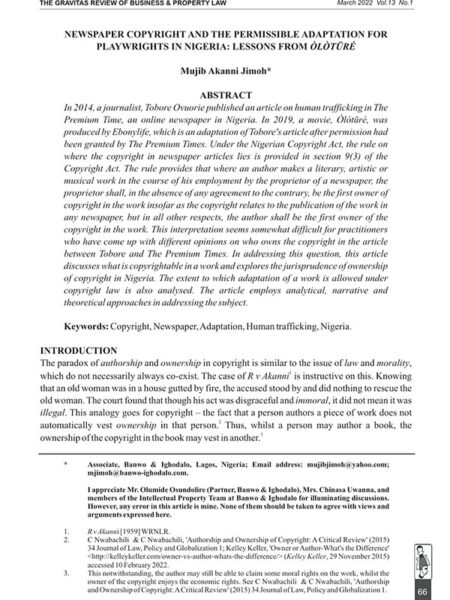
Newspaper Copyright and the Permissible Adaption for Playwrights in Nigeria: Lessons from Òlòtūré
0₦2,500.00Mujib Jimoh, Associate, Banwo & Ighodalo, Lagos, Nigeria, in his article, Newspaper Copyright and the Permissible Adaption for Playwrights in Nigeria: Lessons from Òlòtūré, explains that in 2014, a journalist, Tobore Ovuorie published an article on human trafficking in The Premium Times, an online newspaper in Nigeria. In 2019, a movie, Òlòtūré, which became a Netflix blockbuster, was produced by Ebonylife, which is an adaptation of Tobore’s article after permission had been granted by The Premium Times. Tobore posited that she ought to grant the permission. Under the Nigerian Copyright Act, the rule on where the copyright in newspaper articles lies is provided in section 9(3). There were differing interpretations of section 9(3) by practitioners. In this brilliant article, Mujib dissects the differing claims and interpretations. He discusses what is copyrightable in a work, the jurisprudence of ownership of copyright in Nigeria, and the extent to which adaptation of a work is allowed under copyright law.
-
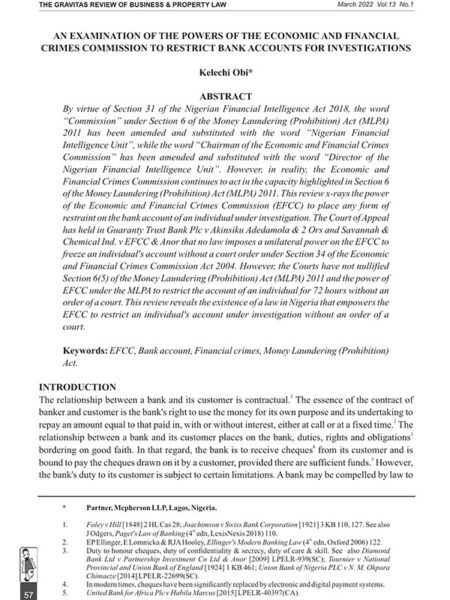
An Examination of the Powers of the Economic and Financial Crimes Commission to Restrict Bank Accounts for Investigations
0₦2,500.00Kelechi Obi, Partner, McPherson LLP, Lagos, Nigeria, in his article, An Examination of the Powers of the Economic and Financial Crimes Commission to Restrict Bank Accounts for Investigations, considers the provisions of the Nigerian Financial Intelligence Act 2018, the Money Laundering (Prohibition) Act 2011 (as amended), the Economic and Financial Crimes Commission Act 2004 in x-raying the powers of the EFCC to place restraint on the bank account of an individual under investigation. Kelechi reviews two crucial decisions of the Court of Appeal on the issue and concludes that there is a law that empowers the EFCC to restrict an individual’s account under investigation without an order of a court.
-
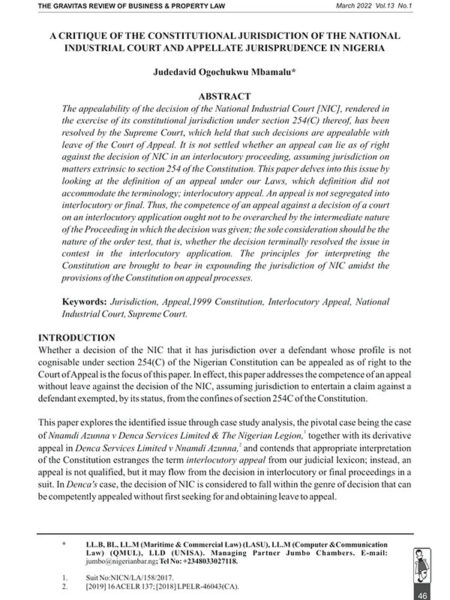
A Critique of the Constitutional Jurisdiction of the National Industrial Court and Appellate Jurisprudence in Nigeria
0₦2,500.00Dr Judedavid Mbamalu, Managing Partner of Jumbo Chambers, in his paper, A Critique of the Constitutional Jurisdiction of the National Industrial Court and Appellate Jurisprudence in Nigeria, argues that while the appealability of the decision of the National Industrial Court (NIC), rendered in the exercise of its jurisdiction under section 254(C) of the 1999 Constitution of Nigeria has been resolved by the Supreme Court, it is not settled whether an appeal can lie as of right against the decision of the NIC in an interlocutory proceeding, assuming jurisdiction on matters extrinsic to section 254. Dr Mbamalu argues that the segregation of appeals into ‘interlocutory’ and ‘final’ is unknown to ‘our Statutes and Rules of Court’, and the competence of an appeal against a decision of a court on an interlocutory application ought not to be overarched by the intermediate nature of the Proceeding in which the decision was given. He elaborates on the principles for interpreting the Constitution in expounding the jurisdiction of the NIC amidst the provisions of the Constitution on appeal processes.
-
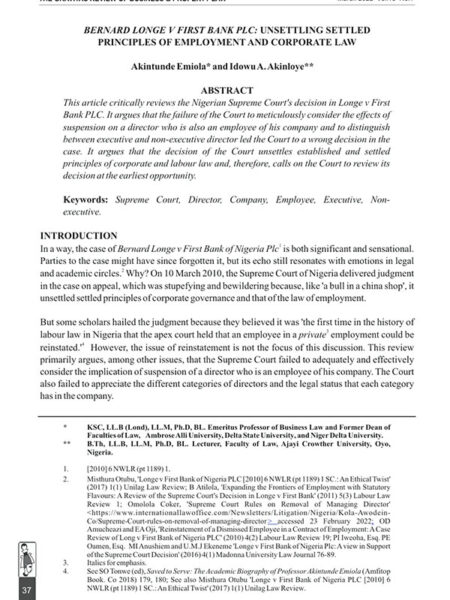
Bernard Longe v First Bank Plc: Unsettling Settled Principles of Employment and Corporate Law
0₦2,500.00Akintunde Emiola, Emeritus Professor of Business Law and Former Dean of Faculties of Law, Ambrose Alli University, Delta State University, and Niger Delta University, and Dr Idowu Akinloye of the Faculty of Law, Ajayi Crowther University, Oyo, Nigeria, in their article, Bernard Longe v First Bank Plc: Unsettling Settled Principles of Employment and Corporate Law, cast a second look at the celebrated Nigerian Supreme Court case. They argue that the failure of the Court to consider the effects of suspension on a director who is also an employee, and to distinguish between an executive and non-executive director led the Court to a wrong decision. Emiola and Akinloye argue that the decision of the Supreme Court unsettles established and settled principles of corporate and labour law and ought to be reviewed at the earliest opportunity.
-
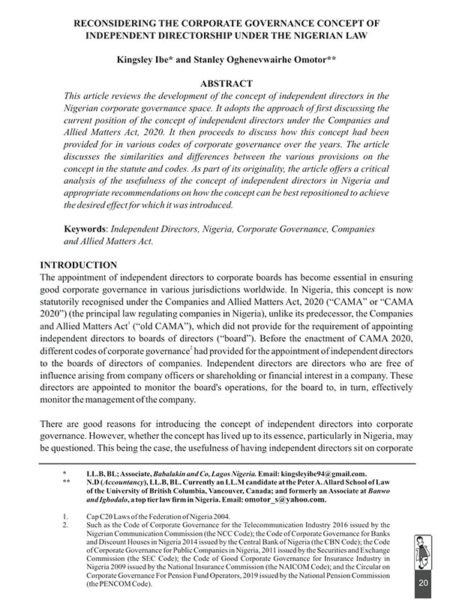
Reconsidering the Corporate Governance Concept of Independent Directorship Under Nigerian Law
0₦2,500.00Kingsley Ibe, Associate at Babalakin & Co and Stanley Omotor, formerly of Banwo and Ighodalo and now an LL.M candidate at the Peter A. Allard School of Law of the University of British Columbia, Canada, in their article, Reconsidering the Corporate Governance Concept of Independent Directorship Under Nigerian Law, note that the concept of independent directorship is now statutorily recognised under the Companies and Allied Matters Act, 2020. Ibe and Omotor review the development of the concept of independent directors in the Nigerian corporate governance space. They examine the regulatory framework for independent directors in Nigeria, the various corporate governance codes, the similarities and differences between the various provisions in the statute and codes. They offer a critical analysis of the usefulness of the concept of independent directors in Nigeria, and recommendations on how the concept can be best repositioned to achieve the desired effect.
-
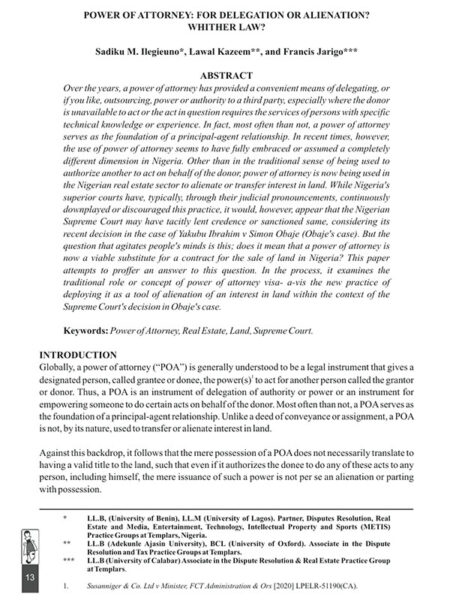
Power of Attorney: For Delegation or Alienation? Whither Law?
0₦2,500.00Sadiku Ilegieuno, Lawal Kazeem and Francis Jarigo, all of Templars, Nigeria, in their article, Power of Attorney: For Delegation or Alienation? Whither Law? note that other than using a power of attorney in the traditional sense to authorize a donee to act on behalf of a donor, power of attorney is now being used in the Nigerian real estate sector to alienate or transfer interest in land. While Nigeria’s superior courts have downplayed or discouraged this practice through their judicial pronouncements, Nigerian Supreme Court may have tacitly lent credence or sanctioned the practice, considering its recent decision in the case of Yakubu Ibrahim v Simon Obaje. Ilegieuno et al. consider whether a power of attorney is now a viable substitute for a contract for the sale of land in Nigeria. They examine the traditional role of the power of attorney vis- a-vis the new practice of deploying it as a tool of alienation of an interest in land within the context of the Supreme Court’s decision in Obaje’s case.
-
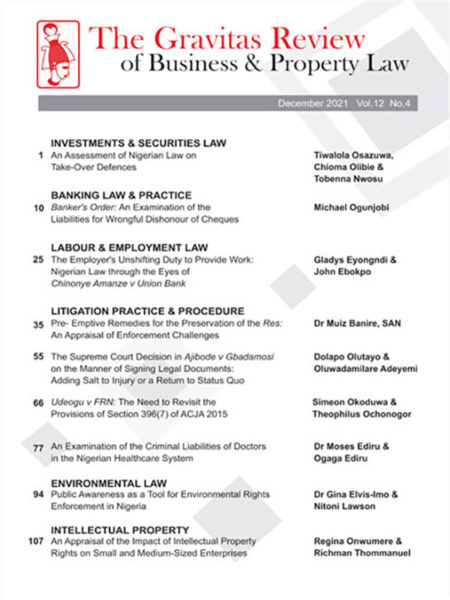
The Gravitas Review of Business & Property Law Vol.12 No.4 – Print
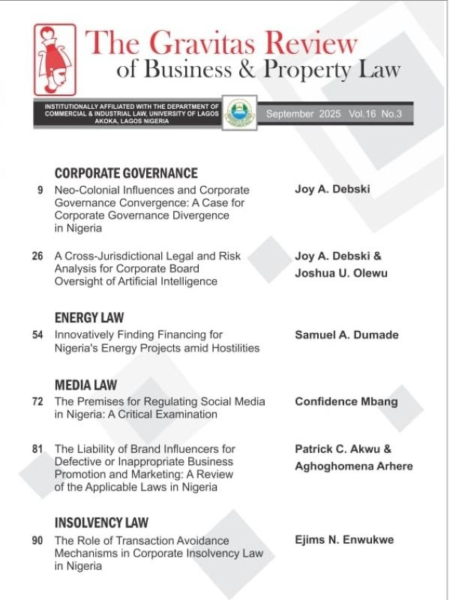
0₦5,000.00In this issue of The Gravitas Review of Business & Property Law Vol.12 No.4, there are well researched articles on:
- Investments & Securities Law
- Banking Law
- Litigation Practice & Procedure
- Environmental Law
- Labour & Employment Law
- Intellectual Property
-
The Gravitas Review of Business & Property Law Vol.12 No.4 – E-Book
0₦5,000.00In this issue of The Gravitas Review of Business & Property Law Vol.12 No.4, there are well researched articles on:
- Investments & Securities Law
- Banking Law
- Litigation Practice & Procedure
- Environmental Law
- Labour & Employment Law
- Intellectual Property
-
The Gravitas Review of Business & Property Law Vol.12 No.4
0₦5,000.00In this issue of The Gravitas Review of Business & Property Law Vol.12 No.4, there are well researched articles on:
- Investments & Securities Law
- Banking Law
- Litigation Practice & Procedure
- Environmental Law
- Labour & Employment Law
- Intellectual Property
-
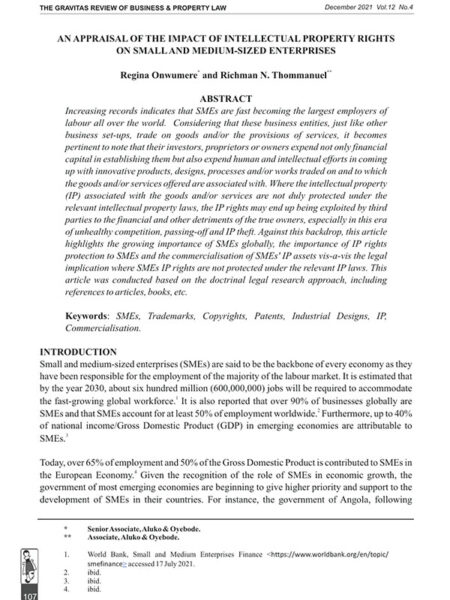
An Appraisal of the Impact of Intellectual Property Rights on Small and Medium-Sized Enterprises
0₦2,500.00Regina Onwumere and Richman Thommanuel, both of Aluko & Oyebode, in their article, An Appraisal of the Impact of Intellectual Property Rights on Small and Medium-Sized Enterprises, indicate that small and medium-sized enterprises (SMEs) are fast becoming the largest employers of labour all over the world. Where the intellectual property (IP) associated with the goods or services produced by SMEs are not duly protected under the relevant intellectual property laws, the IP rights may end up being exploited by third parties to the detriment of the true owners. Against this backdrop, the authors highlight the growing importance of SMEs globally, the importance of IP rights protection to SMEs and the commercialisation of SMEs’ IP assets vis-a-vis the legal implication where SMEs IP rights are not protected under the relevant IP laws.
-
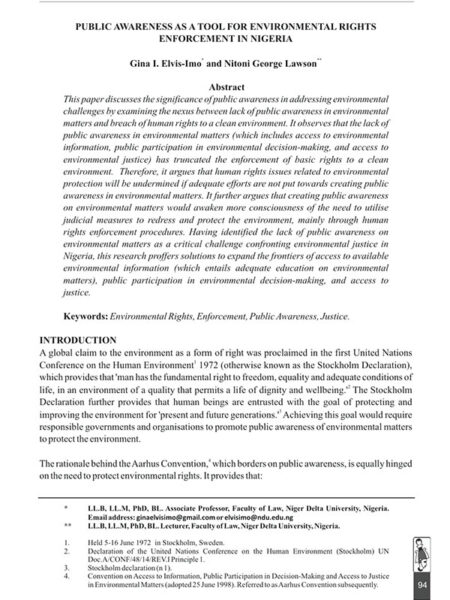
Public Awareness as a Tool for Environmental Rights Enforcement in Nigeria
0₦2,500.00Dr Gina Elvis-Imo and Nitoni Lawson, Associate Professor and Lecturer respectively, at the Niger Delta University, in their article, Public Awareness as a Tool for Environmental Rights Enforcement in Nigeria, discuss the significance of public awareness in addressing environmental challenges by examining the nexus between lack of public awareness in environmental matters and breach of human rights to a clean environment. They argue that human rights issues related to environmental protection will be undermined if adequate efforts are not put towards creating public awareness in environmental matters. Creating public awareness on environmental matters would awaken more awareness of the need to use judicial measures to redress and protect the environment. They then proffer solutions to expand the frontiers of access to available environmental information, public participation in environmental decision-making, and access to justice.
The Gravitas Review of Business & Property Law