-
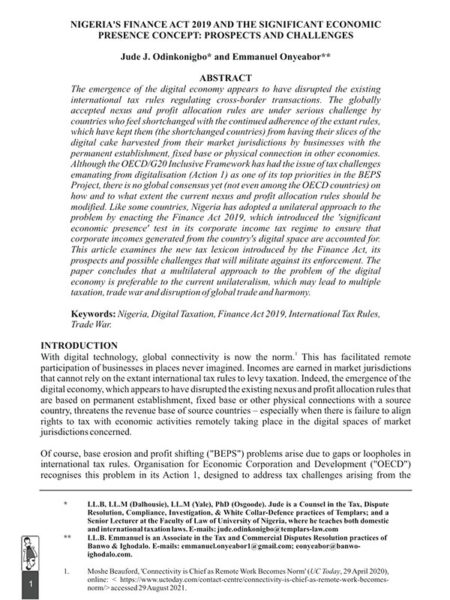
Nigeria’s Finance Act 2019 and the Significant Economic Presence Concept: Prospects and Challenges
0₦2,500.00Dr Jude Odinkonigbo of Templars, and a Senior Lecturer at the Faculty of Law University of Nigeria, and Emmanuel Onyeabor of Banwo & Ighodalo, in their article, Nigeria’s Finance Act 2019 and the Significant Economic Presence Concept: Prospects and Challenges, note that the emergence of the digital economy has significantly disrupted the existing international tax rules regulating cross-border transactions. They examine how Nigeria has tried to solve this problem by enacting the Finance Act 2019, which introduced the ‘significant economic presence’ test, with the objectives of ensuring that corporate incomes generated from Nigeria’s digital space are liable to tax. They note Nigeria’s unilateral adoption of the OECD ‘Significant Economic Presence Test’ on the taxation of Non-Resident Companies (NRCs) in the Finance Act. They consider the prospects and challenges the country might have enforcing the taxation of NRCs operating in the country’s digital space, including the possibility of retaliatory measures by other countries. They conclude with suggestions on how to enforce the provisions of the Finance Act.
-
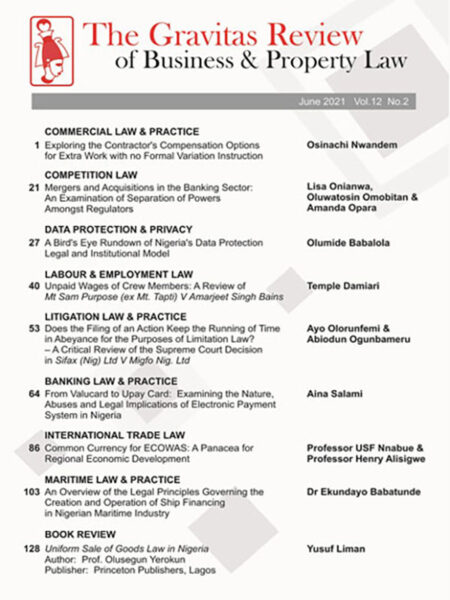
The Gravitas Review of Business & Property Law Vol.12 No.2 – Print
0₦5,000.00In this issue of The Gravitas Review of Business & Property Law Vol.12 No.2, there are well researched articles on:
- Commercial Law & Practice
- Competition Law
- Labour & Employment Law
- Litigation Law & Practice
- Banking Law & Practice
- International Trade Law
- Maritime Law & Practice
- Book Review
-
The Gravitas Review of Business & Property Law Vol.12 No.2 – E-Book
0₦5,000.00In this issue of The Gravitas Review of Business & Property Law Vol.12 No.2, there are well researched articles on:
- Commercial Law & Practice
- Competition Law
- Labour & Employment Law
- Litigation Law & Practice
- Banking Law & Practice
- International Trade Law
- Maritime Law & Practice
- Book Review
-
The Gravitas Review of Business & Property Law Vol.12 No.2
0₦5,000.00In this issue of The Gravitas Review of Business & Property Law Vol.12 No.2, there are well researched articles on:
- Commercial Law & Practice
- Competition Law
- Labour & Employment Law
- Litigation Law & Practice
- Banking Law & Practice
- International Trade Law
- Maritime Law & Practice
- Book Review
-
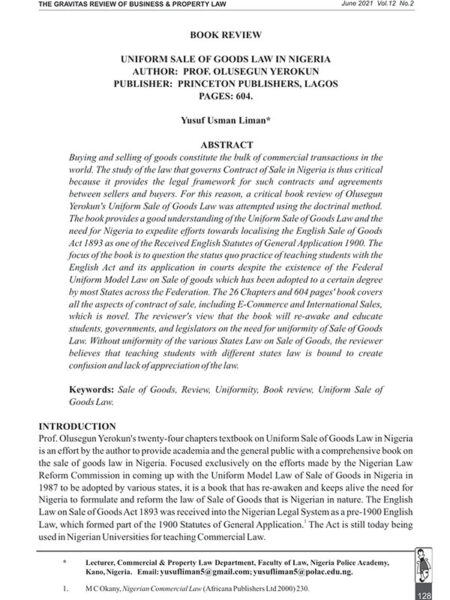
Uniform Sale of Goods Law in Nigeria by Prof. Olusegun Yerokun
0₦2,500.00Yusuf Usman Liman, Lecturer, Faculty of Law, Nigeria Police Academy, Kano Nigeria, reviews the book, Uniform Sale of Goods Law in Nigeria by Prof. Olusegun Yerokun, highlighting that the book provides a good understanding of the need for concerted efforts towards uniformity of the Federal and State Laws on Sale of Goods. Using the review as a backdrop, Liman examines the current state of the law with regards to the status of the Sale of Goods Act 1893, an English Statute of General Application.
-
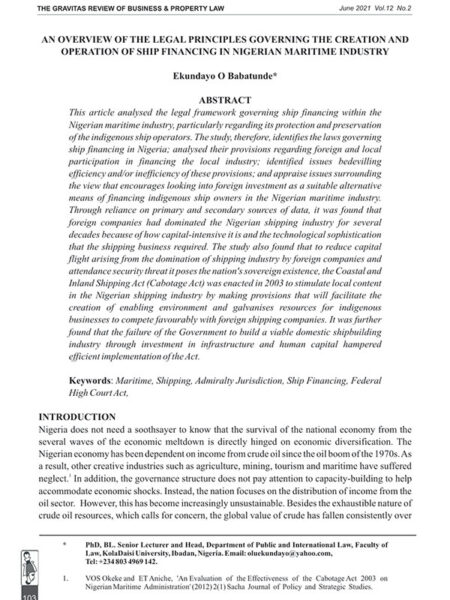
An Overview of the Legal Principles Governing the Creation and Operation of Ship Financing in Nigerian Maritime Industry
0₦2,500.00Dr Ekundayo Babatunde, Senior Lecturer, Faculty of Law, KolaDaisi University Ibadan Nigeria, in his article, An Overview of the Legal Principles Governing the Creation and Operation of Ship Financing in Nigerian Maritime Industry, analyses the legal framework governing ship financing in the Nigerian maritime industry. He considers laws governing ship financing in Nigeria with particular attention to foreign and local participation in the maritime industry. Babatunde explores global best practices on the protection of local maritime industry, Nigeria’s experience with Cabotage and other burning issues in the Nigerian maritime industry.
-
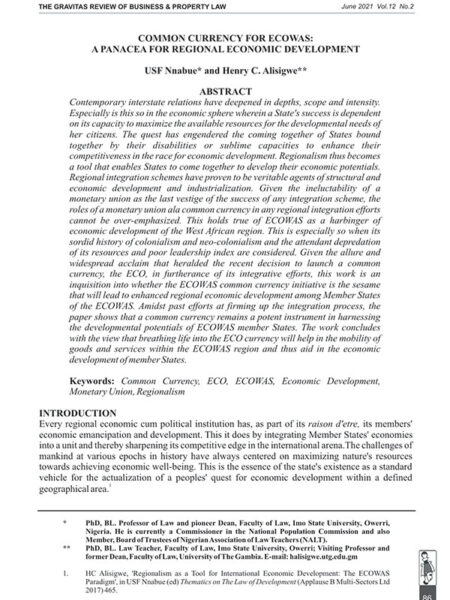
Common Currency for ECOWAS: A Panacea for Regional Economic Development
0₦2,500.00Professor USF Nnabue, pioneer Dean, Faculty of Law, Imo State University and currently a Commissioner in the National Population Commission and Professor Henry Alisigwe of the Faculty of Law, Imo State University Owerri Nigeria, in their article, Common Currency for ECOWAS: A Panacea for Regional Economic Development, note the widespread acclaim that heralded the recent decision to launch a common currency, the ECO, in furtherance of the integrative efforts of the Economic Community of West African States (ECOWAS). They interrogate whether the common currency initiative is the sesame that will lead to enhanced regional economic development among member States of the ECOWAS. They argue that a common currency remains a potent instrument in harnessing the developmental potentials of ECOWAS member States and conclude that breathing life into the ECO currency will help in the mobility of goods and services within the ECOWAS region.
-
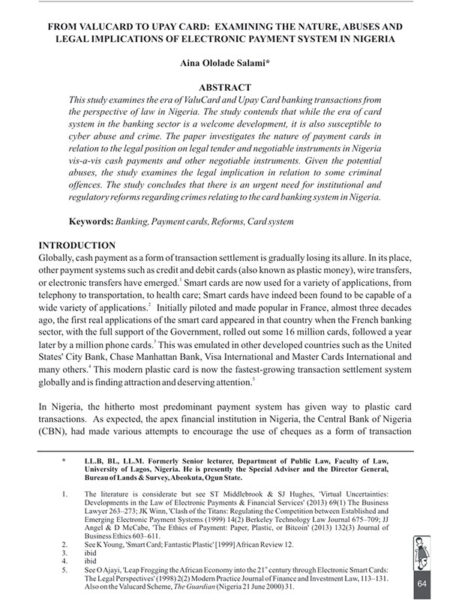
From Valucard to Upay Card: Examining the Nature, Abuses and Legal Implications of Payment Cards in Nigeria
0₦2,500.00Aina Salami, formerly Senior lecturer, Department of Public Law, University of Lagos and presently the Director-General, Bureau of Lands & Survey Ogun State, in his article, From Valucard to Upay Card: Examining the Nature, Abuses and Legal Implications of Payment Cards in Nigeria, examines the legal nature, types and abuses of payment cards in Nigeria. Given the potential abuses of card transactions, Salami explores some criminal offences relating to card transaction and advocates urgent institutional and regulatory reforms to accommodate global trends in payment systems.
-
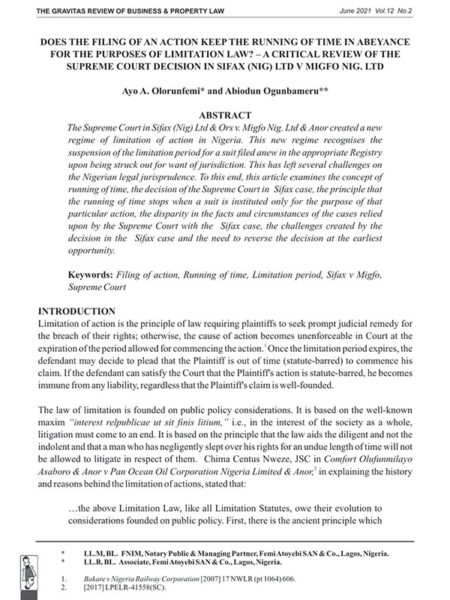
Does the Filing of an Action Keep the Running of Time in Abeyance for the Purposes of Limitation Law? – A Critical Review of the Supreme Court Decision in Sifax (Nig) Ltd v Migfo Nig. Ltd
0₦2,500.00Ayo Olorunfemi and Abiodun Ogunbameru, Managing Partner and Associate respectively at Femi Atoyebi SAN & Co in their article, Does the Filing of an Action Keep the Running of Time in Abeyance for the Purposes of Limitation Law? – A Critical Review of the Supreme Court Decision in Sifax (Nig) Ltd v Migfo Nig. Ltd, examine the new regime of limitation of action created by the Supreme Court in Sifax v Migfo and how it recognises the suspension of the limitation period for a suit filed anew in the appropriate Registry upon being struck out for want of jurisdiction. They examine the concept of the running of time, the principle that the running of time stops when a suit is instituted only for that particular action, the disparity in the facts and circumstances of the cases relied upon by the Supreme Court, and the several challenges created by the decision in the Sifax case.
-
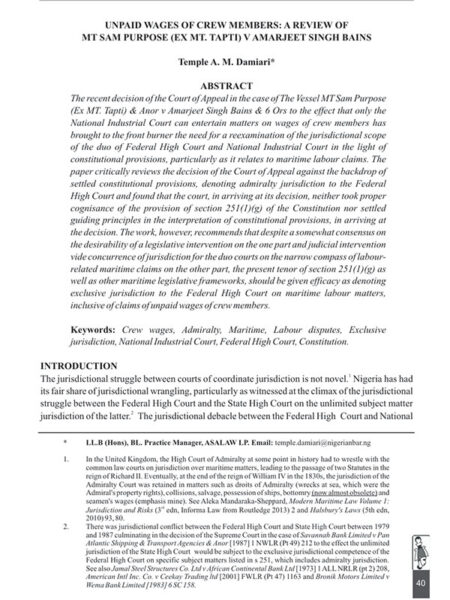
Unpaid Wages of Crew Members: A Review of Mt Sam Purpose (Ex Mt. Tapti) v Amarjeet Singh Bains
0₦2,500.00Temple Damiari of ASALAW LP continues with the exciting debate begun in the last issue of The Gravitas Review on the appropriate court with jurisdiction in wages of ship crew. In his article, Unpaid Wages of Crew Members: A Review of Mt Sam Purpose (Ex Mt. Tapti) v Amarjeet Singh Bains, Damiari critically analyses the decision of the Court of Appeal that only the National Industrial Court can entertain matters on wages of ship crew. He opines that given the settled constitutional provisions denoting admiralty jurisdiction in the Federal High Court, the Court of Appeal in arriving at its decision, neither took proper cognisance of the provision of section 251(1)(g) of the Constitution nor settled guiding principles in the interpretation of constitutional provisions.
-
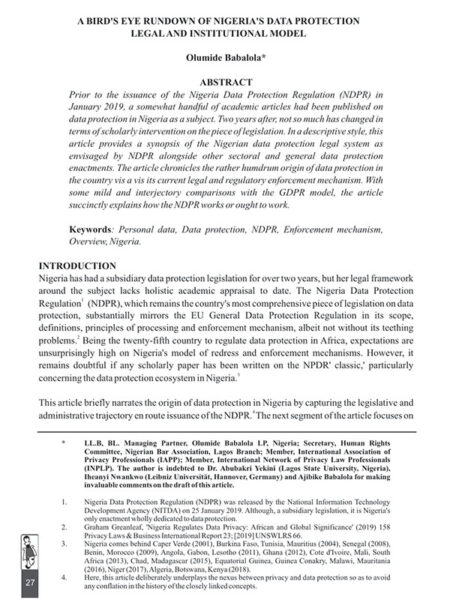
A Bird’s Eye Rundown of Nigeria’s Data Protection Legal and Institutional Model
0₦2,500.00Olumide Babalola of Olumide Babalola LP, in his article, A Bird’s Eye Rundown of Nigeria’s Data Protection Legal and Institutional Model, provides a synopsis of legislation and regulations dealing with data protection in Nigeria. He chronicles the rather humdrum origin of data protection in the country vis-a-vis its current legal and regulatory enforcement mechanism. Through comparisons with the General Data Protection Regulation (GDPR) model, Olumide explains how the Nigeria Data Protection Regulation (NDPR) works or ought to work.
-
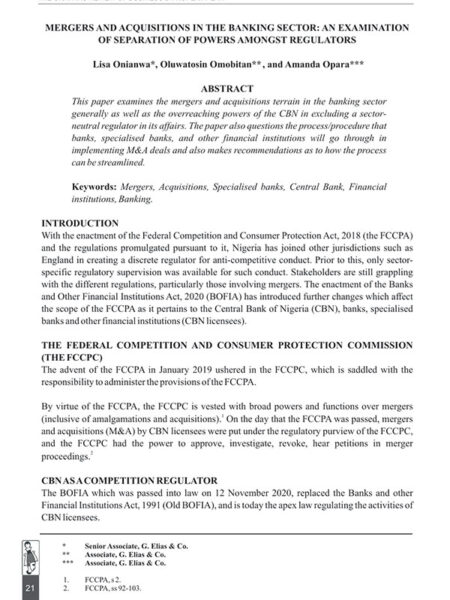
Mergers and Acquisitions in the Banking Sector: An Examination of Separation of Powers Amongst Regulators
0₦2,500.00Lisa Onianwa, Oluwatosin Omobitan, and Amanda Opara, all of G. Elias & Co, in their article, Mergers and Acquisitions in the Banking Sector: An Examination of Separation of Powers Amongst Regulators, examine the mergers and acquisitions (M&A) terrain in the banking sector and the overreaching powers of the Central Bank of Nigeria (CBN) in excluding a sector-neutral regulator in M&A deals. Onianwa et al. question the process and procedure that banks and other financial institutions implement in M&A deals and make recommendations on how the process can be streamlined.
The Gravitas Review of Business & Property Law