-
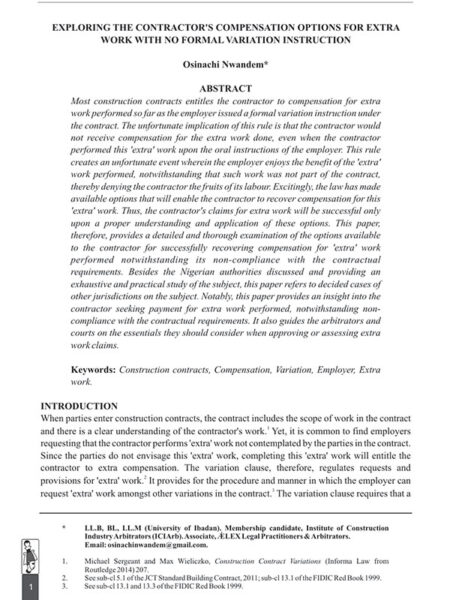
Exploring the Contractor’s Compensation Options for Extra Work with no Formal Variation Instruction
0₦2,500.00Osinachi Nwandem, an Associate at ǼLEX, in his article, Exploring the Contractor’s Compensation Options for Extra Work with no Formal Variation Instruction, notes that most construction contracts entitle the contractor to compensation for extra work performed so far as the employer issued a formal variation instruction under the contract. The unfortunate implication is that the contractor may not receive compensation for additional works done, if the contractor performed the extra work upon the oral instructions of the employer. Osinachi reviews Nigerian and foreign authorities on the issue of extra work done when there was no formal variation instruction and proffers the options available to a contractor to successfully recover compensation in such instances.
-
The Gravitas Review of Business & Property Law Vol.12 No.1 – Print
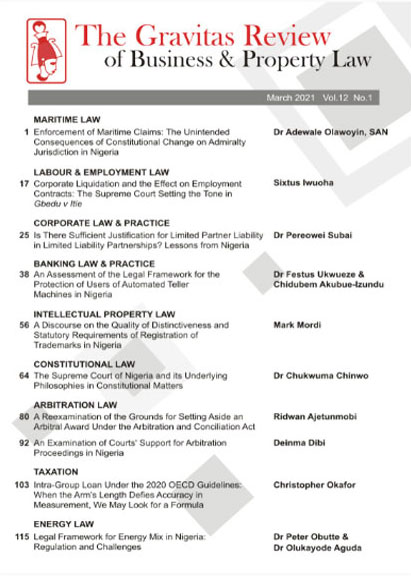
0₦5,000.00In this issue of The Gravitas Review of Business & Property Law Vol.12 No.1, there are well researched articles on:
- Maritime Law
- Labour & Employment Law
- Corporate Law & Practice
- Banking Law & Practice
- Intellectual Property
- Constitutional Law
- Arbitration Law
- Taxation
- Energy Law
-
The Gravitas Review of Business & Property Law Vol.12 No.1 – E-Book
0₦5,000.00In this issue of The Gravitas Review of Business & Property Law Vol.12 No.1, there are well researched articles on:
- Maritime Law
- Labour & Employment Law
- Corporate Law & Practice
- Banking Law & Practice
- Intellectual Property
- Constitutional Law
- Arbitration Law
- Taxation
- Energy Law
-
The Gravitas Review of Business & Property Law Vol.12 No.1
0₦5,000.00In this issue of The Gravitas Review of Business & Property Law Vol.12 No.1, there are well researched articles on:
- Maritime Law
- Labour & Employment Law
- Corporate Law & Practice
- Banking Law & Practice
- Intellectual Property
- Constitutional Law
- Arbitration Law
- Taxation
- Energy Law
-
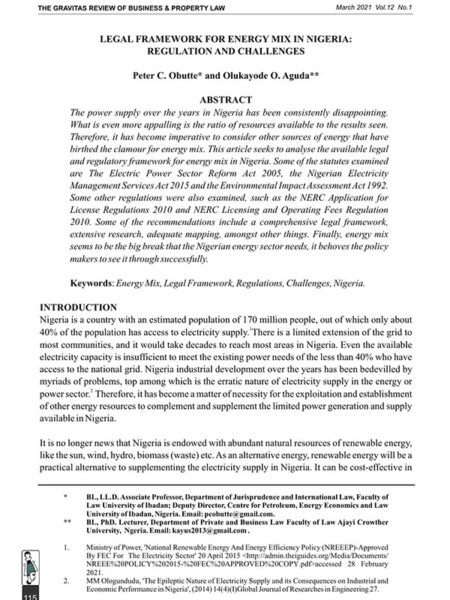
Legal Framework for Energy Mix in Nigeria: Regulation and Challenges
0₦2,500.00Dr Peter Obutte, Associate Professor, Faculty of Law, University of Ibadan and Dr Olukayode Aguda of the Faculty of Law, Ajayi Crowther University, in their article, Legal Framework for Energy Mix in Nigeria: Regulation and Challenges, note that energy mix refers to the combination of the various primary energy sources used to meet energy needs: fossil fuels (oil, natural gas and coal), nuclear energy, and renewable energy sources. Dr Obutte and Dr Aguda analyse the legal and regulatory framework for energy mix in Nigeria. They posit that energy mix seems to be the big break that the Nigerian energy sector needs, and it behooves the policymakers to see it through successfully with a comprehensive legal framework, extensive research and adequate mapping, amongst other things.
-
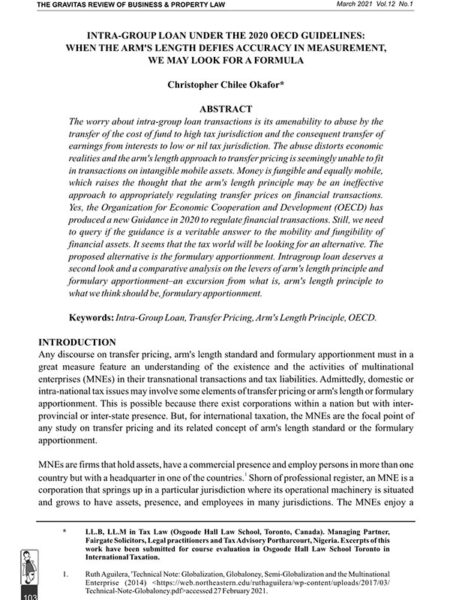
Intra-Group Loan Under the 2020 OECD Guidelines: When the Arm’s Length Defies Accuracy in Measurement, We May Look for a Formula
0₦2,500.00Christopher Okafor, Managing Partner, Fairgate Solicitors, Legal Practitioners and Tax Advisory Port Harcourt, Nigeria, in his article, Intra-Group Loan Under the 2020 OECD Guidelines: When the Arm’s Length Defies Accuracy in Measurement, We May Look for a Formula, argues that the worry about intra-group loan transactions is its amenability to abuse by the transfer of the cost of fund to high tax jurisdiction and the consequent transfer of earnings from interests to low or nil tax jurisdiction. The abuse distorts economic realities, and the arm’s length approach to transfer pricing is seemingly unable to fit in transactions on intangible mobile assets. Though the Organization for Economic Cooperation and Development (OECD) has produced a new Guidance in 2020 to regulate intra-group loan, it is moot whether the guidance is a veritable answer to the mobility and fungibility of financial assets. Christopher proposes an alternative to the arm’s length principle. In his words, intragroup loan deserves a second look and a comparative analysis on the levers of arm’s length principle and formulary apportionment–an excursion from what is, arm’s length principle to what we think should be, formulary apportionment.
-
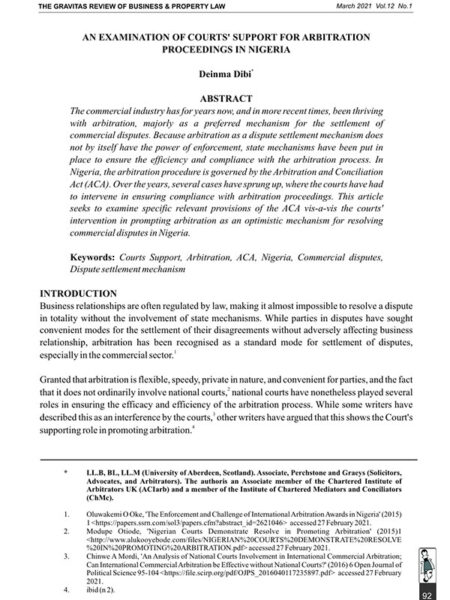
An Examination of Courts’ Support for Arbitration Proceedings in Nigeria
0₦2,500.00Deinma Dibi, Associate at Perchstone and Graeys in his article, An Examination of Courts’ Support for Arbitration Proceedings in Nigeria, examines the Arbitration and Conciliation Act, and decided cases to identify ways in which the courts in Nigeria support arbitral proceedings.
-
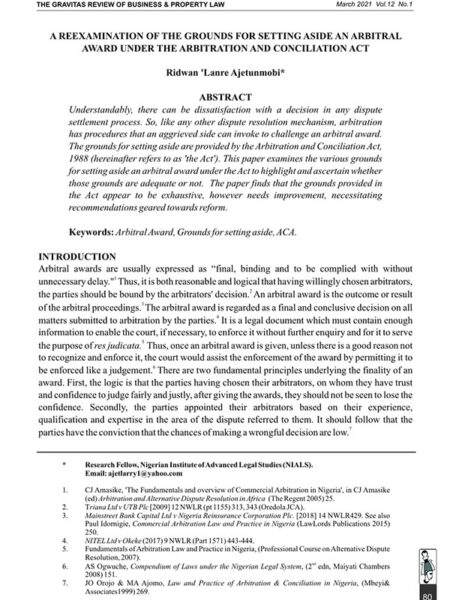
A Reexamination of the Grounds for Setting Aside an Arbitral Award Under the Arbitration and Conciliation Act
0₦2,500.00Ridwan Ajetunmobi, Research Fellow at the Nigerian Institute of Advanced Legal Studies, in his article, A Reexamination of the Grounds for Setting Aside an Arbitral Award Under the Arbitration and Conciliation Act, critically examines the various grounds for setting aside an arbitral award under the ACA. Ajetunmobi considers the adequacy of the grounds, the procedure for, and the legal effect of, setting aside an award. He proffers recommendations for further reform.
-
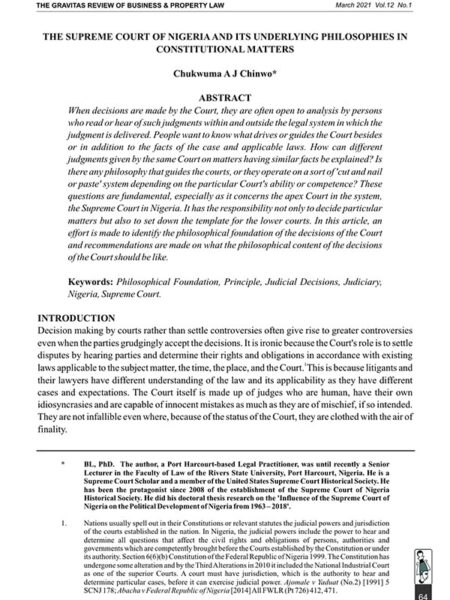
The Supreme Court of Nigeria and its Underlying Philosophies in Constitutional Matters
0₦2,500.00Dr Chukwuma Chinwo, formerly Senior Lecturer at the Rivers State University, and now a Port Harcourt-based Legal Practitioner in his article, The Supreme Court of Nigeria and its Underlying Philosophies in Constitutional Matters, asks a question that bothers many: How can the same Court give different judgments on matters having similar facts? Dr Chinwo examines the Supreme Court of Nigeria’s judicial philosophy. From an extensive review of several Supreme Court decisions, he weaves a coherent thread of factors that influence the Court’s judgments.
-
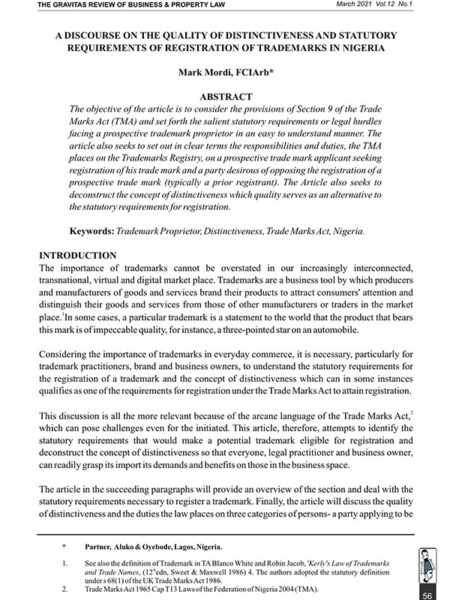
A Discourse on the Quality of Distinctiveness and Statutory Requirements of Registration of Trademarks in Nigeria
0₦2,500.00Mark Mordi, Partner Aluko & Oyebode in, A Discourse on the Quality of Distinctiveness and Statutory Requirements of Registration of Trademarks in Nigeria, deconstructs the concept of distinctiveness which quality, serves as an alternative to the statutory requirements for registration. Mordi examines the responsibilities and duties the Trade Marks Act 1965 places on the Trademarks Registry, on a prospective trademark applicant seeking registration of his trademark, and a party desirous of opposing a trademark registration (typically a prior registrant).
-
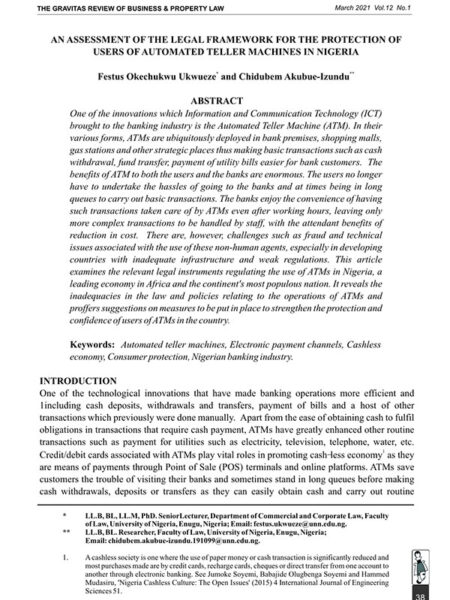
An Assessment of the Legal Framework for the Protection of Users of Automated Teller Machines in Nigeria
0₦2,500.00Dr Festus Ukwueze and Chidubem Akubue-Izundu of the Faculty of Law University of Nigeria Enugu Nigeria in their article, An Assessment of the Legal Framework for the Protection of Users of Automated Teller Machines in Nigeria, note the convenience and benefits of ATMs: faster cash withdrawals, easy fund transfer, convenient payment of utility bills. There are, however, challenges, mainly fraud and technical issues associated with the use of these non-human agents. Dr Ukwueze and Akubue-Izundu comprehensively review the relevant legal instruments regulating the use of ATMs in Nigeria. They posit that the laws and policies relating to ATMs’ operations are inadequate and proffer suggestions on measures to be put in place to strengthen the protection and confidence of users of ATMs in the country.
-
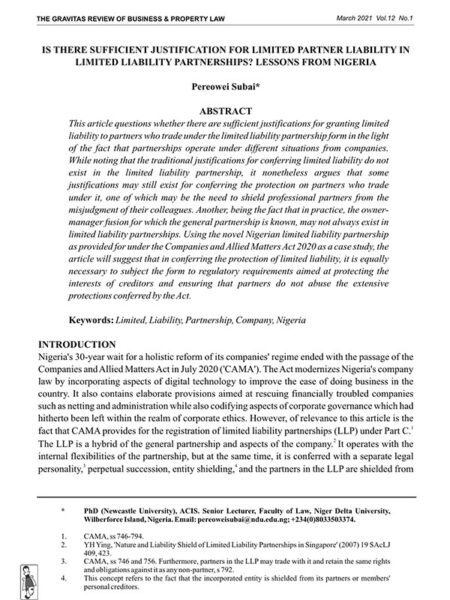
Is There Sufficient Justification for Limited Partner Liability in Limited Liability Partnerships? Lessons from Nigeria
0₦2,500.00Dr Pereowei Subai, Senior Lecturer, Faculty of Law Niger Delta University Wilberforce Island Nigeria in his article, Is There Sufficient Justification for Limited Partner Liability in Limited Liability Partnerships? Lessons from Nigeria, questions whether there are sufficient justifications for granting limited liability to partners who trade under limited liability partnership in the light of the fact that partnerships operate under different situations from companies. While the traditional justifications for conferring limited liability do not exist in the limited liability partnership, Dr Subai argues that some justifications may still exist for granting the protection on partners who trade under it. A significant reason is the need to shield professional partners from the misjudgment of their colleagues. Using the Companies and Allied Matters Act 2020 as a case study, Dr Subai suggests that in conferring the protection of limited liability, it is necessary to subject the form to regulatory requirements aimed at protecting the interests of creditors and ensuring that partners do not abuse the extensive protections conferred by the Act.
The Gravitas Review of Business & Property Law