-
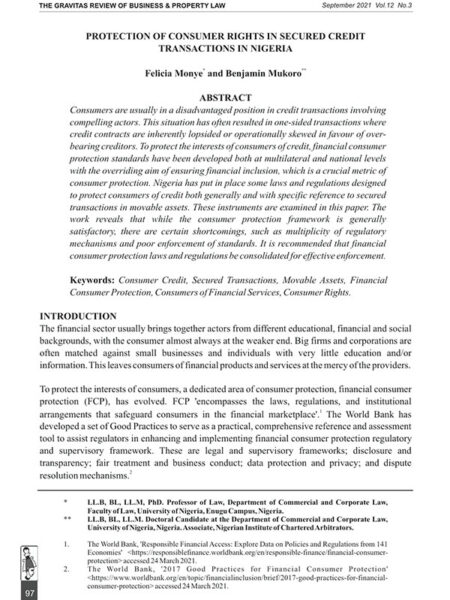
Protection of Consumer Rights in Secured Credit Transactions in Nigeria
0₦2,500.00Professor Felicia Monye of the Faculty of Law, University of Nigeria and Benjamin Mukoro, Doctoral Candidate at the Faculty of Law, University of Nigeria, in their article, Protection of Consumer Rights in Secured Credit Transactions in Nigeria, consider the existing laws and regulations designed to protect consumers of credit with a focus on secured transactions in movable assets. They note that while the consumer protection framework is generally satisfactory, there are certain shortcomings, such as multiplicity of regulatory mechanisms and poor enforcement of standards.
-
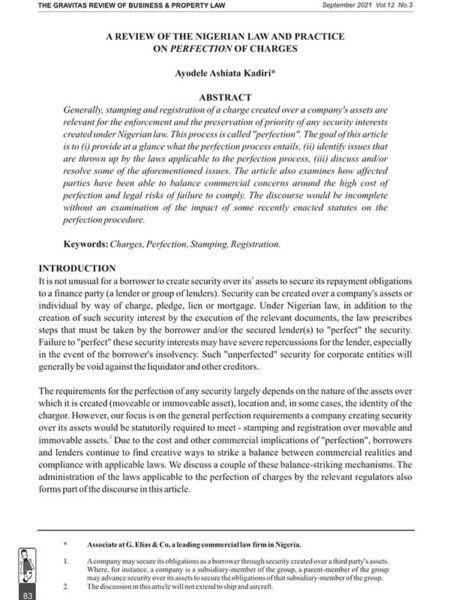
A Review of the Nigerian Law and Practice on Perfection of Charges
0₦2,500.00Ashiata Kadiri, Associate at G. Elias & Co, in her article, A Review of the Nigerian Law and Practice on Perfection of Charges, comprehensively considers the process of perfection of charges in Nigeria. She identifies the extant laws applicable to perfection noting the requirements by the Corporate Affairs Commission, the Federal Inland Revenue Service and the National Collateral Registry established under the Secured Transactions in Movable Assets Act 2017.
-
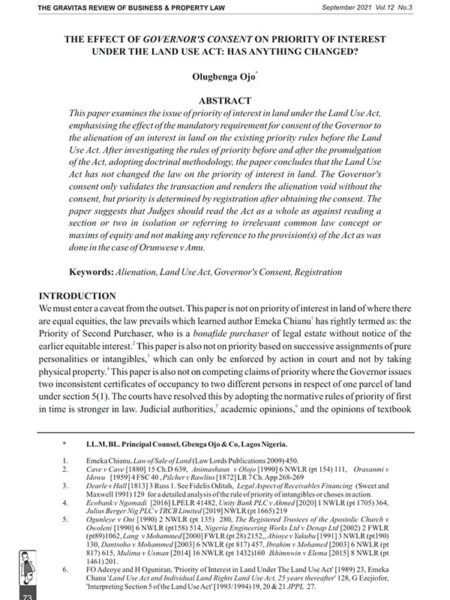
The Effect of Governor’s Consent on Priority of Interest Under the Land Use Act: Has Anything Changed?
0₦2,500.00Olugbenga Ojo, Principal Counsel at Gbenga Ojo & Co, in his article, The Effect of Governor’s Consent on Priority of Interest Under the Land Use Act: Has Anything Changed? examines the issue of priority of interest in land under the Land Use Act and the effect of the Governor’s Consent. He considers the rule of priority before the enactment of the Land Use Act, and under the Act to determine whether there are changes. He concludes that the Governor’s Consent only validates a transaction and renders an alienation void without the Consent, but priority is determined by registration after obtaining the Consent. He suggests that Judges should read the Land Use Act as a whole as against reading a section or two in isolation or referring to irrelevant common law concepts or maxims of equity as was done in the case of Orunwese v Amu.
-
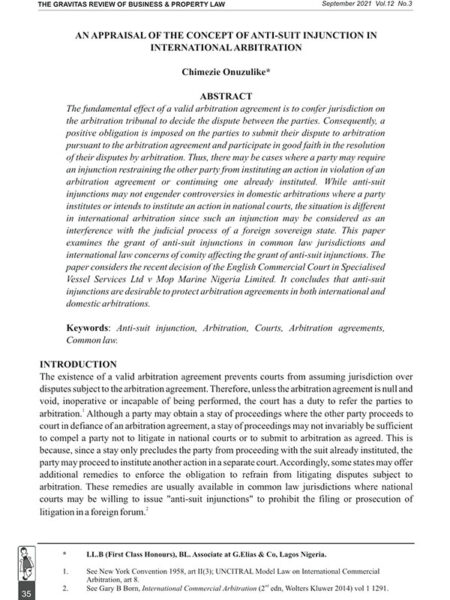
An Appraisal of the Concept of Anti-Suit Injunction in International Arbitration
0₦2,500.00Chimezie Onuzulike, Associate at G. Elias & Co, in his article, An Appraisal of the Concept of Anti-Suit Injunction in International Arbitration, explains that Anti-suit injunctions are orders of national courts usually granted in common law jurisdictions, restraining a party from commencing an action concerning a dispute subject to an arbitration agreement or continuing one already commenced in defiance of an arbitration agreement. He reviews the stance of courts in relation to the grant of anti-suit injunctions. He argues that while anti-suit injunctions may not engender controversies in domestic arbitrations where a party institutes or intends to institute an action in national courts, the situation is different in international arbitration since such an injunction may be considered as an interference with the judicial process of a foreign sovereign state. Chimezie reviews the decision of the English Court in Specialised Vessel Services Ltd v Mop Marine Nigeria Limited and stresses the importance of anti-suit injunctions in protecting arbitration agreements in both international and domestic arbitrations.
-
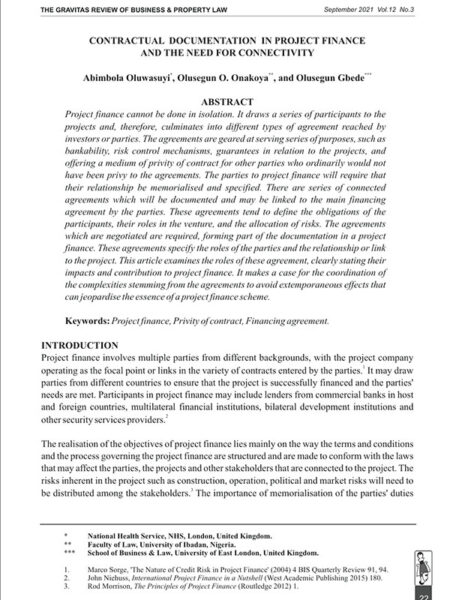
Contractual Documentation in Project Finance and the Need for Connectivity
0₦2,500.00Abimbola Oluwasuyi of NHS London United Kingdom, Olusegun Onakoya of the Faculty of Law University of Ibadan Nigeria, and Olusegun Gbede of the School of Business & Law, University of East London United Kingdom, in their article, Contractual Documentation in Project Finance and the Need for Connectivity, stress the importance of several contractual agreements to the success of a Project. They note that the agreements set out the duties and obligations of different parties at different stages of Project Finance. They examine the different types of agreements, their role, their impacts on project finance, and the importance of coordination among parties involved at all stages of the project to ensure its success.
-
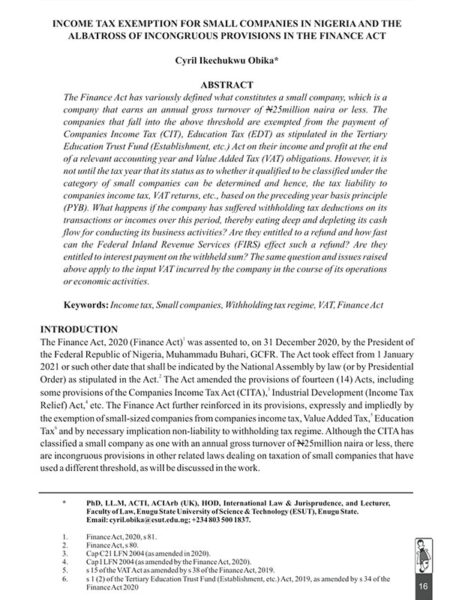
Income Tax Exemption for Small Companies in Nigeria and the Albatross of Incongruous Provisions in The Finance Act
0₦2,500.00Dr Cyril Obika HOD International Law & Jurisprudence, Faculty of Law, Enugu State University of Science & Technology, in his article, Income Tax Exemption for Small Companies in Nigeria and the Albatross of Incongruous Provisions in The Finance Act, examines the provisions of the Finance Act that exempt small companies from the payment of several taxes. He considers the definitions of a ‘small company’ in various tax laws, noting the differences in the threshold to qualification as a small company in these laws. Dr Obika argues that categorising a company as ‘small’ can only be determined at the end of a relevant assessment year and effected in the tax year. He opines that the status of a small company should be presumed for the same company in subsequent years until proven to the contrary that the company has exceeded the threshold set by legislation.
-
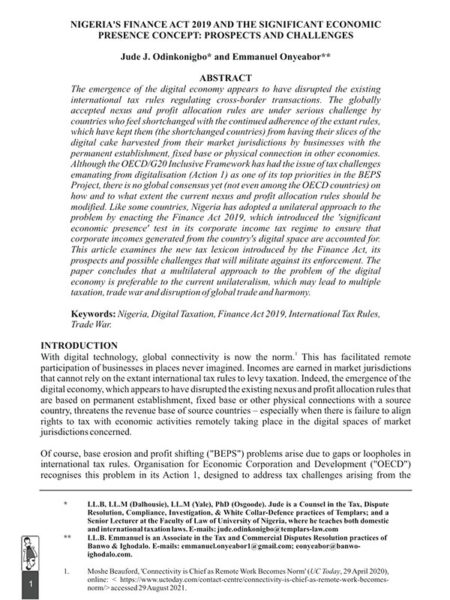
Nigeria’s Finance Act 2019 and the Significant Economic Presence Concept: Prospects and Challenges
0₦2,500.00Dr Jude Odinkonigbo of Templars, and a Senior Lecturer at the Faculty of Law University of Nigeria, and Emmanuel Onyeabor of Banwo & Ighodalo, in their article, Nigeria’s Finance Act 2019 and the Significant Economic Presence Concept: Prospects and Challenges, note that the emergence of the digital economy has significantly disrupted the existing international tax rules regulating cross-border transactions. They examine how Nigeria has tried to solve this problem by enacting the Finance Act 2019, which introduced the ‘significant economic presence’ test, with the objectives of ensuring that corporate incomes generated from Nigeria’s digital space are liable to tax. They note Nigeria’s unilateral adoption of the OECD ‘Significant Economic Presence Test’ on the taxation of Non-Resident Companies (NRCs) in the Finance Act. They consider the prospects and challenges the country might have enforcing the taxation of NRCs operating in the country’s digital space, including the possibility of retaliatory measures by other countries. They conclude with suggestions on how to enforce the provisions of the Finance Act.
-
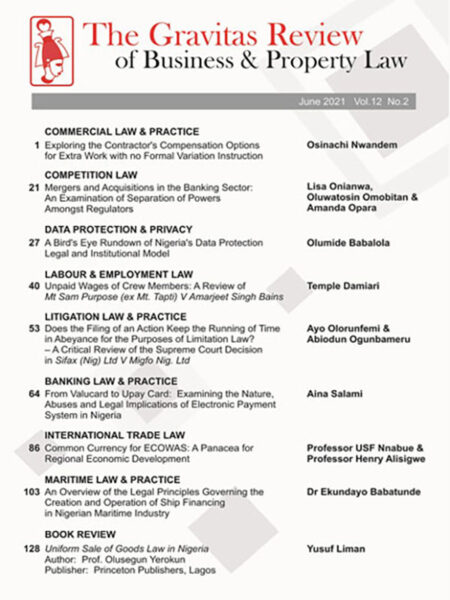
The Gravitas Review of Business & Property Law Vol.12 No.2 – Print
0₦5,000.00In this issue of The Gravitas Review of Business & Property Law Vol.12 No.2, there are well researched articles on:
- Commercial Law & Practice
- Competition Law
- Labour & Employment Law
- Litigation Law & Practice
- Banking Law & Practice
- International Trade Law
- Maritime Law & Practice
- Book Review
-
The Gravitas Review of Business & Property Law Vol.12 No.2 – E-Book
0₦5,000.00In this issue of The Gravitas Review of Business & Property Law Vol.12 No.2, there are well researched articles on:
- Commercial Law & Practice
- Competition Law
- Labour & Employment Law
- Litigation Law & Practice
- Banking Law & Practice
- International Trade Law
- Maritime Law & Practice
- Book Review
-
The Gravitas Review of Business & Property Law Vol.12 No.2
0₦5,000.00In this issue of The Gravitas Review of Business & Property Law Vol.12 No.2, there are well researched articles on:
- Commercial Law & Practice
- Competition Law
- Labour & Employment Law
- Litigation Law & Practice
- Banking Law & Practice
- International Trade Law
- Maritime Law & Practice
- Book Review
-
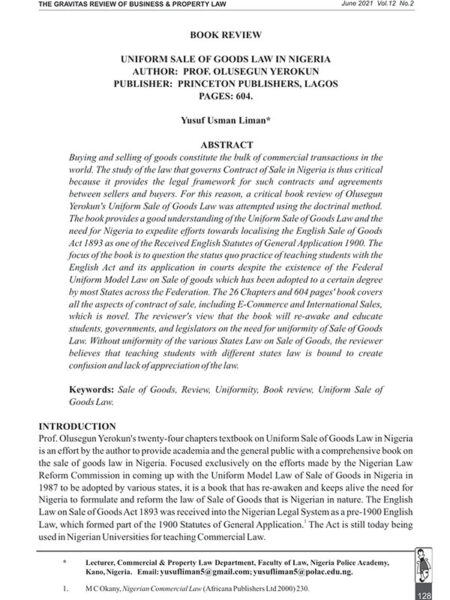
Uniform Sale of Goods Law in Nigeria by Prof. Olusegun Yerokun
0₦2,500.00Yusuf Usman Liman, Lecturer, Faculty of Law, Nigeria Police Academy, Kano Nigeria, reviews the book, Uniform Sale of Goods Law in Nigeria by Prof. Olusegun Yerokun, highlighting that the book provides a good understanding of the need for concerted efforts towards uniformity of the Federal and State Laws on Sale of Goods. Using the review as a backdrop, Liman examines the current state of the law with regards to the status of the Sale of Goods Act 1893, an English Statute of General Application.
-
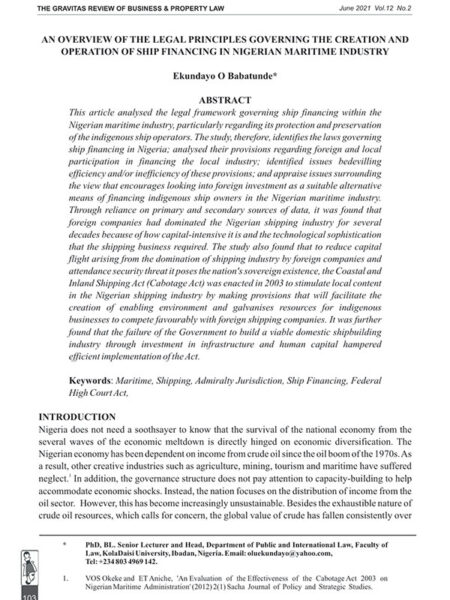
An Overview of the Legal Principles Governing the Creation and Operation of Ship Financing in Nigerian Maritime Industry
0₦2,500.00Dr Ekundayo Babatunde, Senior Lecturer, Faculty of Law, KolaDaisi University Ibadan Nigeria, in his article, An Overview of the Legal Principles Governing the Creation and Operation of Ship Financing in Nigerian Maritime Industry, analyses the legal framework governing ship financing in the Nigerian maritime industry. He considers laws governing ship financing in Nigeria with particular attention to foreign and local participation in the maritime industry. Babatunde explores global best practices on the protection of local maritime industry, Nigeria’s experience with Cabotage and other burning issues in the Nigerian maritime industry.
The Gravitas Review of Business & Property Law