-
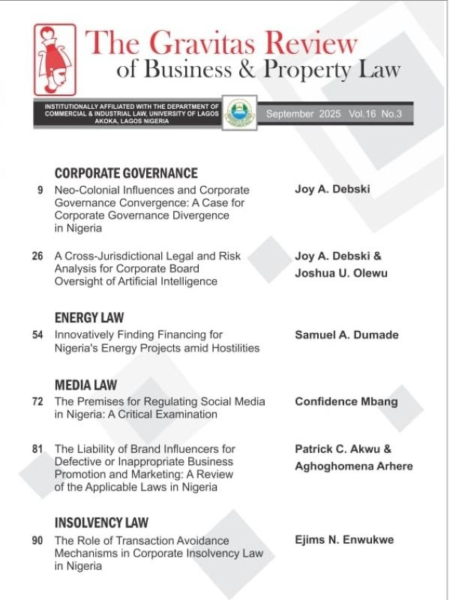
The Gravitas Review of Business & Property Law Vol.16 No.3 – E-Book
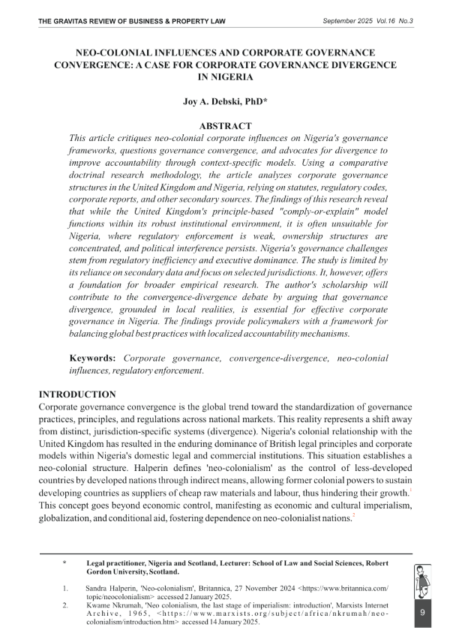
0₦5,000.00In this issue of The Gravitas Review of Business & Property Law Vol.16 No.3, there are well researched articles on:
- Corporate Governance
- Energy Law
- Media Law
- Insolvency Law
-
The Gravitas Review of Business & Property Law Vol.16 No.1 – Print
0₦5,000.00In this issue of The Gravitas Review of Business & Property Law Vol.16 No.1, there are well researched articles on:
- Commercial Law & Practice
- Intellectual Property Law
- Data Protection & Privacy
- Employment Law
- Taxation
- Energy Law
- Medical Law
-
The Gravitas Review of Business & Property Law Vol.15 No.4 – Print
0₦5,000.00In this issue of The Gravitas Review of Business & Property Law Vol.15 No.4, there are well researched articles on:
- Taxation
- Arbitration Law & Practice
- International Investments
- Litigation Practice & Procedure
- Education – Commentary
-
The Gravitas Review of Business & Property Law Vol.15 No.3 – E-Book
0₦5,000.00In this issue of The Gravitas Review of Business & Property Law Vol.15 No.3, there are well researched articles on:
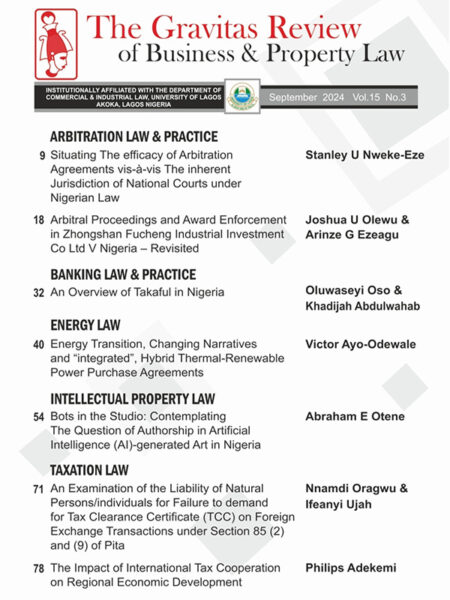
- Arbitration Law & Practice
- Banking Law & Practice
- Energy Law
- Intellectual Property Law
- Taxation
-
An Overview of Takaful in Nigeria
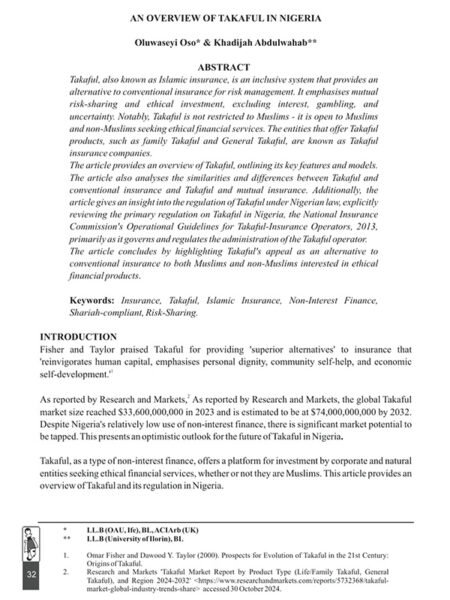
0₦2,500.00Oluwaseyi Oso and Khadijah Abdulwahab in their article, An Overview of Takaful in Nigeria, introduce our readers to the practice of Takaful, an Islamic insurance practice which provides an alternative to conventional insurance for risk management. Takaful underscores, among others, mutual risk-sharing and ethical investment which excludes prohibited elements such as interest, gambling, and uncertainty. Interestingly, Takaful, though must be Shariah-compliant is not restricted to Muslims – both Muslims and non-Muslims seeking ethical financial services can invest in Takaful products. The Takaful operators are Takaful insurance companies which offer Takaful products such as family Takaful and general Takaful. Oso and Abdulwahab provide an overview of Takaful, outlining its key features and models. Oso and Abdulwahab also analyse the similarities and differences between Takaful and conventional insurance, and Takaful and mutual insurance. Additionally, Oso and Abdulwahab give an insight into the regulation of Takaful under Nigerian law, specifically reviewing the primary regulation on Takaful in Nigeria, the National Insurance Commission’s Operational Guidelines for Takaful-Insurance Operators, 2013, especially as it governs and regulates the administration of the Takaful operator. They conclude by highlighting Takaful’s appeal, as an alternative to conventional insurance, to both Muslims and non-Muslims interested in ethical financial products.
-
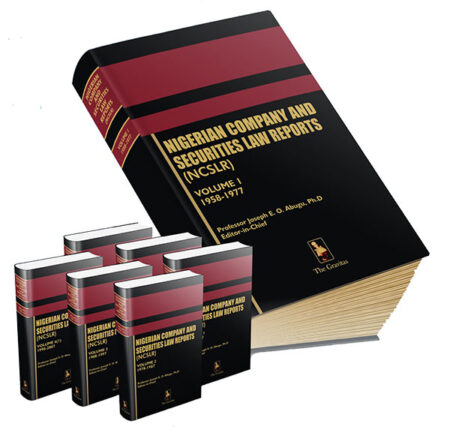
Nigerian Company and Securities Law Reports (NCSLR) 1958-2017 Volumes 1-7
0₦75,000.00Nigerian Company and Securities Law Reports (NCSLR) 1958-2017 Volumes 1-7, edited by Professor Joseph Abugu, and published by The Gravitas Legal and Business Resources Limited, is a composite compendium of superior court decisions on Corporate and Securities law.
-
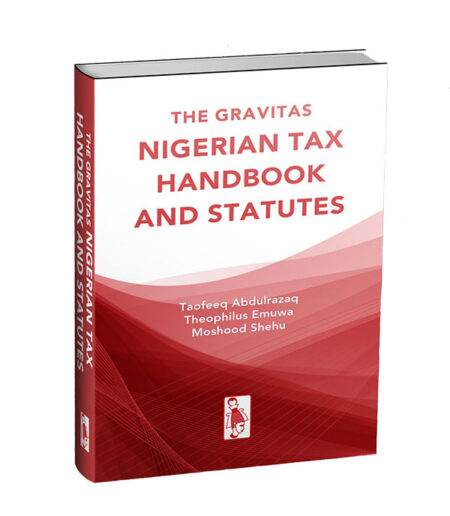
The Gravitas Nigerian Tax Handbook and Statutes
0₦50,000.00The Gravitas Nigerian Tax Handbook and Statutes, written and complied by Professor Taofeeq Abdulrazaq, SAN, Theophilus Emuwa and Moshood Shehu, is a comprehensive reference work written by experienced professionals and covering major aspects of Nigerian taxation. The Handbook offers a thorough guide to Nigerian taxation.
-
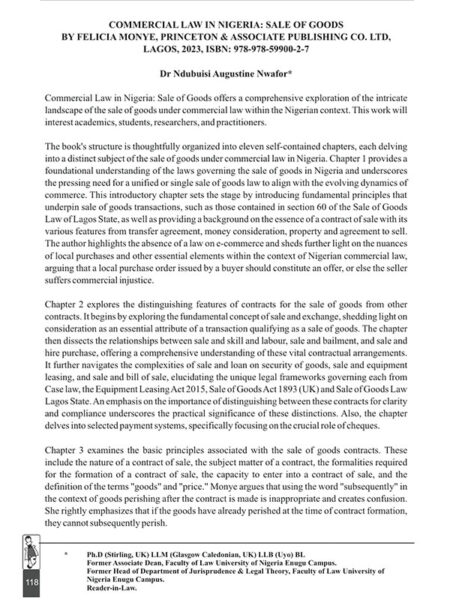
Book Review: Commercial Law in Nigeria: Sale of Goods
0₦2,500.00Dr. Ndubuisi Nwafor offers a comprehensive review of a work by a renowned author on Commercial Law in Nigeria. The Book – Commercial Law in Nigeria: Sale of Goods published in 2023 offers a comprehensive exploration of the intricate landscape of the sale of goods under commercial law within the Nigerian context. Structurally organised in eleven chapters, each delving into a distinct subject of sale of goods, the book offers a source of interesting reading by students, practitioners and members of the judiciary.
-
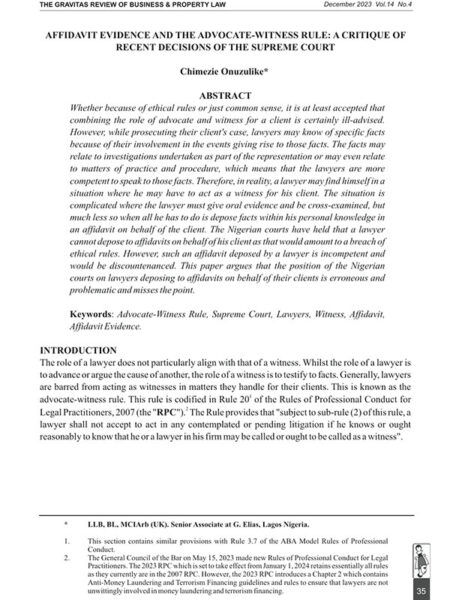
Affidavit Evidence and The Advocate-Witness Rule: A Critique of the Recent Decisions of the Supreme Court
0₦2,500.00Chimezie Onuzulike, in his article, Affidavit Evidence and The Advocate-Witness Rule: A Critique of the Recent Decisions of the Supreme Court, examines the ethical issues arising when counsel combines the role of advocate and witness for a client. Onuzulike posits that in the course of prosecuting their client’s case, lawyers may know of certain facts because of their involvement in the events giving rise to those facts. The facts may relate to investigations undertaken as part of the representation or may even relate to matters of practice and procedure, which means that the lawyers are more competent to speak to those facts. Therefore, in reality, a lawyer may find himself in a situation where he may have to act as a witness for his client. The situation is complicated where the lawyer is required to give oral evidence and be cross-examined, but much less so when all he has to do is depose to facts within his personal knowledge in an affidavit on behalf of the client. The Nigerian courts have not only held that a lawyer cannot depose to affidavits on behalf of his client as that would amount to a breach of ethical rules, but also that such an affidavit deposed to by a lawyer is incompetent and would be discountenanced. Onuzulike argues that the position of the Nigerian courts on lawyers deposing to affidavits on behalf of their clients is erroneous, problematic and misses the point.
-
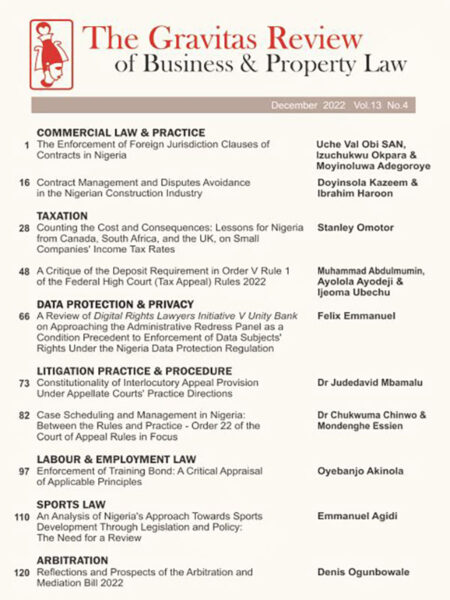
The Gravitas Review of Business & Property Law Vol.13 No.4 – E-Book
0₦5,000.00In this issue of The Gravitas Review of Business & Property Law Vol.13 No.4, there are well researched articles on:
- Commercial Law & Practice
- Taxation
- Data Protection & Privacy
- Litigation Practice & Procedure
- Labour & Employment Law
- Sports Law
- Arbitration
-
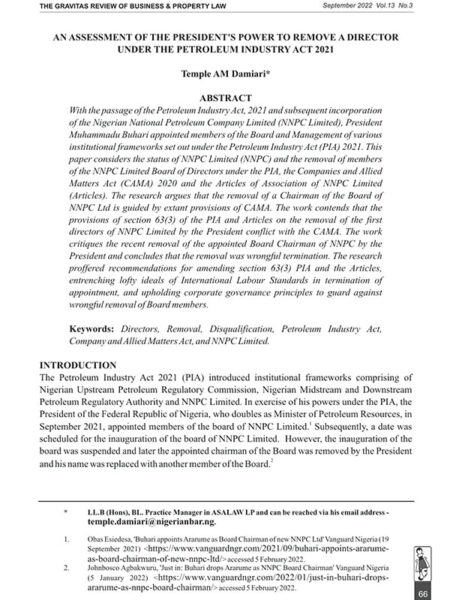
An Assessment of the President’s Power to Remove a Director under the Petroleum Industry Act 2021
0₦2,500.00Temple Damiari of ASALAW LP, in his paper, An Assessment of the President’s Power to Remove a Director under the Petroleum Industry Act 2021, notes that with the passage of the Petroleum Industry Act 2021 and subsequent incorporation of the Nigerian National Petroleum Company Limited (NNPC Limited), President Muhammadu Buhari appointed members of the Board and Management of various institutional frameworks set out under the Petroleum Industry Act (PIA) 2021. Damiari considers the status of NNPC Limited and the removal of members of NNPC Limited Board of Directors under the PIA, the Companies and Allied Matters Act (CAMA) 2020 and Articles of Association of NNPC Limited (Articles). He argues that extant provisions of CAMA guide the removal of a Chairman of the Board of NNPC Ltd. He contends that the provisions of section 63(3) of the PIA and Articles on the removal of the first directors of NNPC Limited by the President conflict with the CAMA. He critiques the recent removal of the appointed Board Chairman of NNPC by the President and concludes that the removal was wrongful termination.
-
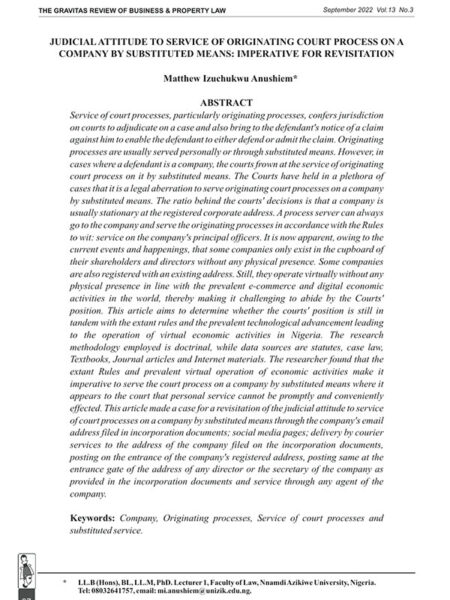
Judicial Attitude to Service of Originating Court Process on a Company by Substituted Means: Imperative for Revisitation
0₦2,500.00Dr Mathew Anushiem of the Faculty of Law, Nnamdi Azikiwe University, Nigeria, in his article, Judicial Attitude to Service of Originating Court Process on a Company by Substituted Means: Imperative for Revisitation, explains that the service of court processes, particularly originating processes, confers jurisdiction on courts to adjudicate on a case and also bring to the defendant’s notice of a claim against him to enable the defendant to either defend or admit the claim. Originating processes are usually served personally or through substituted means. However, in cases where a defendant is a company, the courts frown at the service of originating court process on it by substituted means. The ratio behind the courts’ decisions is that a company is usually stationary at the registered corporate address. A process server can always go to the company and serve the originating processes in accordance with the Rules to wit: service on the company’s principal officers. Given current happenings, the nature of some businesses and technological advancement, Dr Anushiem posits that there is the need to revisit the Rules and judicial attitude to bring them in tandem with modern trends.
The Gravitas Review of Business & Property Law