-
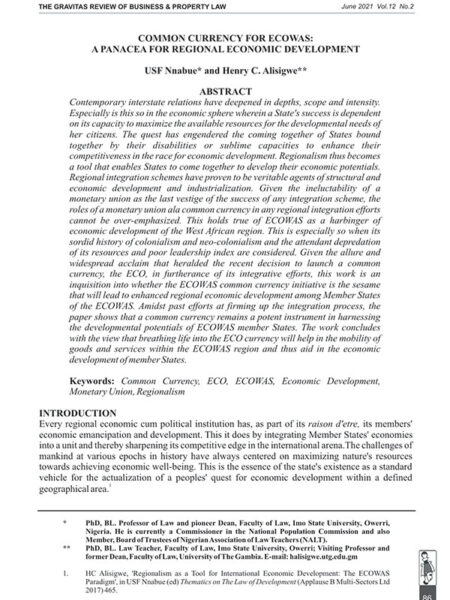
Common Currency for ECOWAS: A Panacea for Regional Economic Development
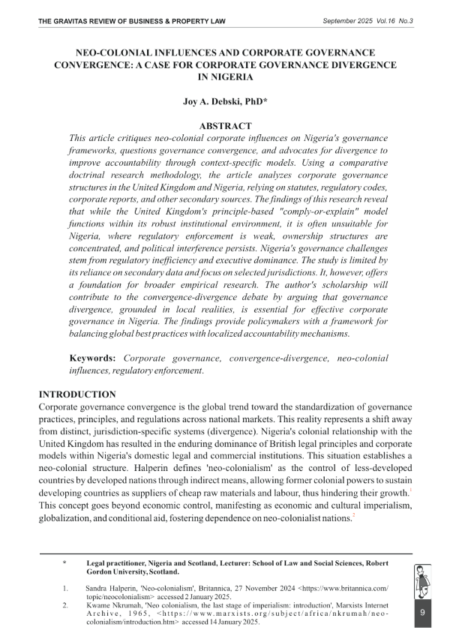
0₦2,500.00Professor USF Nnabue, pioneer Dean, Faculty of Law, Imo State University and currently a Commissioner in the National Population Commission and Professor Henry Alisigwe of the Faculty of Law, Imo State University Owerri Nigeria, in their article, Common Currency for ECOWAS: A Panacea for Regional Economic Development, note the widespread acclaim that heralded the recent decision to launch a common currency, the ECO, in furtherance of the integrative efforts of the Economic Community of West African States (ECOWAS). They interrogate whether the common currency initiative is the sesame that will lead to enhanced regional economic development among member States of the ECOWAS. They argue that a common currency remains a potent instrument in harnessing the developmental potentials of ECOWAS member States and conclude that breathing life into the ECO currency will help in the mobility of goods and services within the ECOWAS region.
-
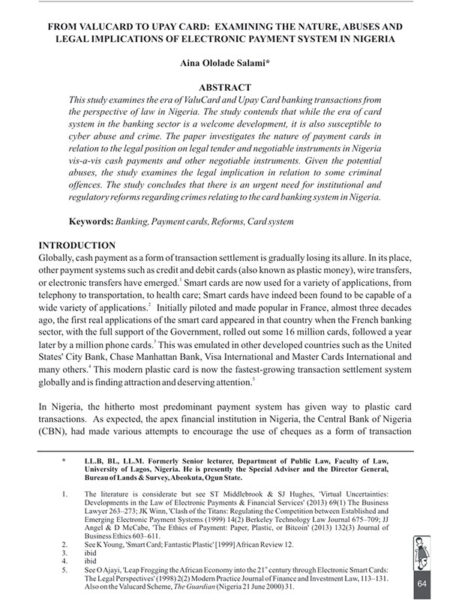
From Valucard to Upay Card: Examining the Nature, Abuses and Legal Implications of Payment Cards in Nigeria
0₦2,500.00Aina Salami, formerly Senior lecturer, Department of Public Law, University of Lagos and presently the Director-General, Bureau of Lands & Survey Ogun State, in his article, From Valucard to Upay Card: Examining the Nature, Abuses and Legal Implications of Payment Cards in Nigeria, examines the legal nature, types and abuses of payment cards in Nigeria. Given the potential abuses of card transactions, Salami explores some criminal offences relating to card transaction and advocates urgent institutional and regulatory reforms to accommodate global trends in payment systems.
-
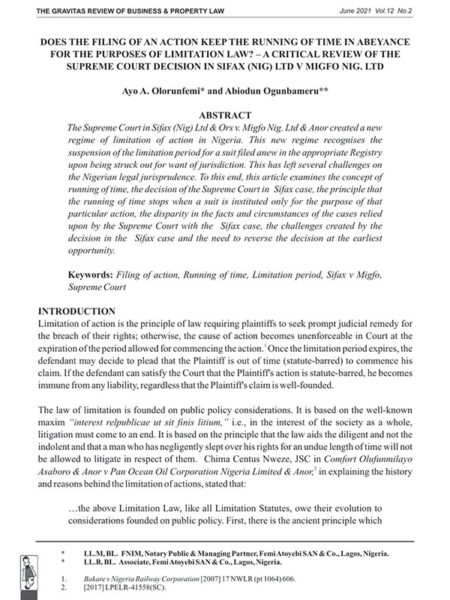
Does the Filing of an Action Keep the Running of Time in Abeyance for the Purposes of Limitation Law? – A Critical Review of the Supreme Court Decision in Sifax (Nig) Ltd v Migfo Nig. Ltd
0₦2,500.00Ayo Olorunfemi and Abiodun Ogunbameru, Managing Partner and Associate respectively at Femi Atoyebi SAN & Co in their article, Does the Filing of an Action Keep the Running of Time in Abeyance for the Purposes of Limitation Law? – A Critical Review of the Supreme Court Decision in Sifax (Nig) Ltd v Migfo Nig. Ltd, examine the new regime of limitation of action created by the Supreme Court in Sifax v Migfo and how it recognises the suspension of the limitation period for a suit filed anew in the appropriate Registry upon being struck out for want of jurisdiction. They examine the concept of the running of time, the principle that the running of time stops when a suit is instituted only for that particular action, the disparity in the facts and circumstances of the cases relied upon by the Supreme Court, and the several challenges created by the decision in the Sifax case.
-
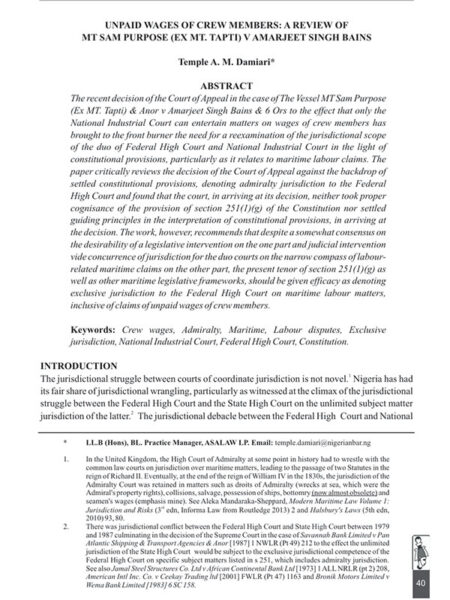
Unpaid Wages of Crew Members: A Review of Mt Sam Purpose (Ex Mt. Tapti) v Amarjeet Singh Bains
0₦2,500.00Temple Damiari of ASALAW LP continues with the exciting debate begun in the last issue of The Gravitas Review on the appropriate court with jurisdiction in wages of ship crew. In his article, Unpaid Wages of Crew Members: A Review of Mt Sam Purpose (Ex Mt. Tapti) v Amarjeet Singh Bains, Damiari critically analyses the decision of the Court of Appeal that only the National Industrial Court can entertain matters on wages of ship crew. He opines that given the settled constitutional provisions denoting admiralty jurisdiction in the Federal High Court, the Court of Appeal in arriving at its decision, neither took proper cognisance of the provision of section 251(1)(g) of the Constitution nor settled guiding principles in the interpretation of constitutional provisions.
-
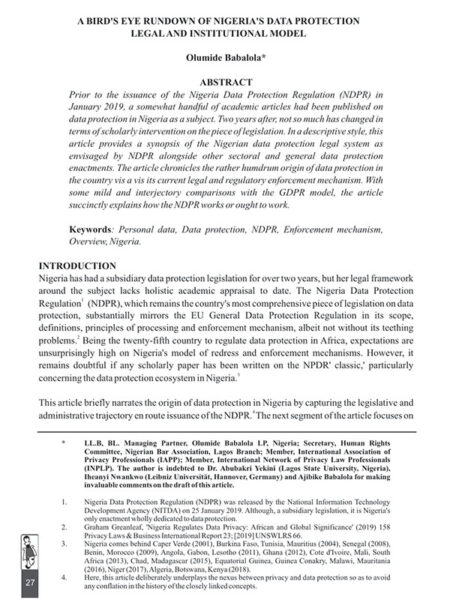
A Bird’s Eye Rundown of Nigeria’s Data Protection Legal and Institutional Model
0₦2,500.00Olumide Babalola of Olumide Babalola LP, in his article, A Bird’s Eye Rundown of Nigeria’s Data Protection Legal and Institutional Model, provides a synopsis of legislation and regulations dealing with data protection in Nigeria. He chronicles the rather humdrum origin of data protection in the country vis-a-vis its current legal and regulatory enforcement mechanism. Through comparisons with the General Data Protection Regulation (GDPR) model, Olumide explains how the Nigeria Data Protection Regulation (NDPR) works or ought to work.
-
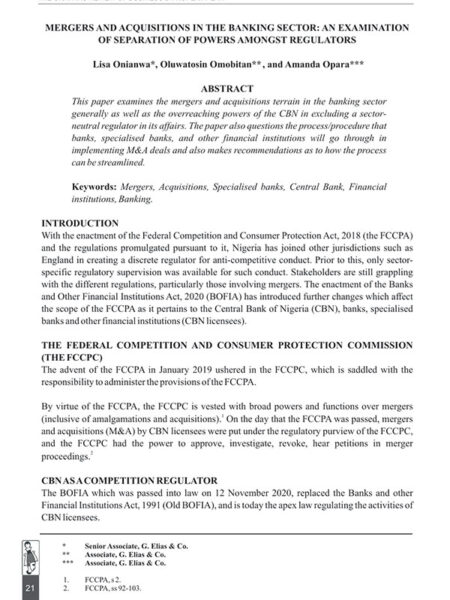
Mergers and Acquisitions in the Banking Sector: An Examination of Separation of Powers Amongst Regulators
0₦2,500.00Lisa Onianwa, Oluwatosin Omobitan, and Amanda Opara, all of G. Elias & Co, in their article, Mergers and Acquisitions in the Banking Sector: An Examination of Separation of Powers Amongst Regulators, examine the mergers and acquisitions (M&A) terrain in the banking sector and the overreaching powers of the Central Bank of Nigeria (CBN) in excluding a sector-neutral regulator in M&A deals. Onianwa et al. question the process and procedure that banks and other financial institutions implement in M&A deals and make recommendations on how the process can be streamlined.
-
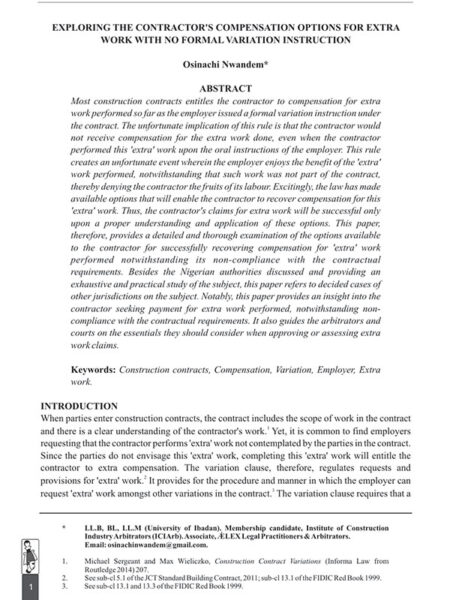
Exploring the Contractor’s Compensation Options for Extra Work with no Formal Variation Instruction
0₦2,500.00Osinachi Nwandem, an Associate at ǼLEX, in his article, Exploring the Contractor’s Compensation Options for Extra Work with no Formal Variation Instruction, notes that most construction contracts entitle the contractor to compensation for extra work performed so far as the employer issued a formal variation instruction under the contract. The unfortunate implication is that the contractor may not receive compensation for additional works done, if the contractor performed the extra work upon the oral instructions of the employer. Osinachi reviews Nigerian and foreign authorities on the issue of extra work done when there was no formal variation instruction and proffers the options available to a contractor to successfully recover compensation in such instances.
-
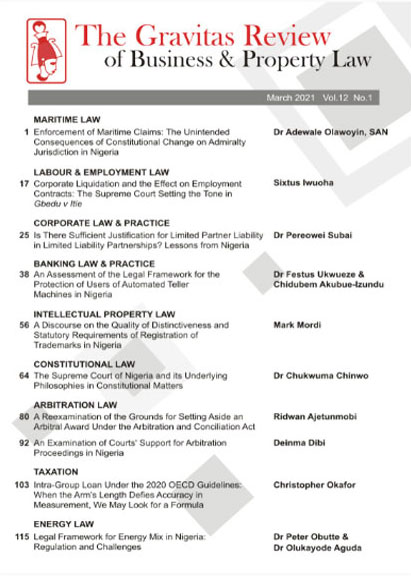
The Gravitas Review of Business & Property Law Vol.12 No.1 – Print
0₦5,000.00In this issue of The Gravitas Review of Business & Property Law Vol.12 No.1, there are well researched articles on:
- Maritime Law
- Labour & Employment Law
- Corporate Law & Practice
- Banking Law & Practice
- Intellectual Property
- Constitutional Law
- Arbitration Law
- Taxation
- Energy Law
-
The Gravitas Review of Business & Property Law Vol.12 No.1 – E-Book
0₦5,000.00In this issue of The Gravitas Review of Business & Property Law Vol.12 No.1, there are well researched articles on:
- Maritime Law
- Labour & Employment Law
- Corporate Law & Practice
- Banking Law & Practice
- Intellectual Property
- Constitutional Law
- Arbitration Law
- Taxation
- Energy Law
-
The Gravitas Review of Business & Property Law Vol.12 No.1
0₦5,000.00In this issue of The Gravitas Review of Business & Property Law Vol.12 No.1, there are well researched articles on:
- Maritime Law
- Labour & Employment Law
- Corporate Law & Practice
- Banking Law & Practice
- Intellectual Property
- Constitutional Law
- Arbitration Law
- Taxation
- Energy Law
-
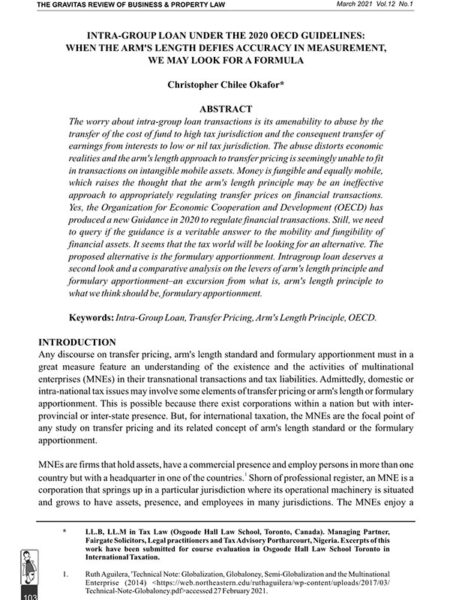
Intra-Group Loan Under the 2020 OECD Guidelines: When the Arm’s Length Defies Accuracy in Measurement, We May Look for a Formula
0₦2,500.00Christopher Okafor, Managing Partner, Fairgate Solicitors, Legal Practitioners and Tax Advisory Port Harcourt, Nigeria, in his article, Intra-Group Loan Under the 2020 OECD Guidelines: When the Arm’s Length Defies Accuracy in Measurement, We May Look for a Formula, argues that the worry about intra-group loan transactions is its amenability to abuse by the transfer of the cost of fund to high tax jurisdiction and the consequent transfer of earnings from interests to low or nil tax jurisdiction. The abuse distorts economic realities, and the arm’s length approach to transfer pricing is seemingly unable to fit in transactions on intangible mobile assets. Though the Organization for Economic Cooperation and Development (OECD) has produced a new Guidance in 2020 to regulate intra-group loan, it is moot whether the guidance is a veritable answer to the mobility and fungibility of financial assets. Christopher proposes an alternative to the arm’s length principle. In his words, intragroup loan deserves a second look and a comparative analysis on the levers of arm’s length principle and formulary apportionment–an excursion from what is, arm’s length principle to what we think should be, formulary apportionment.
-
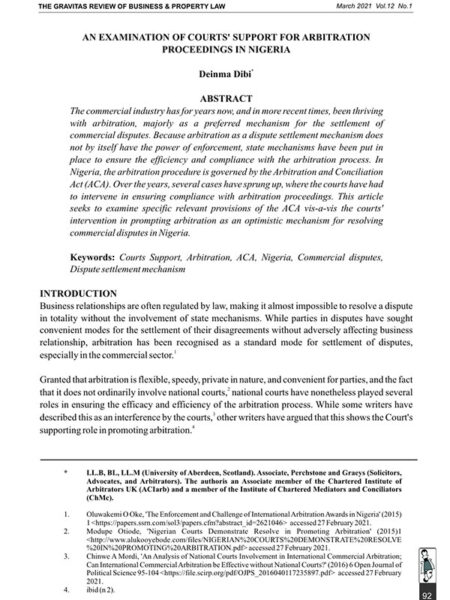
An Examination of Courts’ Support for Arbitration Proceedings in Nigeria
0₦2,500.00Deinma Dibi, Associate at Perchstone and Graeys in his article, An Examination of Courts’ Support for Arbitration Proceedings in Nigeria, examines the Arbitration and Conciliation Act, and decided cases to identify ways in which the courts in Nigeria support arbitral proceedings.
The Gravitas Review of Business & Property Law