-
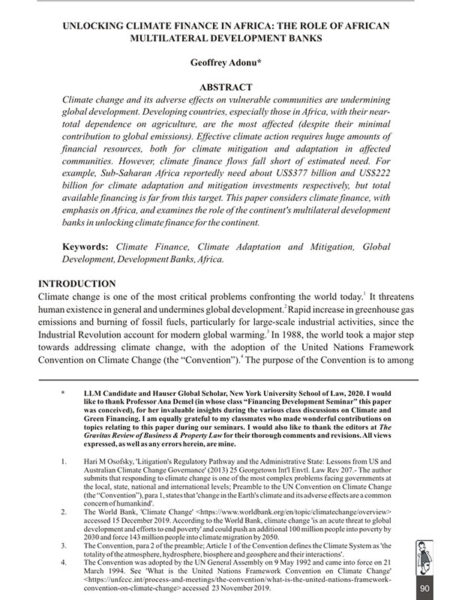
Unlocking Climate Finance in Africa: The Role of African Multilateral Development Banks
0₦2,500.00Geoffrey Adonu, Graduate Student at the New York University School of Law in, Unlocking Climate Finance in Africa: The Role of African Multilateral Development Banks, argues that climate change and its adverse effects on vulnerable communities are undermining global development. Developing countries, especially those in Africa, with their near-total dependence on agriculture, are the most affected despite their minimal contribution to global emissions. Effective climate action requires enormous amounts of financial resources, both for climate mitigation and adaptation in affected communities. However, climate finance flows fall short of the estimated need. Sub-Saharan Africa reportedly needs about US$377 billion and US$222 billion for climate adaptation and mitigation investments respectively, but total available financing is far from this target. Geoffrey considers climate finance, with emphasis on Africa, and examines the role of the continent’s multilateral development banks in unlocking climate finance for the continent.
-
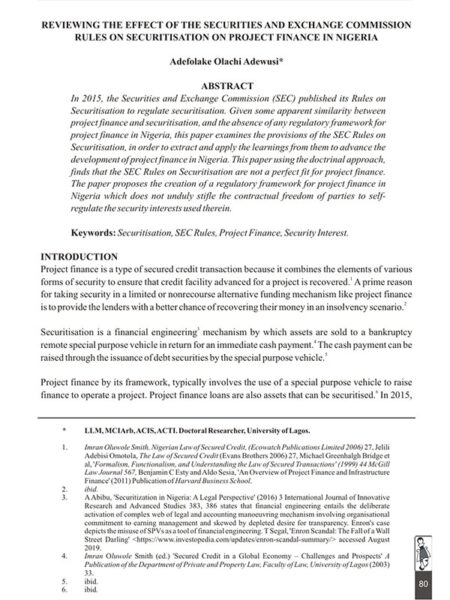
Reviewing the Effect of the Securities and Exchange Commission Rules on Securitisation on Project Finance in Nigeria
0₦2,500.00Adefolake Adewusi, Doctoral Researcher at the University of Lagos in her article, Reviewing the Effect of the Securities and Exchange Commission Rules on Securitisation on Project Finance in Nigeria, posits that the Securities and Exchange Commission (SEC) published its Rules on Securitisation in 2015 to regulate securitisation. Given the apparent similarity between project finance and securitisation, and in the absence of any regulatory framework for project finance in Nigeria. Adefolake examines the provisions of the SEC Rules on Securitisation to extract and apply the principles from them to advance the development of project finance in Nigeria. She argues that the SEC Rules on Securitisation are not a perfect fit for project finance and propose the creation of a regulatory framework for project finance in Nigeria which does not unduly stifle the contractual freedom of parties to self-regulate the security interests used.
-
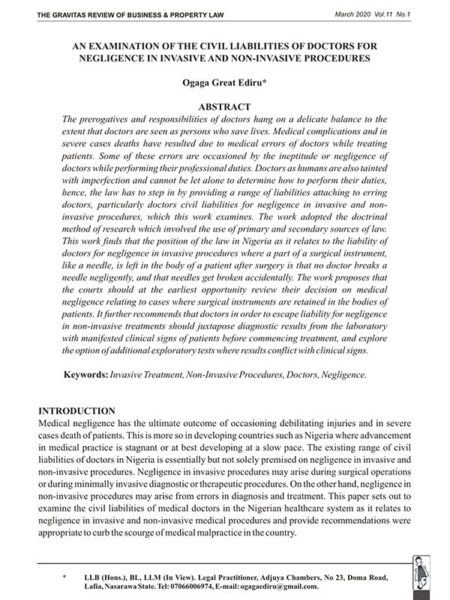
An Examination of the Civil Liabilities of Doctors for Negligence in Invasive and Non-Invasive Procedures
0₦2,500.00Ogaga Ediru of Adjuya Chambers, Lafia, Nasarawa State Nigeria in his article, An Examination of the Civil Liabilities of Doctors for Negligence in Invasive and Non-Invasive Procedures, reviews the liability of doctors for negligence while treating patients. He states that the position of the law in Nigeria as it relates to the liability of doctors for negligence in invasive procedures where a part of a surgical instrument, like a needle, is left in the body of a patient after surgery is that no doctor breaks a needle negligently, and that needles get broken accidentally. Ogaga proposes that the courts should at the earliest opportunity review their decision on medical negligence relating to cases where surgical instruments are retained in the bodies of patients. He recommends that doctors, in order to escape liability for negligence in non-invasive treatments, should juxtapose diagnostic results from the laboratory with manifested clinical signs of patients before commencing treatment, and explore the option of additional exploratory tests where results conflict with clinical signs.
-
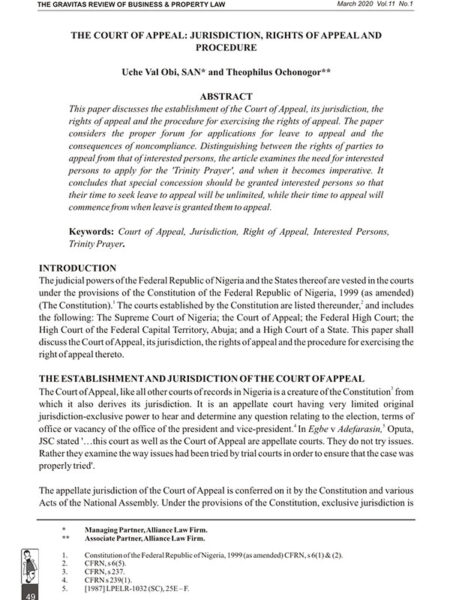
The Court of Appeal: Jurisdiction, Rights of Appeal and Procedure
0₦2,500.00Uche Val Obi, SAN and Theophilus Ochonogor of the Alliance Law Firm in their article, The Court of Appeal: Jurisdiction, Rights of Appeal and Procedure, examine the jurisdiction, rights of appeal and procedure of the Court of Appeal. They consider intriguing issues including appeals by interested persons, whether there is a time limit within which an applicant may seek leave to appeal as an interested party, whether an interested party is exempted from seeking the ‘trinity prayers’ and whether an applicant seeking to appeal as an interested party is to approach the trial high court or the Court of Appeal in the first instance.
-
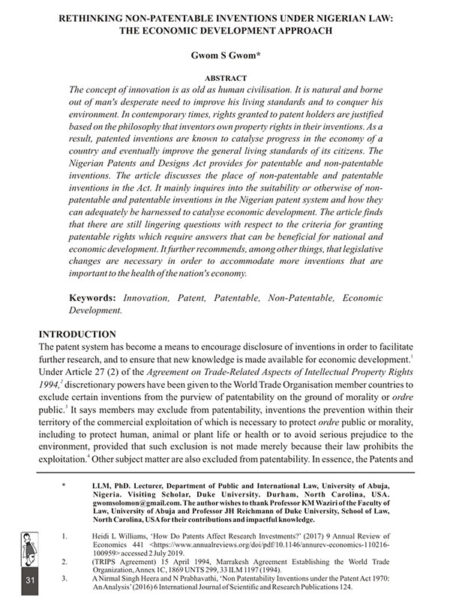
Rethinking Non-Patentable Inventions under Nigerian Law: The Economic Development Approach
0₦2,500.00Dr Gwom Gwom of the Department of Public and International Law, University of Abuja Nigeria in his article, Rethinking Non-Patentable Inventions under Nigerian Law: The Economic Development Approach, reviews the legal and regulatory regime of Patents in Nigeria. He examines the criteria for patentability of an invention; inquire into the suitability or otherwise of patentable and non-patentable inventions in the Nigerian Patent System; posit that there are still lingering questions with respect to the criteria for granting patentable rights which require answers that can be beneficial for national and economic development; and conclude that legislative changes are necessary in order to accommodate more inventions that are important to the health of the nation’s economy.
-
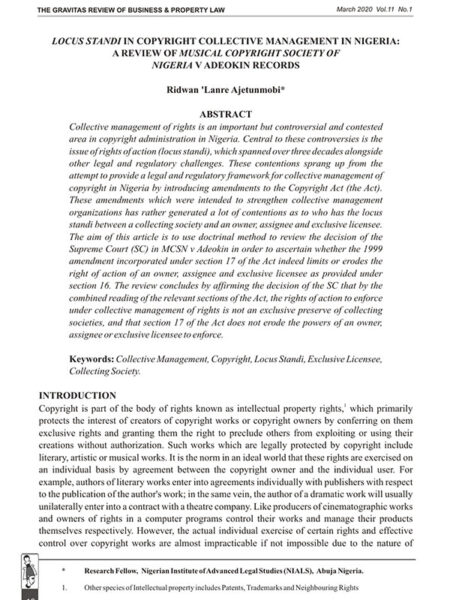
Locus Standi in Copyright Collective Management in Nigeria: A Review of Musical Copyright Society of Nigeria v Adeokin Records
0₦2,500.00Ridwan Ajetunmobi, Research Fellow at the Nigerian Institute of Advanced Legal Studies Abuja Nigeria, in Locus Standi in Copyright Collective Management in Nigeria: A Review of Musical Copyright Society of Nigeria v Adeokin Records, examines the Supreme Court decision in Adeokin against the background of the amendments to the Copyright Act in 1992 and 1999 with regard to whether the right of action in copyright infringement is exclusive to collecting societies or is available to an owner, assignee or licensee of copyrighted works.
-
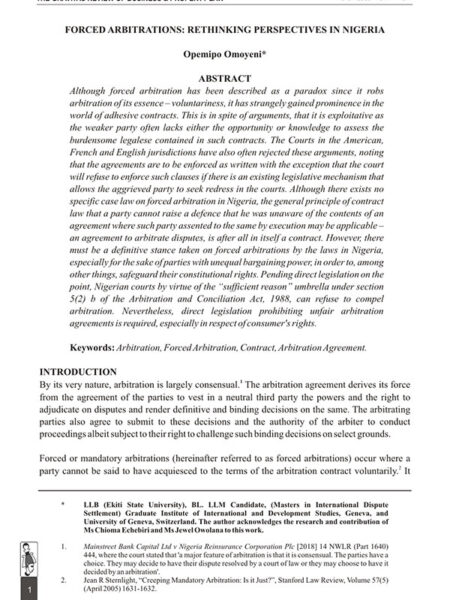
Forced Arbitrations: Rethinking Perspectives in Nigeria
0₦2,500.00Opemipo Omoyeni of the Graduate Institute of International and Development Studies Geneva Switzerland in his article, Forced Arbitrations: Rethinking Perspectives in Nigeria, considers the concept of Forced or Mandatory Arbitration which occurs mostly in standard form contracts where a party cannot be said to have acquiesced to the terms of the arbitration contract voluntarily. Omoyeni examines the state of the law in Nigeria, the United States of America, and the United Kingdom. Omoyeni posits that Forced Arbitration may work an injustice on the weaker party in an uneven bargaining position who is compelled to arbitrate his dispute while lacking the financial capacity or wherewithal to arbitrate, and who as well cannot be said to have given real consent to do so. He concludes with the need for legislation and the courts’ intervention to protect the weaker party.
-
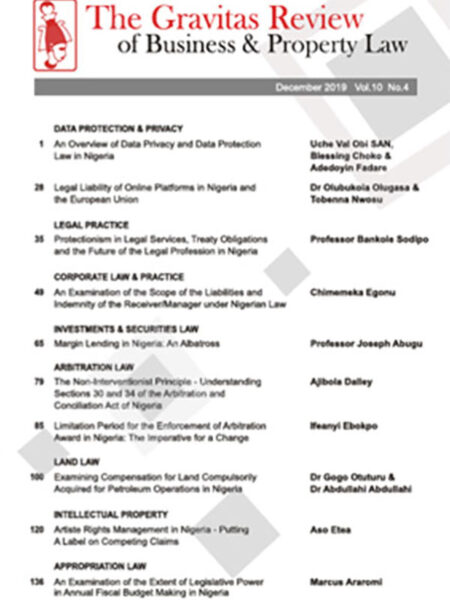
The Gravitas Review of Business & Property Law Vol.10 No.4 – Print
0₦5,000.00In this issue of The Gravitas Review of Business & Property Law Vol.10 No.4, there are well researched articles on:
- Data Protection & Privacy
- Legal Practice
- Corporate Law & Practice
- Investments & Securities Law
- Arbitration Law
- Land Law
- Intellectual Property
- Appropriation Law
-
The Gravitas Review of Business & Property Law Vol.10 No.4
0₦5,000.00In this issue of The Gravitas Review of Business & Property Law Vol.10 No.4, there are well researched articles on:
- Data Protection & Privacy
- Legal Practice
- Corporate Law & Practice
- Investments & Securities Law
- Arbitration Law
- Land Law
- Intellectual Property
- Appropriation Law
-
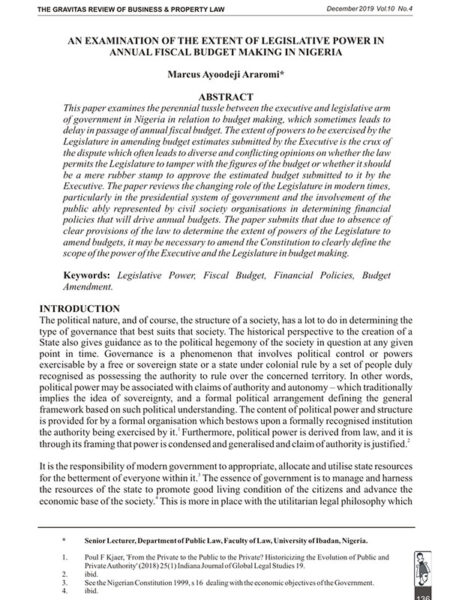
An Examination of the Extent of Legislative Power in Annual Fiscal Budget Making in Nigeria
0₦2,500.00Marcus Araromi, Senior Lecturer at the University of Ibadan, Nigeria in, An Examination of the Extent of Legislative Power in Annual Fiscal Budget Making in Nigeria, contributes to the debate on the extent of the power of the National Assembly to tinker with the budget estimates submitted to it by the Executive. The crux of the perennial disputes between the Legislature and the Executive has been whether the law permits the Legislature to tamper with the figures of the budget or whether it should be a mere rubber stamp to approve the estimated budget submitted to it by the Executive. Araromi reviews the changing role of the Legislature in modern times and the compelling logic of the proponents of the opposing views. He concludes that there is an absence of explicit provisions in the law enabling the Legislature to amend budgets and it is necessary to amend the Constitution to clearly define the scope of the power of the Executive and the Legislature in budget making.
-
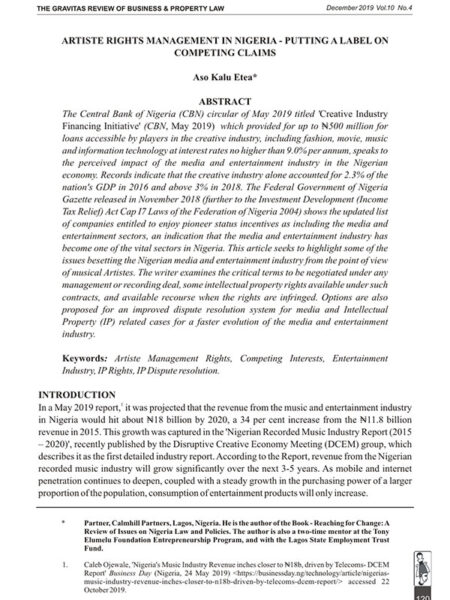
Artiste Rights Management in Nigeria – Putting A Label on Competing Claims
0₦2,500.00Aso Etea, Partner, Calmhill Partners, Lagos Nigeria in his article, Artiste Rights Management in Nigeria – Putting A Label on Competing Claims, reflects on the state of, and issues besetting, the creative industry in Nigeria. He graphically depicts ‘the making and breaking of careers’ of some artistes and what they ought to have done better. Aso examines the critical terms to be negotiated under any management or recording deal, intellectual property rights available under such contracts, and available recourse when the rights are infringed. He proposes an improved dispute resolution system for media and Intellectual Property (IP) related cases for faster evolution of the industry.
-
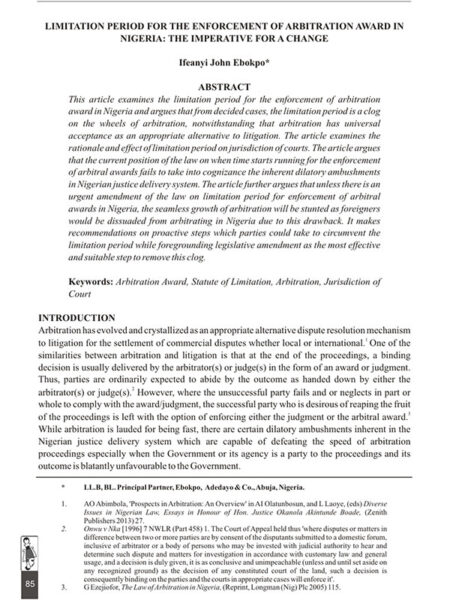
Limitation Period for the Enforcement of Arbitration Award in Nigeria: The Imperative for Change
0₦2,500.00Ifeanyi Ebokpo, Principal Partner, Ebokpo & Adedayo & Co Abuja Nigeria in his article,Limitation Period for the Enforcement of Arbitration Award in Nigeria: The Imperative for Change, examines the several modes and mechanisms for the recognition and enforcement of arbitral awards in Nigeria. He posits that the current position of the law on when time starts running for the enforcement of arbitral awards fails to take into cognizance the inherent dilatory processes in Nigerian justice delivery system. He advocates a change in the law so that the obvious drawback will not stunt the growth of arbitration.
The Gravitas Review of Business & Property Law