-
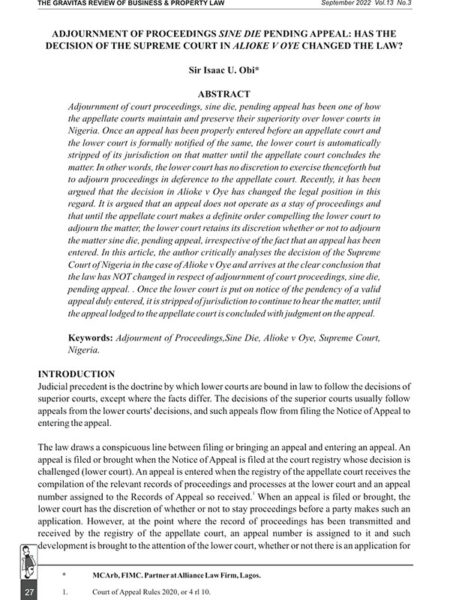
Adjournment of Proceedings Sine Die Pending Appeal: Has the Decision of the Supreme Court in Alioke V Oye Changed the Law?
0₦2,500.00Sir Isaac Obi, Partner at Alliance Law Firm, in his article, Adjournment of Proceedings Sine Die Pending Appeal: Has the Decision of the Supreme Court in Alioke V Oye Changed the Law? explains that adjournment of court proceedings, sine die, pending appeal has been one of the ways the appellate courts maintain and preserve their superiority over lower courts in Nigeria. Once an appeal has been properly entered before an appellate court and the lower court is formally notified, it is automatically stripped of its jurisdiction on that matter until the appellate court concludes the matter. Recently, it has been argued that the decision of the Supreme Court in Alioke v Oye has changed the law. It is argued that an appeal does not operate as a stay of proceedings and that until the appellate court makes a definite order compelling the lower court to adjourn the matter, the lower court retains its discretion whether or not to adjourn the matter sine die, pending appeal, irrespective of the fact that an appeal has been entered. Sir Obi critically analyses the decision in Alioke v Oye to see whether the law has really changed.
-
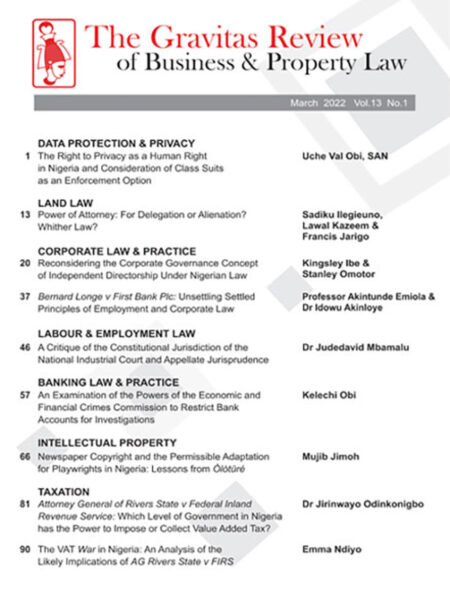
The Gravitas Review of Business & Property Law Vol.13 No.1 – Print
0₦5,000.00In this issue of The Gravitas Review of Business & Property Law Vol.13 No.1, there are well researched articles on:
- Data Protection & Privacy
- Land Law
- Corporate Law & Practice
- Banking Law & Practice
- Labour & Employment Law
- Intellectual Property
- Taxation
-
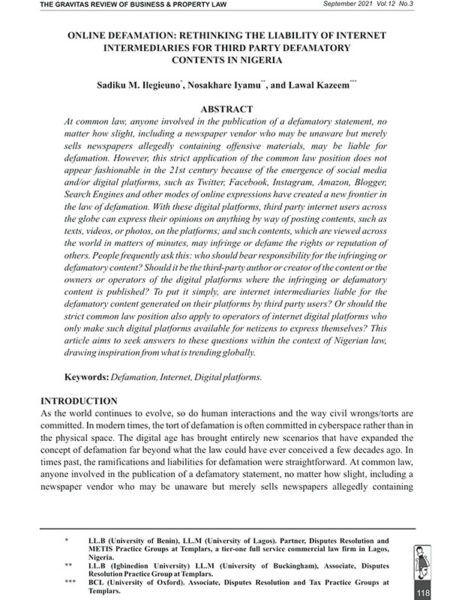
Online Defamation: Rethinking the Liability of Internet Intermediaries for Third-Party Defamatory Contents in Nigeria
0₦2,500.00Sadiku Ilegieuno, Nosakhare Iyamu, and Lawal Kazeem, Partner and Associates respectively at Templars, in their article, Online Defamation: Rethinking the Liability of Internet Intermediaries for Third-Party Defamatory Contents in Nigeria, note that the emergence of digital media has created a whole new category to the original definition of defamation, and the strict definition of the tort at common law has been rendered otiose in application to new media. Sadiku et al examine who bears the liability for defamatory content since several parties are often involved in the publication. Should it be the third-party author or creator of the content or the owners or operators of the digital platforms where the infringing or defamatory content is published? In other words, are internet intermediaries liable for the defamatory content generated on their platforms by third party users? They examine these questions within the context of the common law, the extant laws in Nigeria, and what is obtainable across the globe.
-
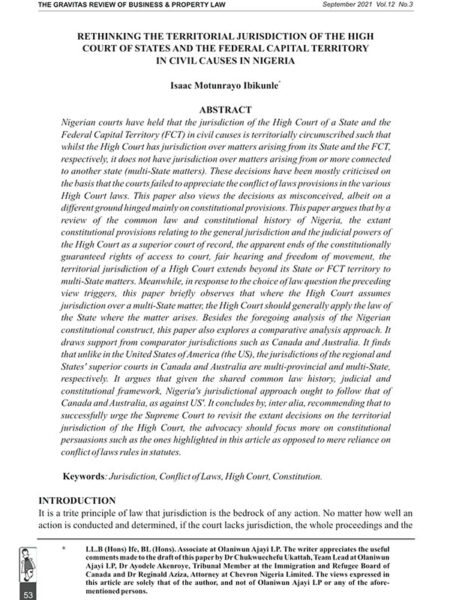
Rethinking the Territorial Jurisdiction of the High Court of States and the Federal Capital Territory in Civil Causes in Nigeria
0₦2,500.00Isaac Ibikunle, Associate at Olaniwun Ajayi LP, in his article, Rethinking the Territorial Jurisdiction of the High Court of States and the Federal Capital Territory in Civil Causes in Nigeria, notes that the extant position of Nigerian courts is that a State High Court does not have jurisdiction over matters arising from or more connected to another state (multi-State matters). He argues that this stance has been criticised because the courts failed to appreciate the conflict of laws provisions in the various High Court laws. From a review of the common law and constitutional history of Nigeria, Ibikunle opines that the territorial jurisdiction of a High Court should extend beyond its State to multi-State matters. He concludes with a recommendation that the Supreme Court should revisit the extant decisions on the territorial jurisdiction of the High Court on multi-State matters by aligning with the Canadian and Australian approaches on the issue.
-
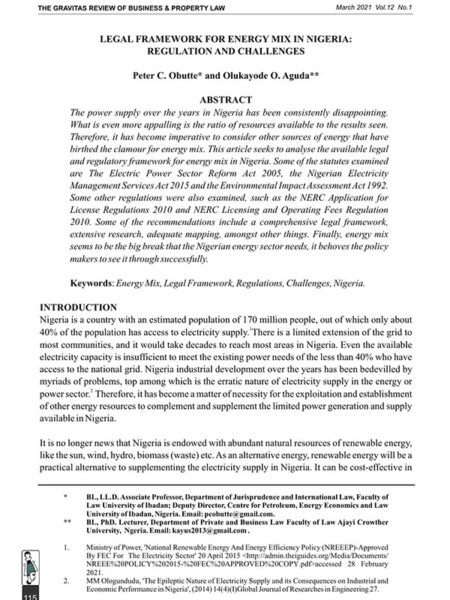
Legal Framework for Energy Mix in Nigeria: Regulation and Challenges
0₦2,500.00Dr Peter Obutte, Associate Professor, Faculty of Law, University of Ibadan and Dr Olukayode Aguda of the Faculty of Law, Ajayi Crowther University, in their article, Legal Framework for Energy Mix in Nigeria: Regulation and Challenges, note that energy mix refers to the combination of the various primary energy sources used to meet energy needs: fossil fuels (oil, natural gas and coal), nuclear energy, and renewable energy sources. Dr Obutte and Dr Aguda analyse the legal and regulatory framework for energy mix in Nigeria. They posit that energy mix seems to be the big break that the Nigerian energy sector needs, and it behooves the policymakers to see it through successfully with a comprehensive legal framework, extensive research and adequate mapping, amongst other things.
-
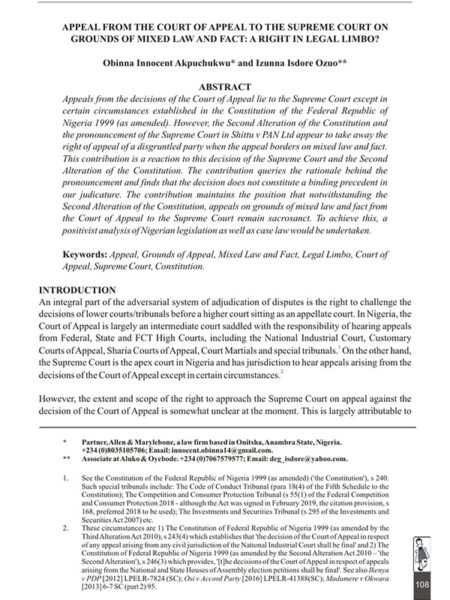
Appeal from the Court of Appeal to the Supreme Court on Grounds of Mixed Law and Fact: A Right in Legal Limbo?
0₦2,500.00Obinna Akpuchukwu, Partner Allen & Marylebone and Izunna Ozuo, Associate at Aluko & Oyebode in their article, Appeal from the Court of Appeal to the Supreme Court on Grounds of Mixed Law and Fact: A Right in Legal Limbo? note that Appeals from the decisions of the Court of Appeal lie to the Supreme Court except in certain circumstances established in the Constitution. However, a pronouncement of His Lordship Bode Rhodes-Vivour, JSC in Shittu v PAN Ltd and the Second Alteration of the Constitution appear to take away the right of appeal of an aggrieved party when the appeal borders on mixed law and fact. Obinna and Izunna query the rationale behind the pronouncement and argue that the decision does not constitute a binding precedent in Nigerian judicature. They opine that notwithstanding the Second Alteration of the Constitution, appeals on grounds of mixed law and fact from the Court of Appeal to the Supreme Court remain sacrosanct.
-
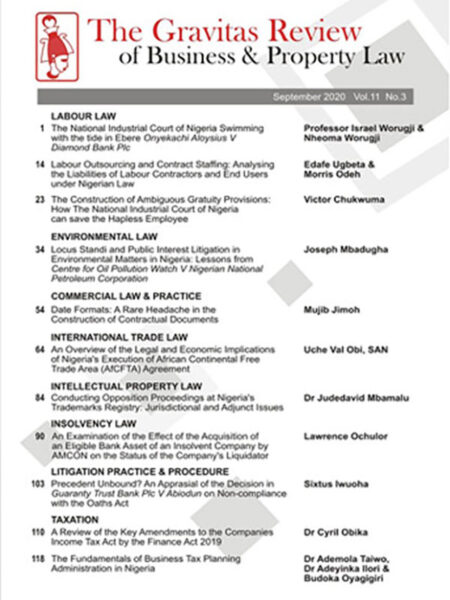
The Gravitas Review of Business & Property Law Vol.11 No.3 – E-Book
0₦5,000.00In this issue of The Gravitas Review of Business & Property Law Vol.11 No.3, there are well researched articles on:
- Labour Law
- Environmental Law
- Commercial Law & Practice
- International Trade Law
- Intellectual Property Law
- Insolvency Law
- Litigation Practice & Procedure
- Taxation
-
Labour Outsourcing and Contract Staffing: Analysing the Liabilities of Labour Contractors and End Users under Nigerian Law
0₦2,500.00Edafe Ugbeta and Morris Udeh of Aluko & Oyebode in their article, Labour Outsourcing and Contract Staffing: Analysing the Liabilities of Labour Contractors and End Users under Nigerian Law, >observe that generally, parties are bound by their contract, and the law does not permit the courts to alter or rewrite the terms and conditions freely agreed by the parties. However, recent decisions of the National Industrial Court of Nigeria suggest that the court may now hold end-users of labour and parent companies liable to adhere to statutory employment obligations relating to pensions, insurance, tax, health and compensation where the court considers that the labour contractor or subsidiary is a mere sham, agent, tool, or employee of the end-user/parent company for purposes of masking the identity of the real employer.
-
The National Industrial Court of Nigeria Swimming with the Tide in Ebere Onyekachi Aloysius V Diamond Bank Plc
0₦2,500.00Professor Israeli Worugji of the University of Calabar, Nigeria and Nheoma Worugji of the Rivers State University, Nkpolu-Oroworukwo Port Harcourt Nigeria, in their article, The National Industrial Court of Nigeria Swimming with the Tide in Ebere Onyekachi Aloysius V. Diamond Bank, note that ordinarily, an employer has the freedom to terminate the employment of an employee upon due notice and regardless of motive. The National Industrial Court of Nigeria (NICN) in a recent decision, however, seems to have limited the employer’s otherwise open-ended power to bring the contract of employment to an end. In Aloysius case, the NICN, relying on international labour standards and its new mandate under the Constitution (Third Alteration) Act, decided that no termination of a contract of employment should take place unless there is a valid reason connected with the capacity or conduct of the employee or based on the operational requirements of the establishment.Professor Israel Worugji and Nheoma Worugji review the Aloysius the case against the background of the common law and statutory provision on termination of employment, the International Labour Organisation’s instruments and international best practices.
-
An Analysis of Corporate Criminal Liability in Nigeria
0₦2,500.00Veronica Ekundayo, Orisakwe Okechinyere, and Olalekan Lalude all of the Babcock University, School of Law and Security Studies Iperu Nigeria, in their article An Analysis of Corporate Criminal Liability in Nigeria, examine the concept and jurisprudential underpinnings of corporate criminal liability. They explore Nigerian criminal statutes providing for liability of companies for criminal infractions. They also consider judicial attitude to corporate criminal liability in Nigeria, the practice in other jurisdictions and conclude that the Nigerian regulatory framework should employ modern approaches in tackling corporate criminal liability in the country.
-
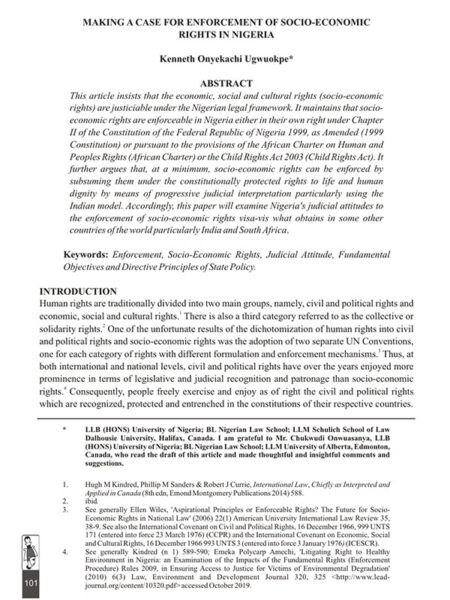
Making a Case for Enforcement of Socio-Economic Rights in Nigeria
0₦2,500.00Kenneth Ugwuokpe in his article, Making a Case for Enforcement of Socio-Economic Rights in Nigeria, insists, no doubt controversially, that the economic, social and cultural rights indicated as “fundamental objectives and directive principles of state policy” in the 1999 Constitution of Nigeria, are justiciable under the Nigerian legal framework. Kenneth argues that the socio-economic rights are enforceable in Nigeria either in their own right under Chapter II of the Constitution or pursuant to the provisions of the African Charter on Human and Peoples Rights or the Child Rights Act 2003. He further posits that, at a minimum, socio-economic rights can be enforced by subsuming them under the constitutionally protected rights to life and human dignity by means of progressive judicial interpretation, particularly using the Indian model. He examines Nigeria’s judicial attitudes to the enforcement of socio-economic rights vis-a-vis what obtains in some other countries, notably India and South Africa.
-
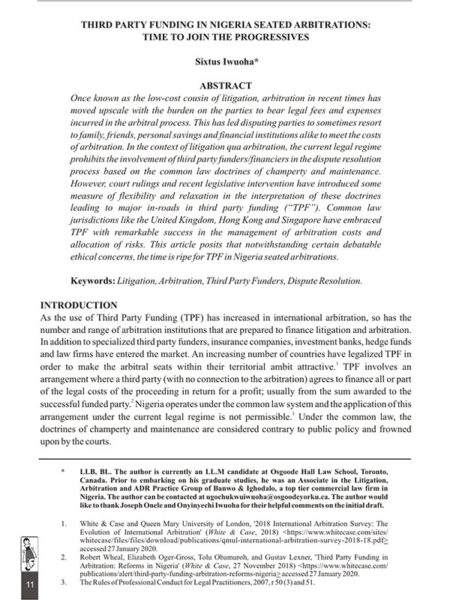
Third-Party Funding in Nigeria Seated Arbitrations: Time To Join The Progressives
0₦2,500.00Sixtus Iwuoha, formerly of Banwo & Igholado and now of the Osgoode Hall Law School, Toronto Canada, in his article, Third-Party Funding in Nigeria Seated Arbitrations: Time To Join The Progressives, posits that Arbitration, once known as the low-cost cousin of litigation, has moved upscale with a heavy burden on the parties to bear legal fees and expenses incurred in the arbitral process. This has led disputing parties to sometimes resort to family, friends, personal savings and financial institutions alike to meet the costs of arbitration. In the context of litigation qua arbitration, Nigeria’s current legal regime prohibits the involvement of third-party funders/financiers in the dispute resolution process based on the common law doctrines of champerty and maintenance. However, court rulings and recent legislative intervention have introduced some measure of flexibility and relaxation in the interpretation of these doctrines leading to major in-roads in third party funding TPF in jurisdictions like the United Kingdom, Hong Kong and Singapore. Sixtus concludes that notwithstanding certain debatable ethical concerns, the time is ripe for TPF in Nigeria seated arbitrations.
The Gravitas Review of Business & Property Law