-
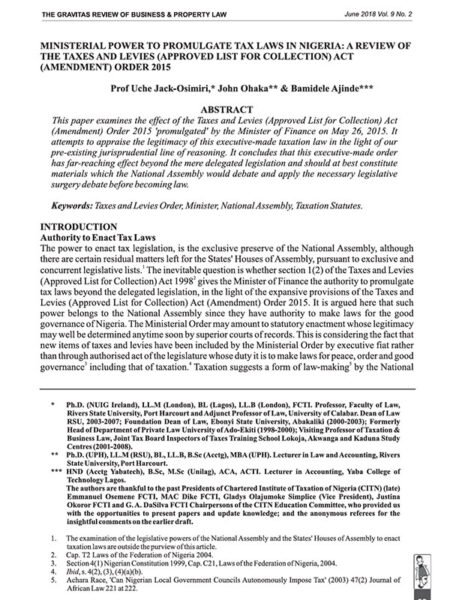
Ministerial Power to Promulgate Tax Laws in Nigeria: A Review of the Taxes and Levies (Approved List for Collection)Act (Amendment) Order 2015
0₦2,500.00Professor Uche Jack-Osimiri, John Ohaka and Bamidele Ajinde in their paper, Ministerial Power to Promulgate Tax Laws in Nigeria: A Review of the Taxes and Levies (Approved List for Collection) Act (Amendment) Order 2015 appraise the legitimacy of the Ministerial Order of 2015 in the light of pre-existing jurisprudential reasoning and case law. They posit that though section 1(2) of the Taxes and Levies (Approved List for Collection) Act 1998 provides that the Minister of Finance, may on the advice of the Joint Tax Board and by Order published in the Gazette, amend the Schedule to the Act, the Amendment Order of 2015 was shoddily done, lacks the necessary legislative rigour, and was most expansive as to belie the concept of delegated or subsidiary legislation.
-
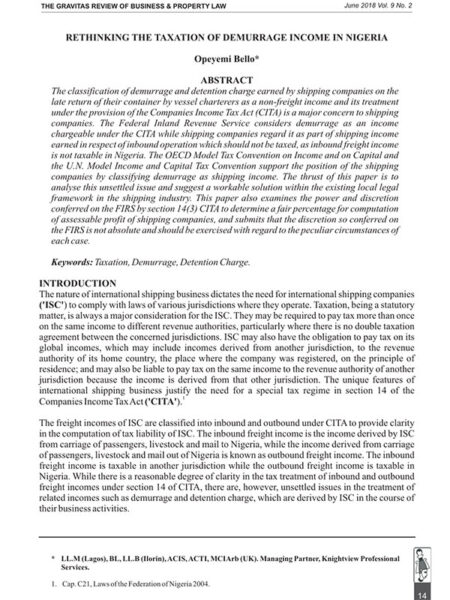
Rethinking the Taxation of Demurrage Income in Nigeria
0₦2,500.00Opeyemi Bello, Managing Partner, Knightview Professional Services in Rethinking the Taxation of Demurrage Income in Nigeria, observes that the classification of demurrage earned by shipping companies on the late return of their containers by charterers as a non-freight income, and its treatment under the provision of the Companies Income Tax Act (CITA) is a major concern to shipping companies; while the Federal Inland Revenue Service (FIRS) considers demurrage as an income chargeable under the CITA, the shipping companies regard it as part of shipping income earned in respect of inbound operation which is not taxable in Nigeria. Bello analyses this unsettled issue, and the discretion conferred on the FIRS by section 14(3) CITA to determine a fair percentage for computation of assessable profit of shipping companies, and suggests a workable solution within the existing legal framework.
-
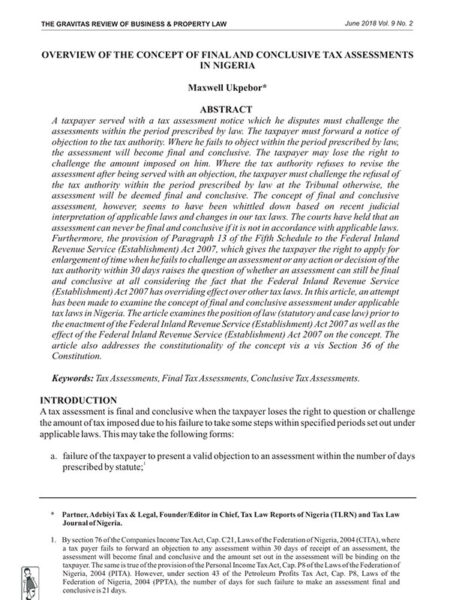
Overview of the Concept of Final and Conclusive Tax Assessments in Nigeria
0₦2,500.00Maxwell Ukpebor, Partner, Adebiyi Tax & Legal, and Editor-in-Chief of Tax Law Reports of Nigeria in his paper, Overview of the Concept of Final and Conclusive Tax Assessments, notes that a taxpayer served with a tax assessment which he disputes must challenge the assessment within the period prescribed by law otherwise the assessment becomes final and conclusive. He examines the constitutionality of the concept of final and conclusive tax assessment in Nigeria, the position of law (statutory and case law) prior to the enactment of the Federal Inland Revenue Service (Establishment) Act 2007, as well as the effect of the FIRS Act on the concept.
-
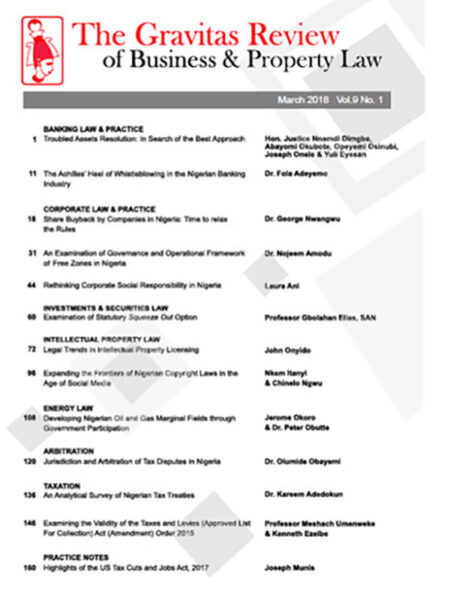
The Gravitas Review of Business & Property Law Vol.9 No.1 – Print
0₦5,000.00In this issue of The Gravitas Review of Business & Property Law Vol.9 No.1, there are well researched articles on:
- Banking Law & Practice
- Corporate Law & Practice
- Investments & Securities Law
- Intellectual Property Law
- Energy Law
- Arbitration
- Taxation
- Practice Notes
-
The Gravitas Review of Business & Property Law Vol.9 No.1 – E-Book
0₦5,000.00In this issue of The Gravitas Review of Business & Property Law Vol.9 No.1, there are well researched articles on:
- Banking Law & Practice
- Corporate Law & Practice
- Investments & Securities Law
- Intellectual Property Law
- Energy Law
- Arbitration
- Taxation
- Practice Notes
-
The Gravitas Review of Business & Property Law Vol.9 No.1
0₦5,000.00In this issue of The Gravitas Review of Business & Property Law Vol.9 No.1, there are well researched articles on:
- Banking Law & Practice
- Corporate Law & Practice
- Investments & Securities Law
- Intellectual Property Law
- Energy Law
- Arbitration
- Taxation
- Practice Notes
-
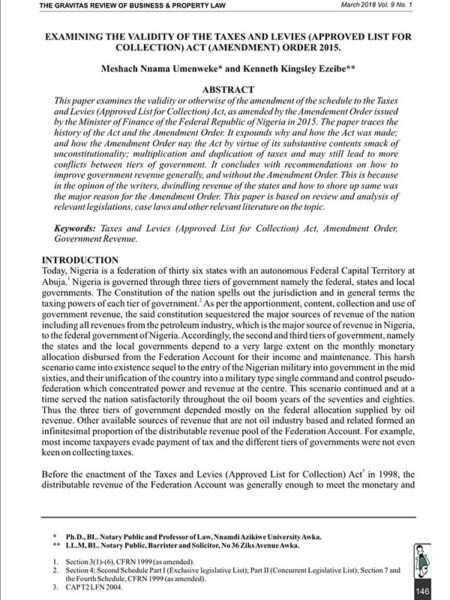
Examining the Validity of the Taxes and Levies (Approved List For Collection) Act (Amendment) Order 2015
0₦2,500.00Professor Meshach Umenweke of the Nnamdi Azikiwe University Awka, and Kenneth Ezeibe, legal practitioner, in their article “Examining the Validity of the Taxes and Levies (Approved List For Collection) Act (Amendment) Order 2015”, consider whether the Minister of Finance has the vires to amend the Schedule to the principal Act, and whether the items listed in the Order are consistent with the legislative and taxing powers of each tier of government under the Constitution.
-
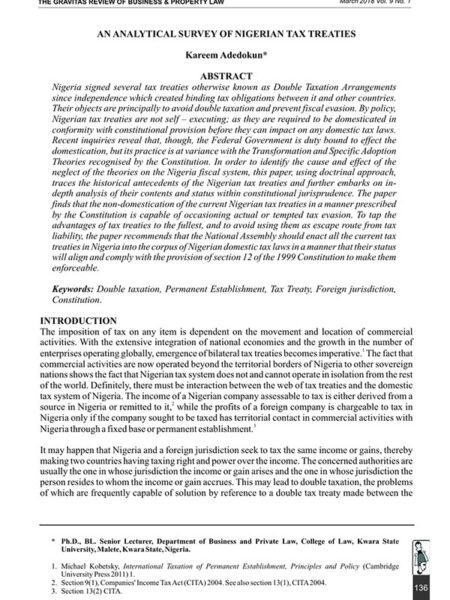
An Analytical Survey of Nigerian Tax Treaties
0₦2,500.00Dr. Kareem Adedokun, Senior Lecturer, Department of Business and Private Law, Kwara State University, in “An Analytical Survey of Nigerian Tax Treaties”,explains that Nigeria has since Independence, signed several tax treaties which created binding tax obligations between it and other countries. The objects of the treaties are principally to avoid double taxation and prevent fiscal evasion. He argues that the non-domestication of the tax treaties in a manner prescribed by the Constitution is capable of occasioning actual or tempted tax evasion. He recommends the domestication of the treaties to take full advantage of them, and to avoid them being used to escape tax liability.
-
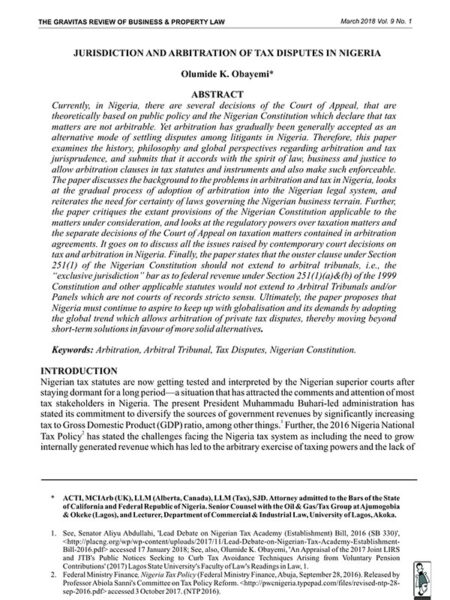
Jurisdiction and Arbitration of Tax Disputes in Nigeria
0₦2,500.00Dr. Olumide Obayemi, of the Department of Commercial & Industrial Law, University of Lagos, and of & Okeke, in his article, “Jurisdiction and Arbitration of Tax Disputes in Nigeria” observes that currently, based on public policy and the Constitution, tax matters are not arbitrable. He examines the history, philosophy and global perspectives regarding arbitration and tax jurisprudence, and submits that it accords with the spirit of law, business and justice to allow arbitration clauses in tax statutes. He reviews the decisions of the Court of Appeal on taxation matters contained in arbitration agreements, and submits that the exclusive jurisdiction conferred on the Federal High Court by Section 251(1)(a)&(b) of the 1999 Constitution should not bar arbitral tribunals which are not courts of records stricto sensu. He concludes that Nigeria must continue to aspire to keep up with and its demands by adopting the global trend which allows arbitration of private tax disputes.
-
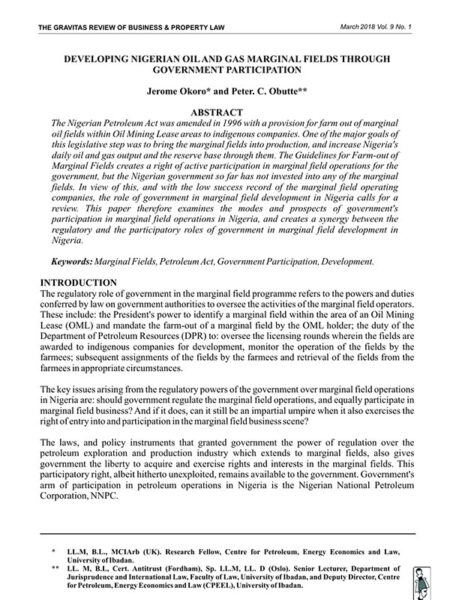
Developing Nigerian Oil and Gas Marginal Fields through Government Participation
0₦2,500.00Jerome Okoro and Dr. Peter Obutte, of the Centre for Petroleum, Energy Economics and Law, University of Ibadan in their article, “Developing Nigerian Oil and Gas Marginal Fields through Government Participation”, define what qualifies as a marginal field and note that the 1996 amendment to the Petroleum Act provides for farming out of marginal oil fields within Oil Mining Lease areas to indigenous companies. A major goal of the law was to bring the marginal fields into production, and increase Nigeria’s daily oil and gas output and the reserve base through them. Though the Guidelines for Farm-out of Marginal Fields creates a right of active participation in marginal field operations for the government, the Nigerian government so far has not invested into any of the marginal fields Okoro and Obutte undertake a review of the Nigerian marginal field development program, the legal basis of regulatory role of government, structure of Nigerian petroleum operations and expected reforms under the Petroleum Industry Governance Bill, 2017.
-
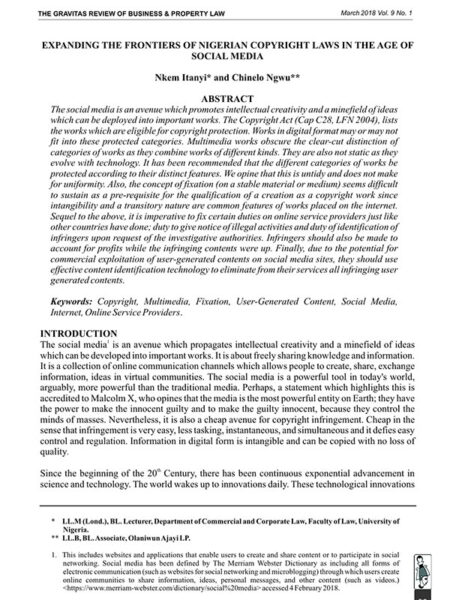
Expanding the Frontiers of Nigerian Copyright Laws in the Age of Social Media
0₦2,500.00Nkem Itanyi, Lecturer, Department of Commercial and Corporate Law, University of Nigeria, Nsukka and Chinelo Ngwu, Associate, Olaniwun Ajayi LP in their article, “Expanding the Frontiers of Nigerian Copyright Laws in the Age of Social Media, note that though social media promotes intellectual creativity, and is a minefield of ideas which can be deployed into important works, works in the digital formal may or may not be protected under the Nigerian Copyright Act. As the fixation concept has become obsolete with technology, it becomes difficult to sustain as a pre-requisite for the qualification of a creation as a copyright work since intangibility and a transitory nature are common features of works placed on the internet. To cope with new infringement mechanisms in the digital era and conflict of law problems, it may be necessary to fix certain duties, such as duty to give notice of illegal activities, and duty of identification of infringers, on online service providers just like other countries have done.
-
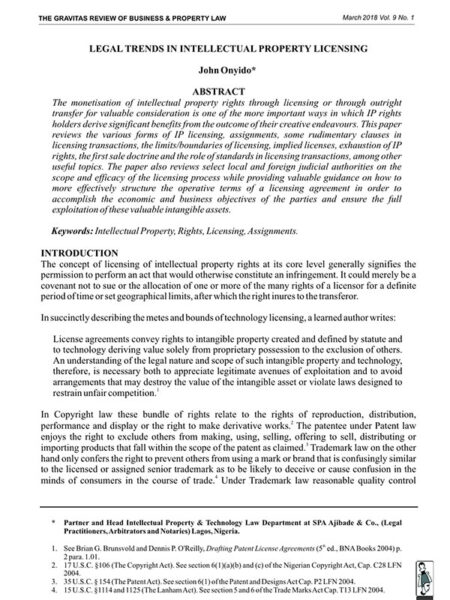
Legal Trends in Intellectual Property Licensing
0₦2,500.00John Onyido, Partner, SPA Ajibade & Co in his article, “Legal Trends in Intellectual Property Licensing”observes that the monetisation of intellectual property rights through licensing or through outright transfer for valuable consideration is one of the more important ways in which IP rights holders derive significant benefits from their creative. John reviews the various forms of IP licensing, assignments, some rudimentary clauses in licensing transactions, the limits/boundaries of licensing, implied licenses, exhaustion of IP rights, the first sale doctrine and the role of standards in licensing transactions, among others. He considers select local and foreign judicial authorities on the scope and efficacy of the licensing process while providing valuable guidance on how to more effectively structure the operative terms of a licensing agreement in order to accomplish the objectives of the parties.
The Gravitas Review of Business & Property Law