-
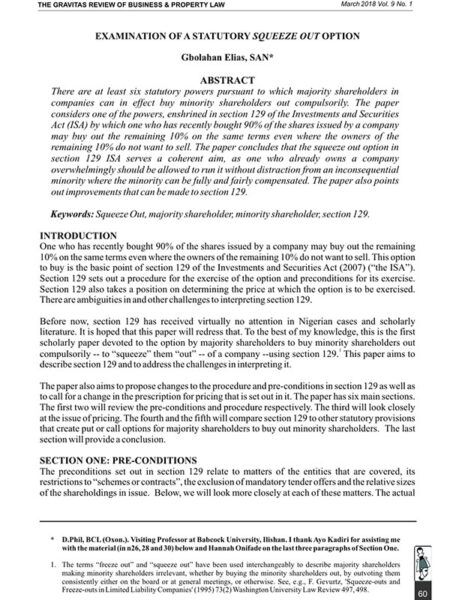
Examination of a Statutory Squeeze Out Option
0₦2,500.00Professor Gbolahan Elias, Chairman, Lagos State Law Reform Commission, and Partner G. Elias & Co in his article, “Examination of a Statutory Squeeze Out Option”, notes that there are at least six statutory powers pursuant to which majority shareholders in companies can in effect buy minority shareholders out compulsorily. He considers one of the powers enshrined in section 129 of the Investments and Securities Act (ISA) by which one who has recently bought 90% of the shares issued by a company may buy out the remaining 10% on the same terms even where the owners of the remaining 10% do not want to sell. He concludes that the squeeze out option in section 12 ISA is, as one who already owns a company overwhelmingly should be allowed to run it without distraction from an inconsequential minority where the minority can be fully and fairly compensated.
-
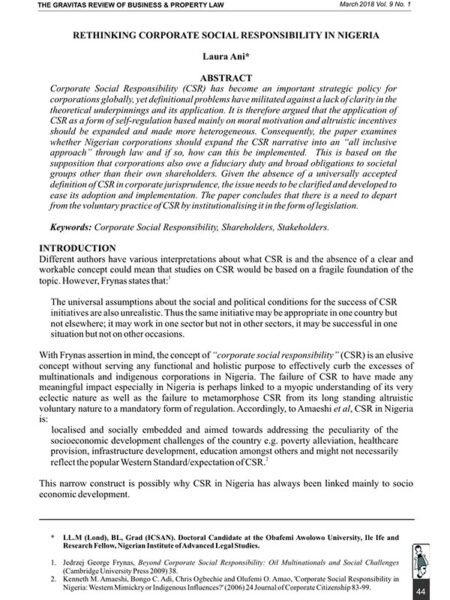
Rethinking Corporate Social Responsibility in Nigeria
0₦2,500.00Laura Ani, Research Fellow, Nigerian Institute of Advanced Legal Studies, in her article, “Rethinking Corporate Social Responsibility in Nigeria”, argues that the application of CSR as a form of self-regulation based mainly on moral motivation and altruistic incentives should be reappraised. She examines the Shareholder Primacy and Stakeholder Communitarianism approaches to CSR, the statutory framework for CSR in Nigeria and how other jurisdictions have treated the issue of CSR. She concludes that there is a need to depart from the voluntary practice of CSR by institutionalising it in the form of legislation.
-
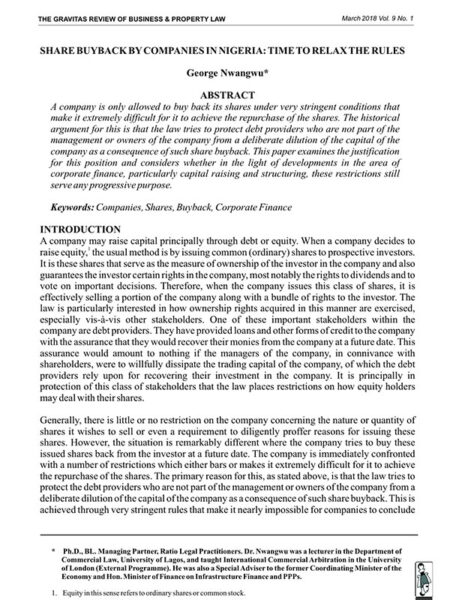
Share Buyback by Companies in Nigeria: Time to Relax the Rule
0₦2,500.00Dr. George Nwangwu, Managing Partner, Ratio Legal Practitioners, and Special Adviser to the ex-Minister of Finance on Infrastructure Finance and PPPs, in his article, “Share Buyback by Companies in Nigeria: Time to Relax the Rules” notes that a Nigerian company is allowed to buy back its shares under very stringent conditions that make it extremely difficult for it to achieve the repurchase of the shares. The historical argument for this is the protection of debt providers, who are not part of the management or owners of the company, from a deliberate dilution of the capital of the company as a consequence of such share buyback. He examines the justification for this position and considers whether in the light of developments in corporate finance, particularly capital raising and structuring, these restrictions still serve any useful.
-
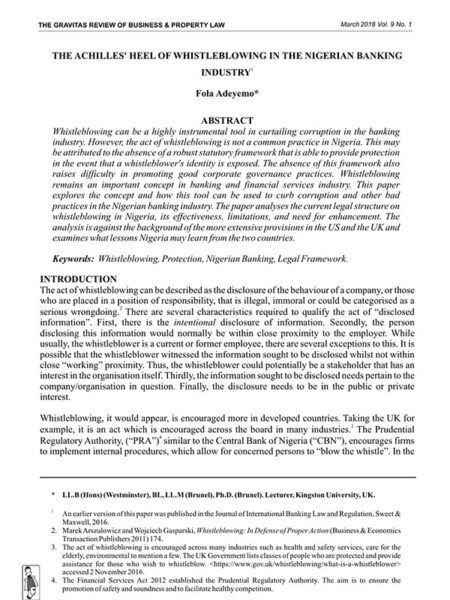
The Achilles’ Heel of Whistleblowing in the Nigerian Banking Industry
0₦2,500.00Dr. Fola Adeyemo, Lecturer, Kingston University UK in her paper, “The Achilles’ Heel of Whistleblowing in the Nigerian Banking Industry”,laments the absence of a robust statutory framework for protection of whistleblowers in Nigeria. She analyses the current legal structure on whistleblowing in Nigeria with emphasis on the banking industry. The analysis is against the background of the more extensive provisions in the US and the UK. She concludes with the lessons Nigeria can learn from the two countries.
-
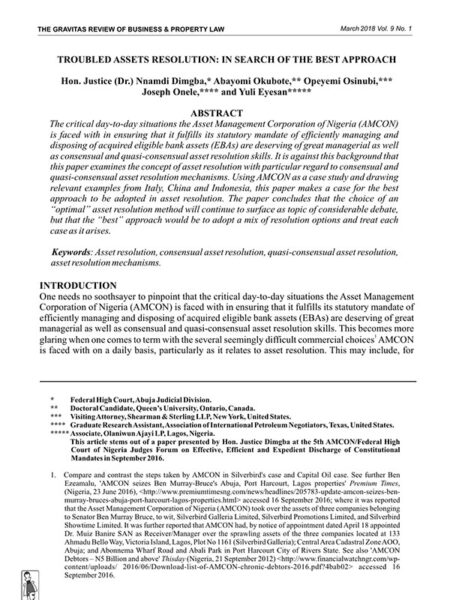
Troubled Assets Resolution in Search of the Best Approach
0₦2,500.00Hon. Justice (Dr) Nnamdi Dimgba of the Federal High Court Abuja, and the quartet of Abayomi Okubote, Opeyemi Osinubi, Joseph Onele and Yuli Eyesan in their paper, “Troubled Assets Resolution-In Search of the Best Approach”,examine the concept of asset resolution with particular regard to consensual and quasi-consensual resolution mechanisms. Using AMCON as a case study, and analysing its mandate to manage and dispose of acquired eligible banks assets (EBAs), and drawing relevant examples from Italy, China and Indonesia, they consider adversarial recovery methods, and non-adversarial consensual or quasi-consensual resolution options by which the ‘toxic assets bank’ may fulfill its mandate. They conclude that the “best” approach would be to adopt a mix of resolution options and treat each case as it arises.
-
The Gravitas Review of Business & Property Law Vol.8 No.4 – Print
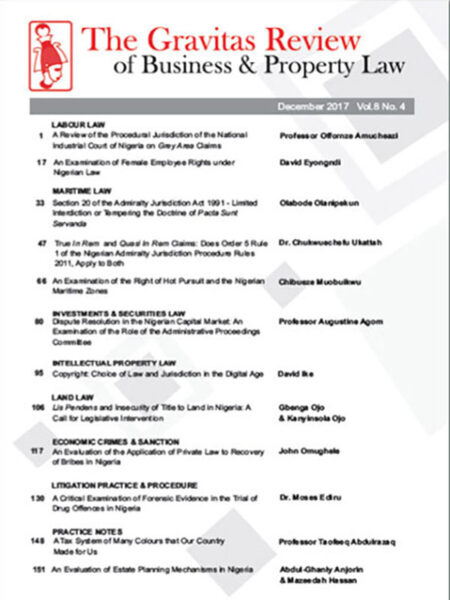
0₦5,000.00In this issue of The Gravitas Review of Business & Property Law Vol.8 No.4, there are well researched articles on:
- Labour Law
- Maritime Law
- Investments & Securities Law
- Intellectual Property Law
- Land Law
- Economic Crimes & Sanction
- Litigation Practice & Procedure
- Practice Notes
-
The Gravitas Review of Business & Property Law Vol.8 No.4 – E-Book
0₦5,000.00In this issue of The Gravitas Review of Business & Property Law Vol.8 No.4, there are well researched articles on:
- Labour Law
- Maritime Law
- Investments & Securities Law
- Intellectual Property Law
- Land Law
- Economic Crimes & Sanction
- Litigation Practice & Procedure
- Practice Notes
-
The Gravitas Review of Business & Property Law Vol.8 No.4
0₦5,000.00In this issue of The Gravitas Review of Business & Property Law Vol.8 No.4, there are well researched articles on:
- Labour Law
- Maritime Law
- Investments & Securities Law
- Intellectual Property Law
- Land Law
- Economic Crimes & Sanction
- Litigation Practice & Procedure
- Practice Notes
-
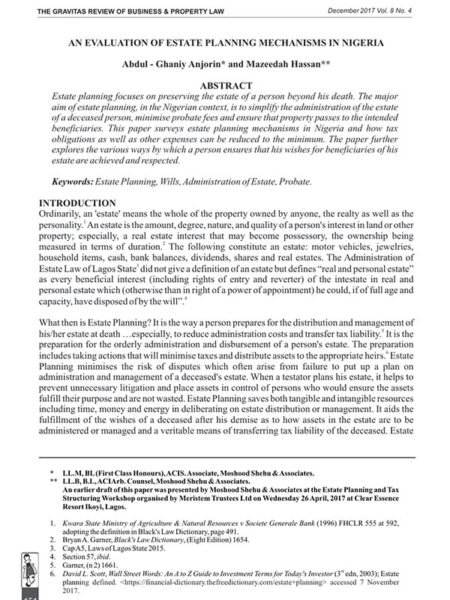
An Evaluation of Estate Planning Mechanisms in Nigeria
0₦2,500.00Despite the repeal of the Capital Transfer Tax Act 1979, some states, including Lagos, continue to charge a variant of inheritance tax called “Estate Duty”, before grant of probate or letters of administration in respect of a deceased person’s estate. Against this background, Abdul-Ghaniy Anjorin and Mazeedah Hassan, Legal Practitioners, in their paper, “An Evaluation of Estate Planning Mechanisms in Nigeria”, examine various estate planning devices that may be employed by an estate owner to simplify the administration of his estate, minimise probate fees, and ensure a seamless intergenerational transfer of assets.
-
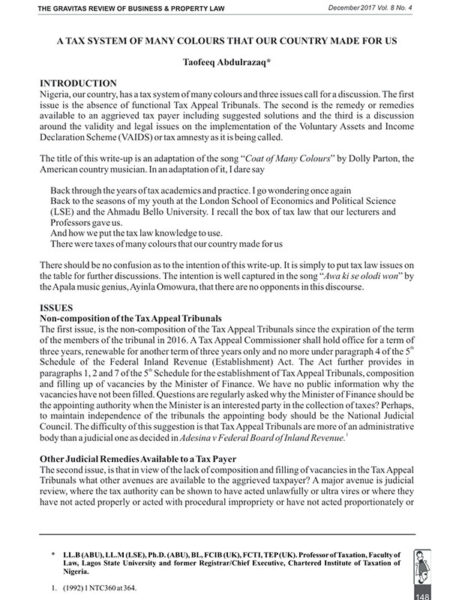
A Tax System of Many Colours that Our Country has Made for Us
0₦2,500.00Professor Taofeeq Abdulrazaq, Tax Partner, Nolands Nigeria Professional Services, waxes lyrical in “A Tax System of Many Colours that Our Country Made for Us”. He examines the legal status and validity of the Voluntary Assets and Income Declaration Scheme (VAIDS) and extra-statutory concessions, generally. He explores other judicial remedies available to a tax payer in light of the non-composition of the Tax Appeal Tribunals, and concludes that “conclusions are meaningless in a state of flux”.
-
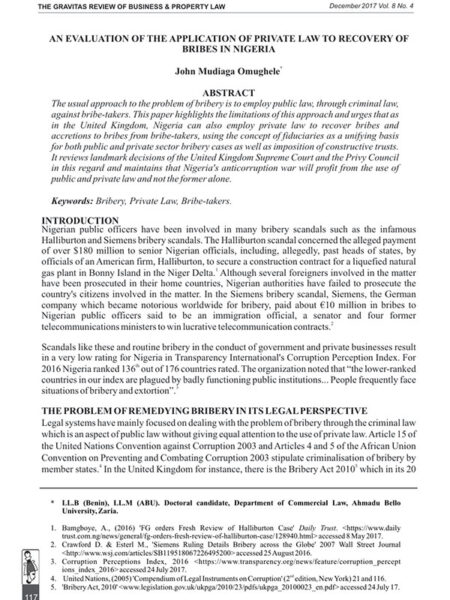
An Evaluation of the Application of Private Law to Recovery of Bribes in Nigeria
0₦2,500.00John Omughele, Legal Practitioner and researcher, in his article, “An Evaluation of the Application of Private Law to Recovery of Bribes in Nigeria”, notes that the usual approach to the problem of bribery is to employ public law, through criminal law, against bribe-takers. He highlights the limitations of this approach and argues that as in the United Kingdom, Nigeria can also employ private law to recover bribes and accretions to bribes from bribe-takers, using the concept of fiduciaries as a unifying basis for both public and private sector bribery cases, as well as imposition of constructive trusts.
-
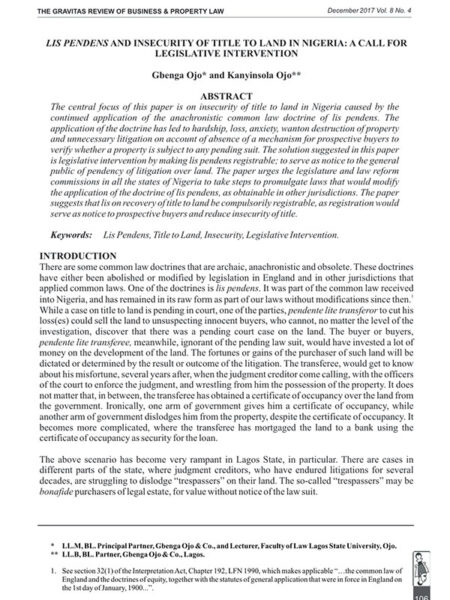
Lis Pendens and Insecurity of Title to Land in Nigeria: A Call for Legislative Intervention
0₦2,500.00Is a sale transaction pendente lite void or voidable? Gbenga Ojo, Lecturer, Lagos State University, and Kanyinsola Ojo, Partner, Gbenga Ojo & Co, in their engaging article, “Lis Pendens and Insecurity of Title to Land in Nigeria: A Call for Legislative Intervention”, review Supreme Court decisions on the nature of title transferred during litigation. They argue that the legal immunity given to a bona fide purchaser for value without notice, and the indefeasibility of title conferred on a purchaser under the (repealed) Registration of Title Law (now replaced by the Land Registration Law of Lagos State, 2015) will not avail a purchaser pendente lite. They call for compulsory registration of pending litigations on land, as done in some other jurisdictions, to serve as notice to prospective buyers, and reduce insecurity of title.
The Gravitas Review of Business & Property Law