-
Enforcement of Arbitral Awards: Navigating the Uncertainties of Public Policy Defence
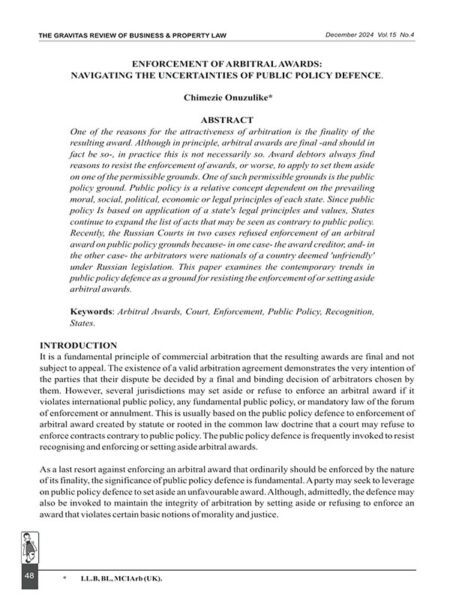
0₦2,500.00Chimezie Onuzulike in his article, Enforcement of Arbitral Awards: Navigating the Uncertainties of Public Policy Defence, examines the contemporary trends in public policy defence as a ground for resisting the enforcement of or setting aside arbitral awards. One of the reasons for the attractiveness of arbitration is the finality of the resulting award. Although in principle, arbitral awards are final -and should in fact be so-, in practice this is not necessarily so. Award debtors always find reasons to resist the enforcement of awards, or worse, to apply to set them aside on one of the permissible grounds. One of such permissible grounds is the public policy ground. Public policy is a relative concept dependent on the prevailing moral, social, political, economic or legal principles of each state. Since public policy Is based on application of a state’s legal principles and values, States continue to expand the list of acts that may be seen as contrary to public policy. Recently, the Russian Courts in two cases refused enforcement of an arbitral award on public policy grounds because- in one case- the award creditor, and- in the other case- the arbitrators were nationals of a country deemed ‘unfriendly’ under Russian legislation.
-
Unlocking Impact Financing in Nigeria: A Guide to Funding
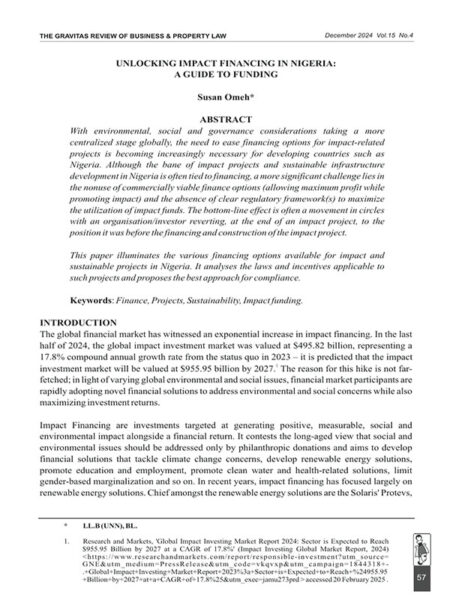
0₦2,500.00Susan Omeh in her article, Unlocking Impact Financing in Nigeria: A Guide to Funding, sheds light on the various financing options available for impact and sustainable projects in Nigeria. In doing this, Omeh analyses the laws and incentives applicable to such projects while also proffering the best approach for compliance. With environmental, social and governance considerations taking a more centralized stage globally, the need to ease financing options for impact-related projects is becoming increasingly necessary for developing countries such as Nigeria. Although the bane of impact projects and sustainable infrastructure development in Nigeria is often tied to financing, a greater challenge lies in the nonuse of commercially viable finance options (allowing maximum profit while promoting impact) and the absence of clear regulatory framework(s) to maximize the utilization of impact funds. The bottom-line effect is often a movement in circles with an organization/investor reverting, at the end of an impact project, to the position it was before the financing and construction of the impact project.
-
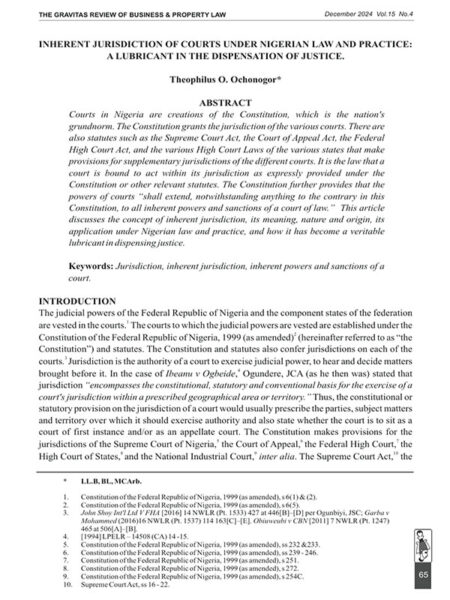
Inherent Jurisdiction of Courts under Nigerian Law and Practice: A Lubricant in the Dispensation of Justice
0₦2,500.00Theophilus Ochonogor in his article, Inherent Jurisdiction of Courts under Nigerian Law and Practice: A Lubricant in the Dispensation of Justice, discusses the concept of inherent jurisdiction, its meaning, nature and origin, its application under Nigerian law and practice, and how it has become a veritable lubricant in the dispensation of justice. Courts in Nigeria are creations of the Constitution, which is the nation’s grundnorm. The Constitution grants the jurisdictions of the various courts. There are also such statutes as the Supreme Court Act, the Court of Appeal Act, the Federal High Court Act and the various High Court Laws of the various states which make provisions for supplementary jurisdictions of the different courts. It is the law that a court is bound to act within its jurisdiction as expressly provided under the Constitution or other relevant statute. The Constitution further provides that the powers of courts “shall extend, notwithstanding anything to the contrary in this Constitution, to all inherent powers and sanctions of a court of law.”
-
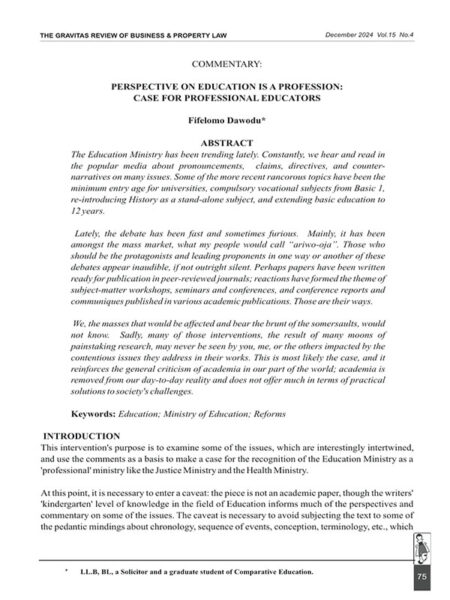
Perspective on Education as a Profession: Case for Professional Educators
0₦2,500.00Fifelomo Dawodu in her commentary, Perspective on Education as a Profession: Case for Professional Educators, takes a swipe at the various somersaults in the regulatory policies of the Ministry of Education highlighting the systemic impact on the entire educational sector. The Education Ministry has been trending lately. Constantly we hear and read in the popular media about pronouncements, claims, directives, counter-narratives on many issues. Some of the more recent rancorous topics have been minimum entry age for universities, compulsory vocational subjects from Basic 1, re-introduction of History as a stand alone subject, and extension of basic education to 12 years. The debate of late has been fast and sometimes, furious. Sadly, many of those interventions, the result of many moons of painstaking research may never be seen. This is most likely the case and it reinforces the general criticism of academia in our part of the world, that academia is removed from our day to day reality and does not offer much in terms of practical solutions to society’s challenges.
-
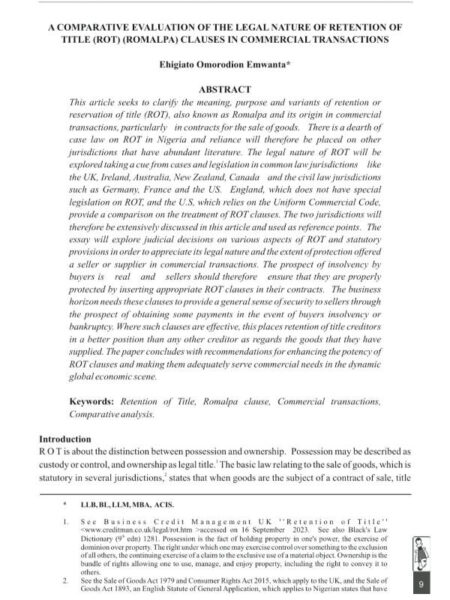
A Comparative Evaluation of the Legal Nature of Retention of Title (ROT) (ROMALPA) Clauses in Commercial Transactions
0₦2,500.00Ehigiato Emwanta in his article, A Comparative Evaluation of the Legal Nature of Retention of Title (ROT) (ROMALPA) Clauses in Commercial Transactions, seeks to clarify the meaning, purpose and variants of retention or reservation of title (ROT), also known as Romalpa and its origin in commercial transactions, particularly in contracts for the sale of goods. The legal nature of ROT is explored taking a cue from cases and legislation in common law jurisdictions like the UK, Ireland, Australia, New Zealand, Canada and civil law jurisdictions such as Germany, France and the US. England, which do not have special legislation on ROT, and that of the U.S, which relies on the Uniform Commercial Code, provide a comparison on the treatment of ROT clauses. The two jurisdictions are extensively discussed and used as reference points. Emwanta further explores judicial decisions on various aspects of ROT and statutory provisions in order to appreciate its legal nature and the extent of protection offered a seller or supplier in commercial transactions. Emwanta underscores the relevant and importance of ROT clauses and concludes with recommendations for enhancing the potency of ROT clauses and making them adequately serve commercial needs in the dynamic global economic scene.
-
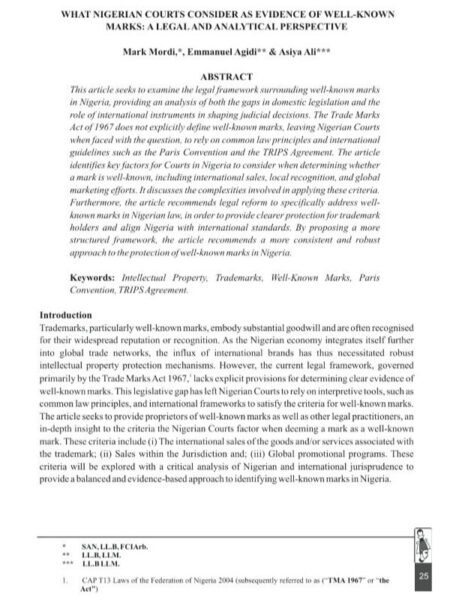
What Nigerian Courts Consider as Evidence of Well-Known Marks: A Legal and Analytical Perspective
0₦2,500.00Mark Mordi SAN, Emmanuel Agidi & Asiya Ali in their article, What Nigerian Courts Consider as Evidence of Well-Known Marks: A Legal and Analytical Perspective, seek to examine the legal framework surrounding well-known marks in Nigeria, providing an analysis of both the gaps in domestic legislation and the role of international instruments in shaping judicial decisions. The Trade Marks Act of 1967 does not explicitly define well-known marks, leaving Nigerian Courts when faced with the question, to rely on common law principles and international guidelines such as the Paris Convention and the TRIPS Agreement. Mordi et al identify key factors for Courts in Nigeria to consider when determining whether a mark is well-known, including international sales, local recognition, and global marketing efforts. Mordi et al discuss the complexities involved in applying these criteria. Furthermore, the article recommends legal reform to specifically address well-known marks in Nigerian law, in order to provide clearer protection for trademark holders and align Nigeria with international standards. By proposing a more structured framework, Mordi et al recommend a more consistent and robust approach to the protection of well-known marks in Nigeria.
-
Cross-Border Data Transfers: Tackling Compliance Challenges in Africa’s Digital Economy
0₦2,500.00Eberechukwu Ezike, Ayomide Abiodun, and Moyinoluwa Adegboye, in their article, Cross-Border Data Transfers: Tackling Compliance Challenges in Africa’s Digital Economy, examine the current landscape of data protection on the continent, highlighting the challenges and gaps that hinder seamless cross-border compliance. With the increasing growth of the African digital economy, the regulation of cross-border data transfers within Africa has become a more critical discourse. This has gained heightened significance with the coming into force of the African Continental Free Trade Area (“AfCFTA”) Agreement and the recently adopted Protocol to the AfCFTA Agreement on Digital Trade (the “Protocol”), which promises to revolutionise intra-African trade, including the digital landscape. Cross-border data transfer is crucial to Africa’s growing digital economy, enabling e-commerce, cloud computing, and various digital services across the continent. However, disparities in data protection regimes across African countries could present challenges for compliance. While some countries impose no restrictions on data transfers, others adopt conditional regimes, and many lack comprehensive data protection laws. This fragmentation could create barriers for businesses operating in several jurisdictions. Ezike et al propose recommendations, among others, to bridge compliance gaps and support the growing digital economy, such as fostering collaborations among Data Protection Authorities in Africa, developing regional harmonisation frameworks, and adopting best practices.
-
Resignation with Immediate Effect: Consequences for Employers and Employees under Nigerian Law
0₦2,500.00Edafe Ugbeta in his article, Resignation with Immediate Effect: Consequences for Employers and Employees under Nigerian Law, explores the subject of resignation from employment under Nigerian law, focusing on the form of resignation called ‘resignation with immediate effect’. Reflecting on the emerging case law of the National Industrial Court, the specialised first-instance court for employment disputes in Nigeria, Ugbeta highlights the implications of this kind of resignation for employers and employees under Nigerian law. He draws on a range of scenarios in developing the conversation.
-
The Process of Tax Appeals and Public Law Challenges to Tax Administration in Nigeria
0₦2,500.00Isaiah Akano in his article, The Process of Tax Appeals and Public Law Challenges to Tax Administration in Nigeria, undertakes a critical look at the process of tax appeal and the available public law challenges to the system of tax administration in Nigeria. The endless discussions on the drive for revenue by the Government, especially through taxation, can never be overstretched in view of the pivotal role tax plays in the generation of revenue by the government. One of the major objectives and even characteristics of tax is the need to ensure equity and fairness not only amongst taxpayers of unequal economic status but also between the taxpayers on one hand and the tax authorities on the other hand. This no doubt highlights the need for an efficient and effective tax administration in Nigeria. It also indicates the need to put in place a system that will ensure checks and balances to curb the excesses of tax officials and thereby promote fairness in the system of tax administration. Over time, statutory provisions and judicial precedents have shown that actions of relevant tax authorities can be challenged, especially when such actions are unconstitutional and unlawful.
-
Analysis of the Challenges and Prospects of Domestic Gas Protection and Utilisation in Nigeria
0₦2,500.00Iyadah Viko & Bonnievolo Ecoma in their article, Analysis of the Challenges and Prospects of Domestic Gas Protection and Utilisation in Nigeria, analyse the challenges and prospects of domestic gas protection and utilisation in Nigeria through the prism of the extant regulatory framework, and makes recommendations based on its findings. Resource-bearing countries, especially those in the Global South, are generally known to be plagued by a resource curse, one which, amongst others, hampers them from effectively developing their natural resources to enhance their economic status. This plague, which represents a fundamental disconnect between reserves, production, utilisation, and national development, is regarded as responsible for the extreme poverty levels in some countries despite the abundance of highly valuable and profitable resources. In Nigeria, the resource curse appears to hold sway potently as the huge reserves of natural gas the country is endowed with have been subjected to intense flaring and venting, and suboptimal utilisation. The practice of flaring, which has continued unabated for over six decades, has significantly hampered economic growth, intensified energy and actual poverty, and resulted in profound health challenges, environmental damage, and the importation of gas to meet domestic demands. In spite of several reforms initiated by the Federal Government over the years, the effective protection and utilisation of gas has remained an arduous task. While previous regulatory frameworks on the subject were censured for being feeble, the new framework under the regime of the Petroleum Industry Act is projected as a game changer for domestic gas protection and utilisation. A cursory review, however, reveals profound replicative issues that could defeat the intentions of the framework, and hamper the effective protection and utilisation of gas in the country.
-
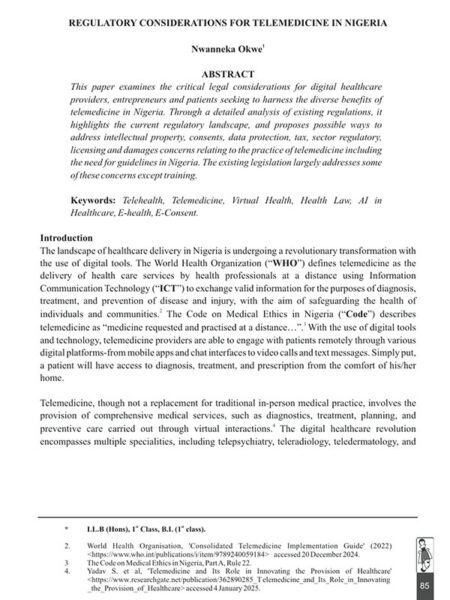
Regulatory Considerations for Telemedicine in Nigeria
0₦2,500.00Nwanneka Okwe, in her article, Regulatory Considerations for Telemedicine in Nigeria, examines the critical legal considerations for digital healthcare providers, entrepreneurs and patients seeking to harness the diverse benefits of telemedicine in Nigeria. Through a detailed analysis of existing regulations, Okwe highlights the current regulatory landscape, and proposes possible ways to address intellectual property, consents, data protection, tax, sector regulatory, licensing and damages concerns relating to the practice of telemedicine including the need for guidelines in Nigeria. The existing legislation largely addresses some of these concerns except training, damages and practice restrictions.
-
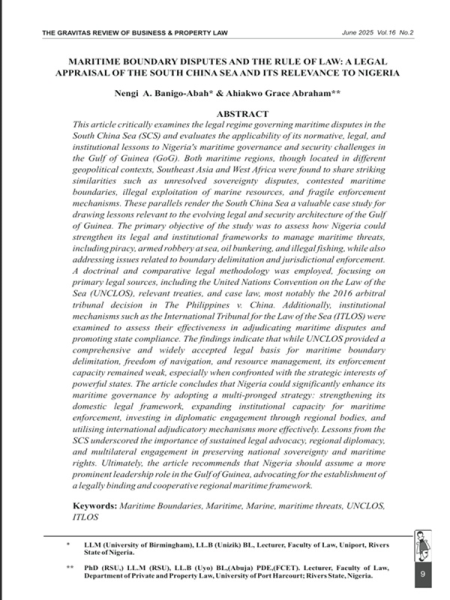
Maritime Boundary Disputes and the Rule of Law: A Legal Appraisal of the South China Sea and its Relevance to Nigeria
0₦2,500.00Nengi Banigo-Abah and Ahiakwo Abraham in their article, Maritime Boundary Disputes and the Rule of Law: A Legal Appraisal of the South China Sea and its Relevance to Nigeria, critically examine the legal regime governing maritime disputes in the South China Sea (SCS). Banigo-Abah and Abraham evaluate the applicability of its normative, legal, and institutional lessons to Nigeria’s maritime governance and security challenges in the Gulf of Guinea (GoG). Both maritime regions, though located in different geopolitical contexts, Southeast Asia and West Africa were found to share striking similarities such as unresolved sovereignty disputes, contested maritime boundaries, illegal exploitation of marine resources, and fragile enforcement mechanisms. These parallels render the South China Sea a valuable case study for drawing lessons relevant to the evolving legal and security architecture of the Gulf of Guinea. The primary objective of the study was to assess how Nigeria could strengthen its legal and institutional frameworks to manage maritime threats, including piracy, armed robbery at sea, oil bunkering, and illegal fishing, while also addressing issues related to boundary delimitation and jurisdictional enforcement. A doctrinal and comparative legal methodology was employed, focusing on primary legal sources, including the United Nations Convention on the Law of the Sea (UNCLOS), relevant treaties, and case law. The findings indicate that while UNCLOS provided a comprehensive and widely accepted legal basis for maritime boundary delimitation, freedom of navigation, and resource management, its enforcement capacity remained weak, especially when confronted with the strategic interests of powerful states. Banigo-Abah and Abraham conclude that Nigeria could significantly enhance its maritime governance by adopting a multi-pronged strategy: strengthening its domestic legal framework, expanding institutional capacity for maritime enforcement, investing in diplomatic engagement through regional bodies, and utilising international adjudicatory mechanisms more effectively.
The Gravitas Review of Business & Property Law