-
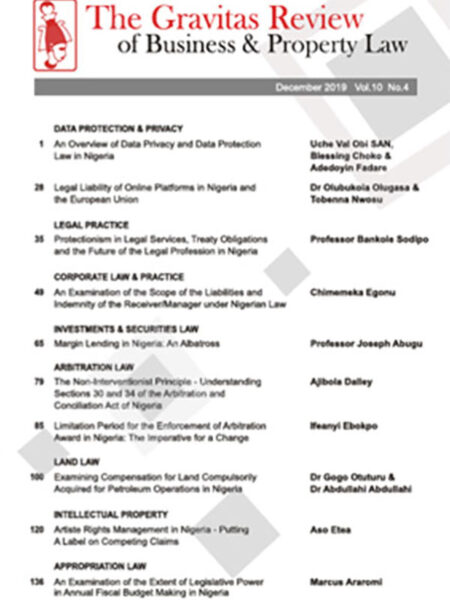
The Gravitas Review of Business & Property Law Vol.10 No.4 – E-Book
0₦5,000.00In this issue of The Gravitas Review of Business & Property Law Vol.10 No.4, there are well researched articles on:
- Data Protection & Privacy
- Legal Practice
- Corporate Law & Practice
- Investments & Securities Law
- Arbitration Law
- Land Law
- Intellectual Property
- Appropriation Law
-
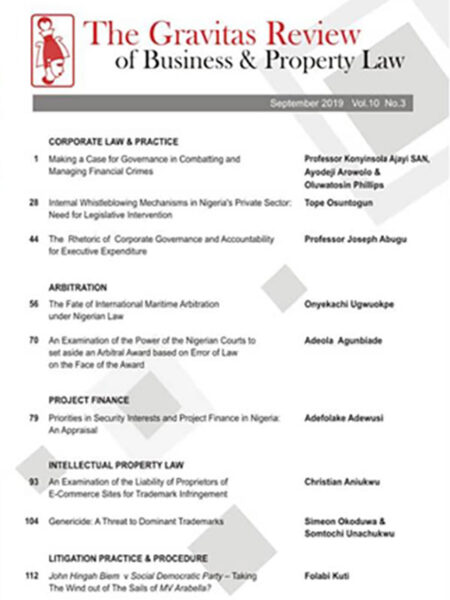
The Gravitas Review of Business & Property Law Vol.10 No.3 – Print
0₦5,000.00In this issue of The Gravitas Review of Business & Property Law Vol.10 No.3, there are well researched articles on:
- Corporate Law & Practice
- Arbitration Law
- Project Finance
- Intellectual Property
- Litigation Practice & Procedure
-
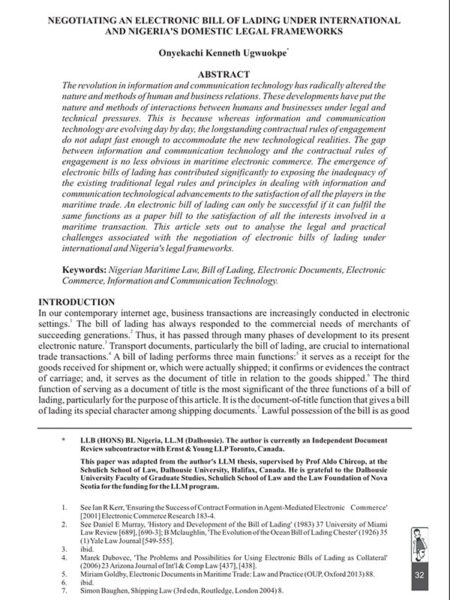
Negotiating an Electronic Bill of Lading under International and Nigeria’s Legal Frameworks
0₦2,500.00Onyekachi Ugwuokpe, Independent Document Review Subcontractor with Ernst & Young LLP Toronto Canada in his article, Negotiating an Electronic Bill of Lading under International and Nigeria’s Domestic Legal Frameworks, notes that although electronic bill of lading in shipping business has great advantages, including savings in time and monetary costs, it has been difficult to replicate the document-of-title function of a bill of lading in an electronic setting. The difficulty for an electronic bill to achieve negotiability arises from the fact that much of the relevant existing legal rules on, and commercial procedures for, negotiating bills of lading are entirely paper-based. The electronic bill of lading is also caught up with the common challenges of electronic documentation, which results from the inability of traditional contract principles to catch up with the rebellious advancements in information and communication technology. Onyekachi masterfully analyses the legal and practical challenges associated with negotiating electronic bills of lading under international and Nigeria’s legal frameworks.
-
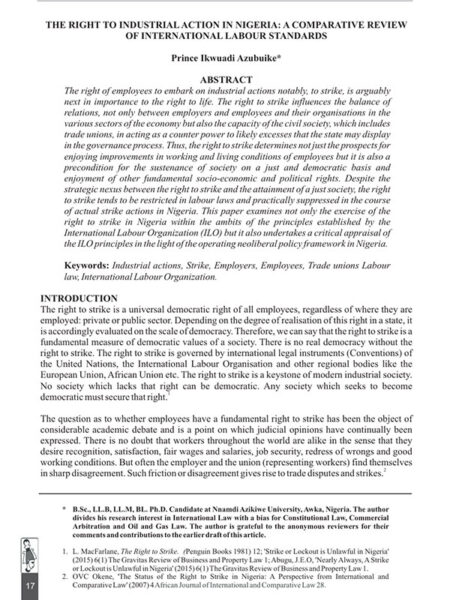
The Right to Industrial Action in Nigeria: A Comparative Review of International Labour Standards
0₦2,500.00Prince Azubuike, legal practitioner and researcher in his article, The Right to Industrial Action in Nigeria: A Comparative Review of International Labour Standards, notes that the right of employees to strike determines not just their prospects for enjoying improvements in working and living conditions, but it is also a precondition for the sustenance of a just and democratic. Despite the strategic nexus between the right to strike and the attainment of a just society, the right to strike tends to be restricted in labour laws and practically suppressed in the course of actual strike actions in Nigeria. He examines the exercise of the right to strike in Nigeria and other jurisdictions within the ambits of the principles established by the International Labour Organization (ILO).
-
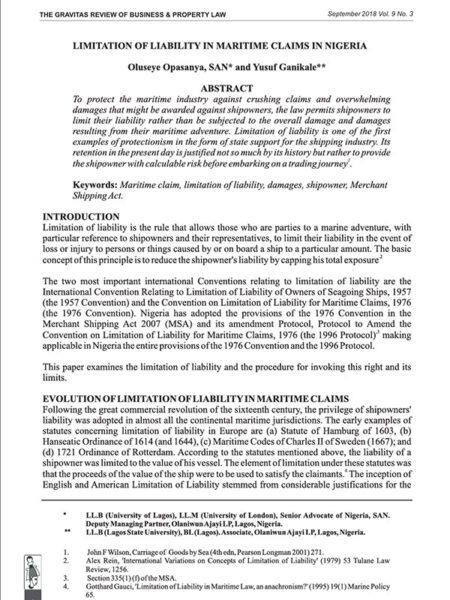
Limitation of Liability in Maritime Claims in Nigeria
0₦2,500.00Oluseye Opasanya SAN, and Yusuf Ganikale, Deputy Managing Partner and Associate respectively at Ajayi LP in their article, Limitation of Liability in Maritime Claims in Nigeria, note that to protect biliathe maritime industry against crushing claims and overwhelming damages that might be awarded against shipowners, the law permits shipowners to limit their liability rather than be subjected to hefty damages resulting from their maritime adventure. They review the provisions of the Merchant Shipping Act 2007 which domesticated the Convention on Limitation of Liability for Maritime Claims, 1976 and its amendment Protocol of 1996, Protocol to Amend the Convention on Limitation of Liability for Maritime Claims, 1976. They distinguish between limitation and liability proceedings, persons who may limit their liability, claims which are subject to limitation, conducts which may defeat limitation and creation of a Limitation Fund.
-
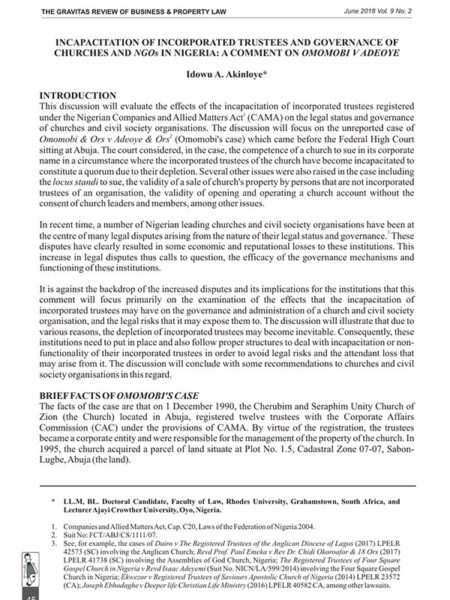
Incapacitation of Incorporated Trustees and Governance of Churches and NGOs in Nigeria: A Commentary of Omomobi v Adeoye
0₦2,500.00Idowu Akinloye, Lecturer Ajayi Crowther University, Oyo and Doctoral Candidate, Rhodes University, Grahamstown, South Africa in his article, Incapacitation of Incorporated Trustees and Governance of Churches and NGOs in Nigeria: A Commentary on Omomobi v Adeoye, examines how a church or civil society organisation may institute legal proceedings or otherwise function where the trustees are all dead, depleted or incapable of functioning.
-
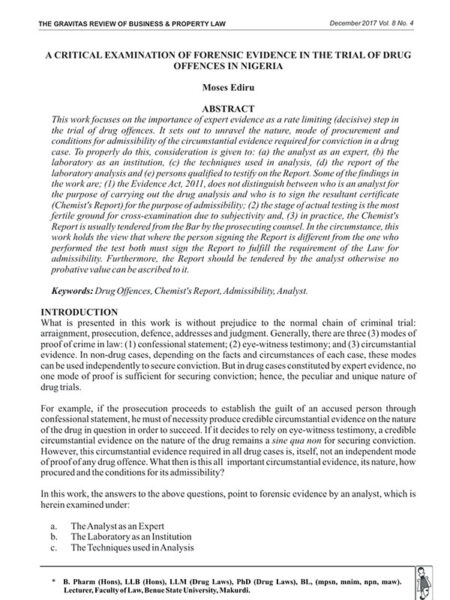
A Critical Examination of Forensic Evidence in the Trial of Drug Offences in Nigeria
0₦2,500.00Dr. Moses Ediru of the Benue State University, Makurdi, in his article, “A Critical Examination of Forensic Evidence in the Trial of Drug Offences in Nigeria”, unravels the nature , mode of procurement, and conditions for admissibility of circumstantial evidence required for conviction in a drug case. He considers salient evidential issues that should engage the attention of counsel in trial of drug offences including the role of the analyst as an expert, the laboratory as an institution, the techniques used in analysis, the report of the laboratory analysis, and persons qualified to testify on the Report.
-
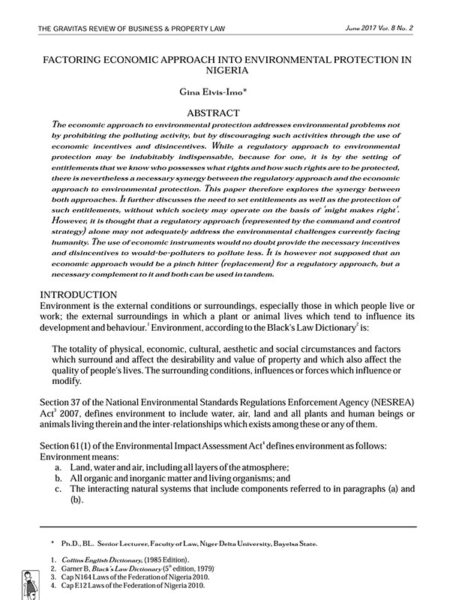
Factoring Economic Approach into Environmental Protection in Nigeria
0₦2,500.00Dr Gina Elvis-Imo, Senior Lecturer, Faculty of Law, Niger Delta University, Bayelsa State in her article “Factoring Economic Approach into Environmental Protection in Nigeria” examines various approaches, voluntary, regulatory and economic, to environmental protection. She argues that while a regulatory approach to environmental protection may be indubitably indispensable, the economic approach addresses environmental problems not by prohibiting the polluting activity, but by discouraging such activities through the use of economic incentives and disincentives. The paper explores the synergy between both approaches, and the need to set entitlements as well as the protection of such entitlements, without which society may operate on the basis of ‘might makes right’.
-
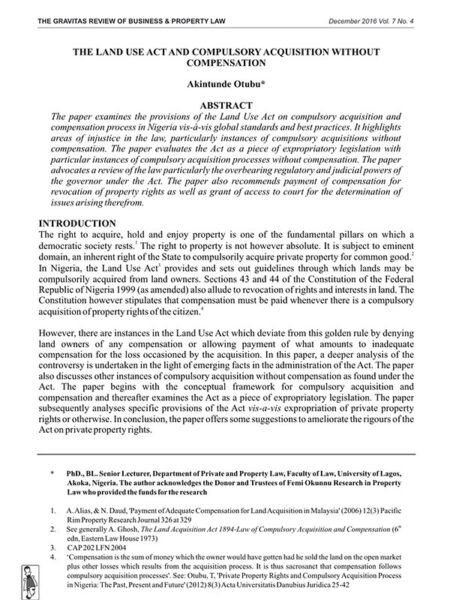
The Land Use Act and Compulsory Acquisition Without Compensation
0₦2,500.00Dr Akintunde Otubu, Senior Lecturer, Department of Private and Property Law, University of Lagos in his article “The Land Use Act and Compulsory Acquisition Without Compensation” examines the provision of the Land Use Act on compulsory acquisition and compensation. Weighing in on the controversy between the ‘nationalisation’ and ‘private property right’ schools, he contends that while the Act nationalises all land in favour of the State, it allows private ownership of the improvements on the land. He explores the half-hectare rule and four instances of revocations by which land is compulsorily acquired without compensation under the Act.
-
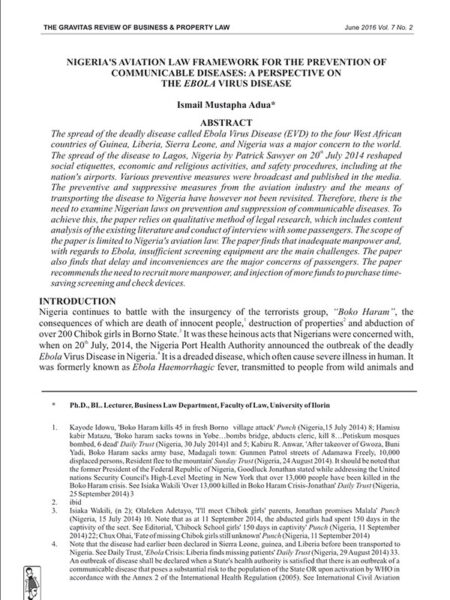
Nigeria’s Aviation Law Framework for the Prevention of Communicable Diseases: A Perspective on the Ebola Virus Disease
0₦2,500.00Dr Ismail Adua, Lecturer, Business Law Department, Faculty of Law, University of Ilorin in “Nigeria’s Aviation Law Framework for the Prevention of Communicable Diseases: A Perspective on the Ebola Virus Disease” examines the scourge of Ebola Virus Disease (EVD) that gripped the nation in 2014. Analysing the measures taken by relevant authorities to combat the menace, Dr Adua uses the EVD saga as a template to critically examine Nigeria’s Aviation laws and international conventions on prevention and suppression of communicable diseases.
-
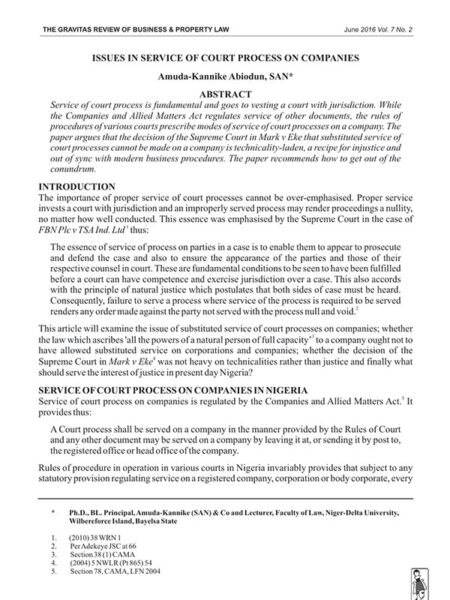
Issues in Service of Court Process on Companies
0₦2,500.00Dr Abiodun Amuda-Kannike SAN, Principal, Amuda-Kannike (SAN) & Co and Lecturer, Faculty of Law, Niger-Delta University, Wilberforce Island in his article, “Issues in Service of Court Process on Companies” examines the provision of the Companies and Allied Matters Act and various Rules of Court on service of court processes on companies. He bemoans the decision of the Supreme Court in Mark v Eke, that substituted service of court processes cannot be made on a company, as technicality-laden, a recipe for injustice and out of sync with modern business process.
-
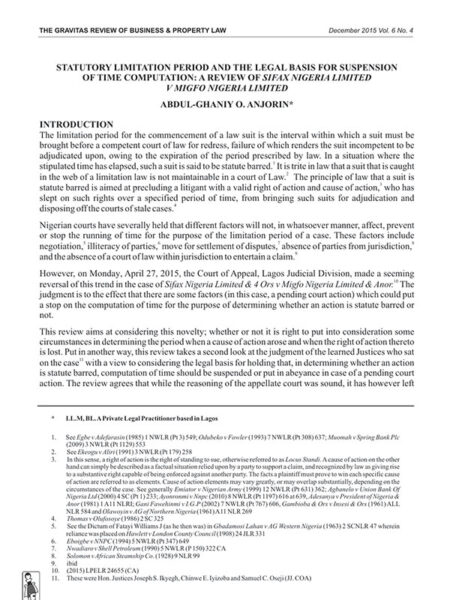
Statutory Limitation Period and the Legal Basis for Suspension of Time Computation: A Review of Sifax Nigeria Limited v. Migfo Nigeria Limited
0₦2,500.00When the clock stops ticking: Abdulghaniy Anjorin explores a recondite issue of law in “Statutory Limitation Period and the Legal Basis for Suspension of Time Computation: A Review of Sifax Nigeria Limited v Migfo Nigeria Limited”.
The Gravitas Review of Business & Property Law