-
Uniform Sale of Goods Law in Nigeria by Prof. Olusegun Yerokun
0₦2,500.00Yusuf Usman Liman, Lecturer, Faculty of Law, Nigeria Police Academy, Kano Nigeria, reviews the book, Uniform Sale of Goods Law in Nigeria by Prof. Olusegun Yerokun, highlighting that the book provides a good understanding of the need for concerted efforts towards uniformity of the Federal and State Laws on Sale of Goods. Using the review as a backdrop, Liman examines the current state of the law with regards to the status of the Sale of Goods Act 1893, an English Statute of General Application.
-
Unlocking Climate Finance in Africa: The Role of African Multilateral Development Banks
0₦2,500.00Geoffrey Adonu, Graduate Student at the New York University School of Law in, Unlocking Climate Finance in Africa: The Role of African Multilateral Development Banks, argues that climate change and its adverse effects on vulnerable communities are undermining global development. Developing countries, especially those in Africa, with their near-total dependence on agriculture, are the most affected despite their minimal contribution to global emissions. Effective climate action requires enormous amounts of financial resources, both for climate mitigation and adaptation in affected communities. However, climate finance flows fall short of the estimated need. Sub-Saharan Africa reportedly needs about US$377 billion and US$222 billion for climate adaptation and mitigation investments respectively, but total available financing is far from this target. Geoffrey considers climate finance, with emphasis on Africa, and examines the role of the continent’s multilateral development banks in unlocking climate finance for the continent.
-
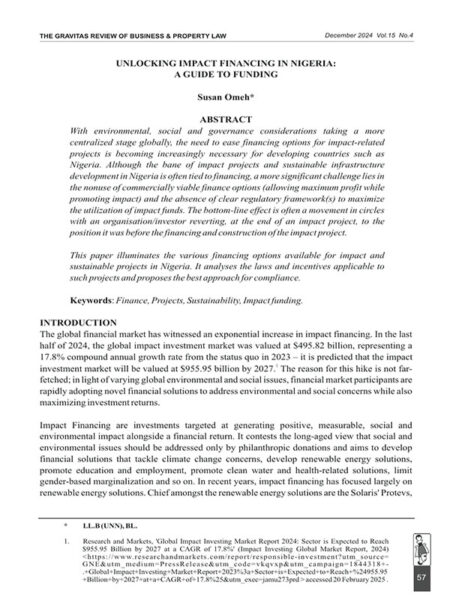
Unlocking Impact Financing in Nigeria: A Guide to Funding
0₦2,500.00Susan Omeh in her article, Unlocking Impact Financing in Nigeria: A Guide to Funding, sheds light on the various financing options available for impact and sustainable projects in Nigeria. In doing this, Omeh analyses the laws and incentives applicable to such projects while also proffering the best approach for compliance. With environmental, social and governance considerations taking a more centralized stage globally, the need to ease financing options for impact-related projects is becoming increasingly necessary for developing countries such as Nigeria. Although the bane of impact projects and sustainable infrastructure development in Nigeria is often tied to financing, a greater challenge lies in the nonuse of commercially viable finance options (allowing maximum profit while promoting impact) and the absence of clear regulatory framework(s) to maximize the utilization of impact funds. The bottom-line effect is often a movement in circles with an organization/investor reverting, at the end of an impact project, to the position it was before the financing and construction of the impact project.
-
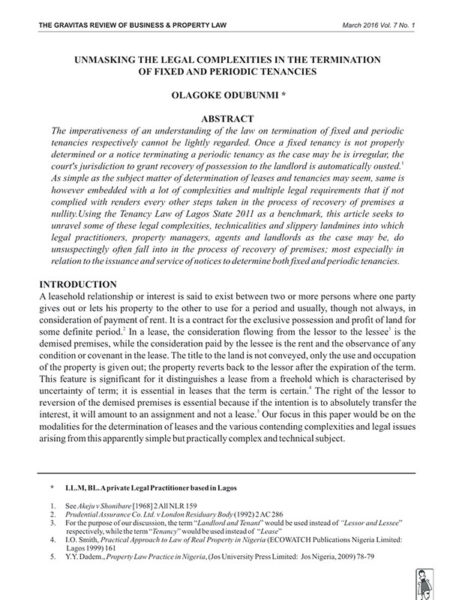
Unmasking the Legal Complications in the Termination of Fixed and Periodic Tenancies
0₦2,500.00Against the background of the Tenancy Law of Lagos State 2011, Olagoke Odubunmi, Lagos based legal practitioner, in his article “Unmasking the Legal Complexities in the Termination of Fixed and Periodic Tenancies” seeks to unravel the complexities, technicalities and slippery landmines into which legal practitioners, property managers, agents and landlords, do unsuspectingly often fall into in the process of recovery of premises, most especially in the termination of fixed and periodic tenancies.
-
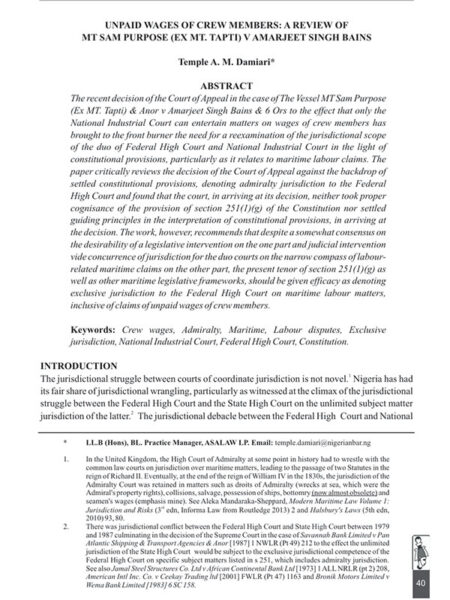
Unpaid Wages of Crew Members: A Review of Mt Sam Purpose (Ex Mt. Tapti) v Amarjeet Singh Bains
0₦2,500.00Temple Damiari of ASALAW LP continues with the exciting debate begun in the last issue of The Gravitas Review on the appropriate court with jurisdiction in wages of ship crew. In his article, Unpaid Wages of Crew Members: A Review of Mt Sam Purpose (Ex Mt. Tapti) v Amarjeet Singh Bains, Damiari critically analyses the decision of the Court of Appeal that only the National Industrial Court can entertain matters on wages of ship crew. He opines that given the settled constitutional provisions denoting admiralty jurisdiction in the Federal High Court, the Court of Appeal in arriving at its decision, neither took proper cognisance of the provision of section 251(1)(g) of the Constitution nor settled guiding principles in the interpretation of constitutional provisions.
-
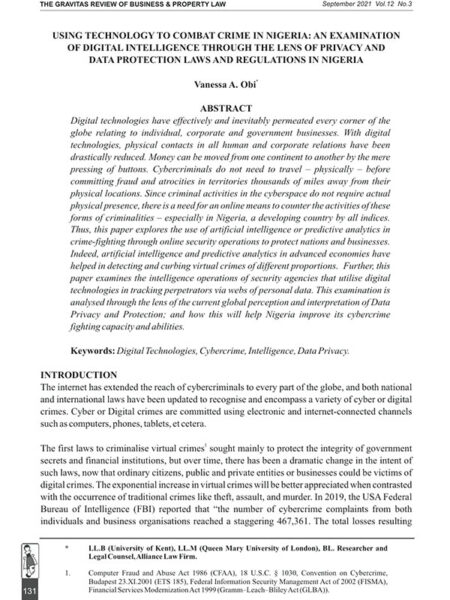
Using Technology to Combat Crime in Nigeria: An Examination of Digital Intelligence Through the Lens of Privacy and Data Protection
0₦2,500.00Vanessa Obi, Researcher and Counsel at the Alliance Law Firm, in her article, Using Technology to Combat Crime in Nigeria: An Examination of Digital Intelligence Through the Lens of Privacy and Data Protection, explores the use of artificial intelligence or predictive analytics in crime-fighting through online security operations to protect nations and businesses. Vanessa examines the intelligence operations of security agencies that utilise digital technologies in tracking perpetrators via webs of personal data. She examines these through the lens of data privacy and protection laws; and how this will help Nigeria improve its cybercrime fighting capacity and abilities.
-
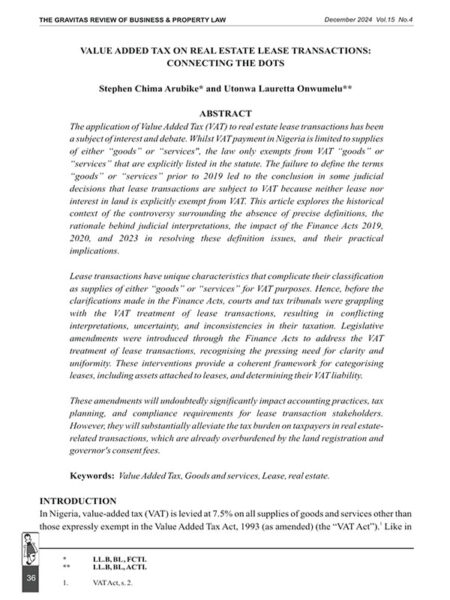
Value Added Tax on Real Estate Lease Transactions: Connecting the Dots
0₦2,500.00In their article, Value Added Tax on Real Estate Lease Transactions: Connecting the Dots, Stephen Arubike and Utonwa Onwumelu tackle the application of Value Added Tax (VAT) to real estate lease transactions. Whilst VAT payment in Nigeria is limited to supplies of either “goods” or “services”, the law only exempts from VAT “goods” or “services” that are explicitly listed in the statute. The failure to define the terms “goods” or “services” prior to 2019 led to the conclusion in some judicial decisions that lease transactions are subject to VAT because neither lease nor interest in land is explicitly exempt from VAT. Arubike and Onwumelu aim to explore the historical context of ‘the absence of precise definition’ controversy, the rationale behind judicial interpretations, the impact of the Finance Acts 2019, 2020 and 2023 in resolving these definition issues and their practical implications.
-
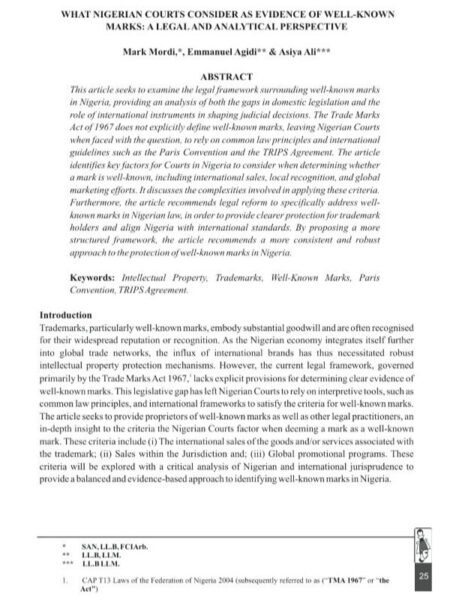
What Nigerian Courts Consider as Evidence of Well-Known Marks: A Legal and Analytical Perspective
0₦2,500.00Mark Mordi SAN, Emmanuel Agidi & Asiya Ali in their article, What Nigerian Courts Consider as Evidence of Well-Known Marks: A Legal and Analytical Perspective, seek to examine the legal framework surrounding well-known marks in Nigeria, providing an analysis of both the gaps in domestic legislation and the role of international instruments in shaping judicial decisions. The Trade Marks Act of 1967 does not explicitly define well-known marks, leaving Nigerian Courts when faced with the question, to rely on common law principles and international guidelines such as the Paris Convention and the TRIPS Agreement. Mordi et al identify key factors for Courts in Nigeria to consider when determining whether a mark is well-known, including international sales, local recognition, and global marketing efforts. Mordi et al discuss the complexities involved in applying these criteria. Furthermore, the article recommends legal reform to specifically address well-known marks in Nigerian law, in order to provide clearer protection for trademark holders and align Nigeria with international standards. By proposing a more structured framework, Mordi et al recommend a more consistent and robust approach to the protection of well-known marks in Nigeria.
-
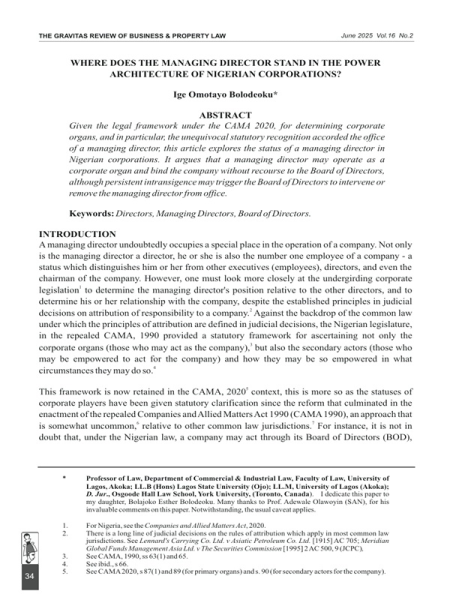
Where Does the Managing Director Stand in the Power Architecture of Nigerian Corporations?
0₦2,500.00Given the legal framework under the CAMA 2020, which determines corporate organs, and in particular, the unequivocal statutory recognition accorded to the office of a managing director, Professor Ige Bolodeoku, in his article Where Does the Managing Director Stand in the Power Architecture of Nigerian Corporations?, explores the status of a managing director in Nigerian corporations. Bolodeoku argues that a managing director may operate as a corporate organ and bind the company without recourse to the Board of Directors. However, persistent intransigence may trigger the Board of Directors to intervene or remove the managing director from office.
-
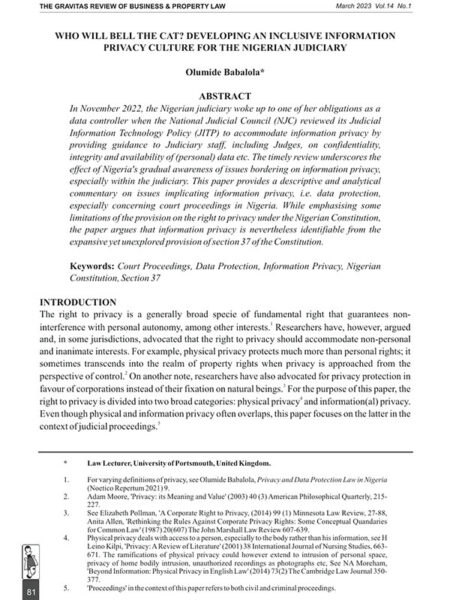
Who Will Bell the Cat? Developing an Inclusive Information Privacy Culture for the Judiciary
0₦2,500.00Olumide Babalola in his article, Who Will Bell the Cat? Developing an Inclusive Information Privacy culture for the Judiciary, provides a descriptive and analytical commentary on issues implicating information privacy i.e data protection, especially in relation to court proceedings in Nigeria. While emphasizing some limitations of the provision on the right to privacy under the Nigerian Constitution, Babalola argues that information privacy is nevertheless identifiable from the expansive yet unexplored provision of section 37 of the Constitution.
The Gravitas Review of Business & Property Law