-
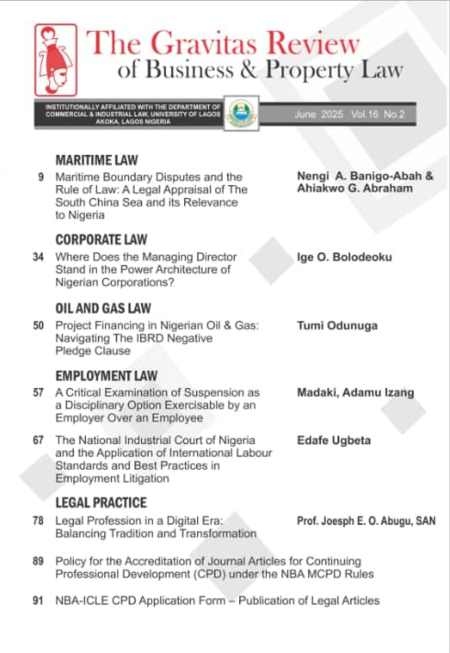
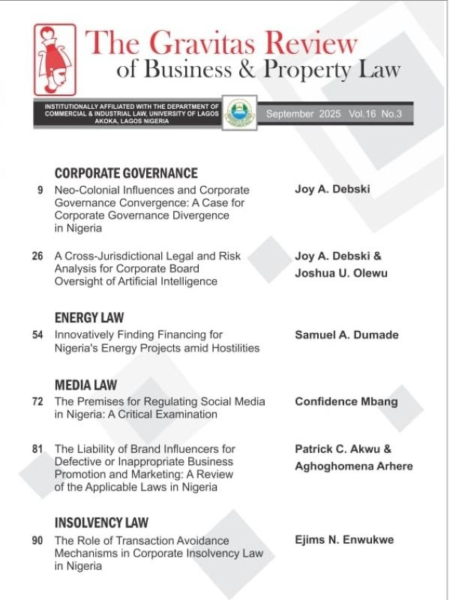
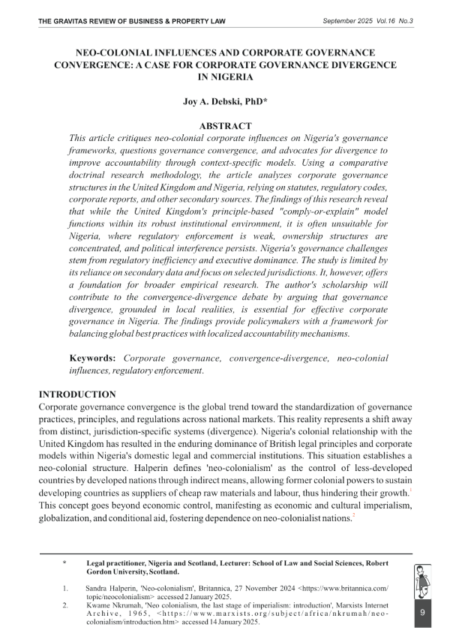
The Gravitas Review of Business & Property Law Vol.16 No.2
0₦5,000.00In this issue of The Gravitas Review of Business & Property Law Vol.16 No.2, there are well researched articles on:
- Maritime Law
- Corporate Law
- Energy Law
- Employment Law
- Legal Practice
-
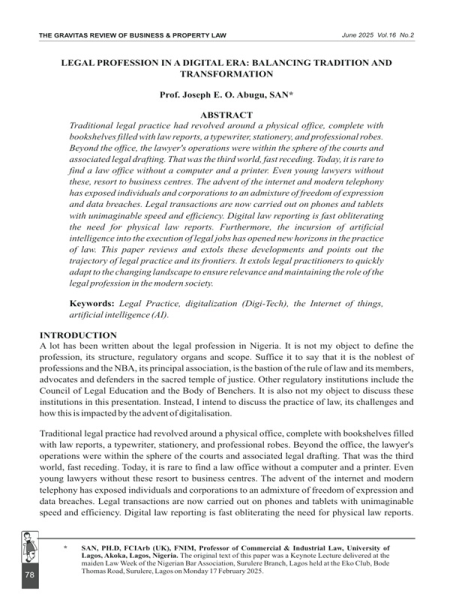
Legal Profession in a Digital Era: Balancing Tradition and Transformation
0₦2,500.00Traditional legal practice had revolved around a physical office, complete with bookshelves filled with law reports, a typewriter, stationery, and professional robes. Beyond the office, the lawyer’s operations were within the sphere of the courts and associated legal drafting. That was the third world, fast receding. Today, it is rare to find a law office without a computer and a printer. Even young lawyers without these, resort to business centres. The advent of the internet and modern telephony has exposed individuals and corporations to an admixture of freedom of expression and data breaches. Legal transactions are now carried out on phones and tablets with unimaginable speed and efficiency. Digital law reporting is fast obliterating the need for physical law reports. Furthermore, the incursion of artificial intelligence into the execution of legal jobs has opened new horizons in the practice of law. Professor Joseph Abugu, SAN, in his article, Legal Profession in a Digital Era: Balancing Tradition and Transformation, reviews and extols these developments and points out the trajectory of legal practice and its frontiers. Abugu extols legal practitioners to quickly adapt to the changing landscape to ensure relevance and maintaining the role of the legal profession in the modern society.
-
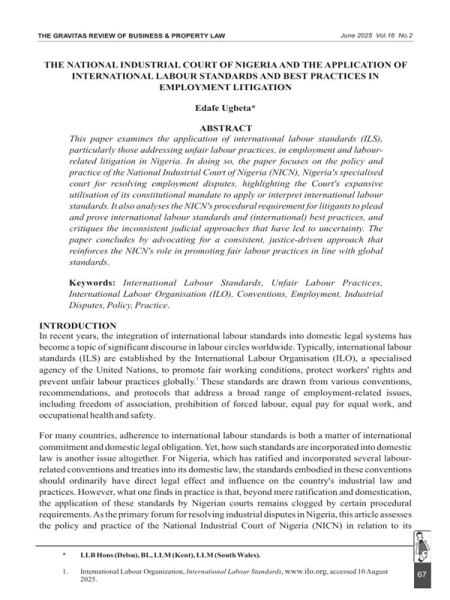
The National Industrial Court of Nigeria and the Application of International Labour Standards and Best Practices in Employment Litigation
0₦2,500.00Edafe Ugbeta in his article, The National Industrial Court of Nigeria and the Application of International Labour Standards and Best Practices in Employment Litigation, examines the application of international labour standards (ILS), particularly those addressing unfair labour practices, in employment and labour-related litigation in Nigeria. In doing so, Ugbeta focuses on the policy and practice of the National Industrial Court of Nigeria (NICN), Nigeria’s specialised court for resolving employment disputes, highlighting the Court’s expansive utilisation of its constitutional mandate to apply or interpret international labour standards. Ugbeta also analyses the NICN’s procedural requirement for litigants to plead and prove international labour standards and (international) best practices, and critiques the inconsistent judicial approaches that have led to uncertainty. Ugbeta concludes by advocating for a consistent, justice-driven approach that reinforces the NICN’s role in promoting fair labour practices in line with global standards.
-
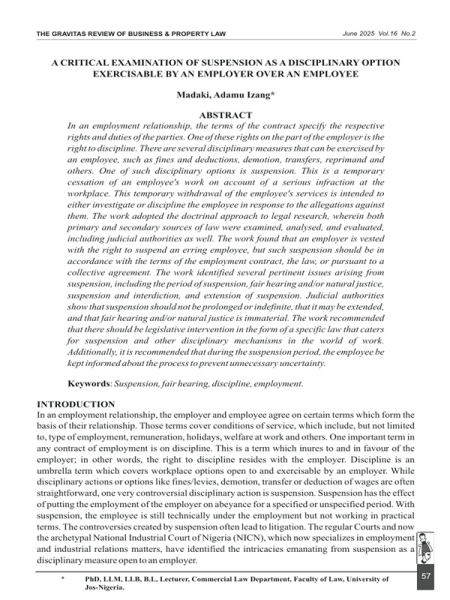
A Critical Examination of Suspension as a Disciplinary Option Exercisable by an Employer over an Employee
0₦2,500.00In an employment relationship, the terms of the contract specify the respective rights and duties of the parties. One of these rights on the part of the employer is the right to discipline. There are several disciplinary measures that can be exercised by an employee, such as fines and deductions, demotion, transfers, reprimand and others. One of such disciplinary options is suspension. This is a temporary cessation of an employee’s work on account of a serious infraction at the workplace. This temporary withdrawal of the employee’s services is intended to either investigate or discipline the employee in response to the allegations against them. Makadi Izang in his article, A Critical Examination of Suspension as a Disciplinary Option Exercisable by an Employer over an Employee, adopts the doctrinal approach to legal research, wherein both primary and secondary sources of law were examined, analysed, and evaluated, including judicial authorities as well. Izang finds that an employer is vested with the right to suspend an erring employee, but such suspension should be in accordance with the terms of the employment contract, the law, or pursuant to a collective agreement. Izang identifies several pertinent issues arising from suspension, including the period of suspension, fair hearing and/or natural justice, suspension and interdiction, and extension of suspension. Judicial authorities show that suspension should not be prolonged or indefinite, that it may be extended, and that fair hearing and/or natural justice is immaterial. Izang recommends that there should be legislative intervention in the form of a specific law that caters for suspension and other disciplinary mechanisms in the world of work. Additionally, it is recommended that during the suspension period, the employee be kept informed about the process to prevent unnecessary uncertainty.
-
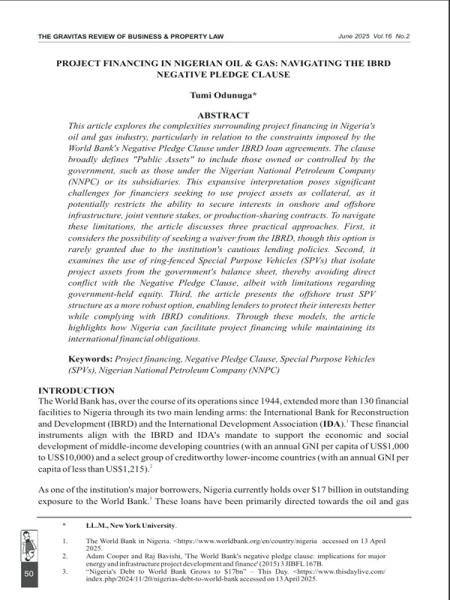
Project Financing in Nigerian Oil & Gas: Navigating the IBRD Clause
0₦2,500.00Tumi Odunuga in his article, Project Financing in Nigerian Oil & Gas: Navigating the IBRD Clause, explores the complexities surrounding project financing in Nigeria’s oil and gas industry, particularly in relation to the constraints imposed by the World Bank’s Negative Pledge Clause under IBRD loan agreements. The clause broadly defines “Public Assets” to include those owned or controlled by the government, such as those under the Nigerian National Petroleum Company (NNPC) or its subsidiaries. This expansive interpretation poses significant challenges for financiers seeking to use project assets as collateral, as it potentially restricts the ability to secure interests in onshore and offshore infrastructure, joint venture stakes, or production-sharing contracts. To navigate these limitations, Odunuga discusses three practical approaches. First, Odunuga considers the possibility of seeking a waiver from the IBRD, though this option is rarely granted due to the institution’s cautious lending policies. Second, Odunuga examines the use of ring-fenced Special Purpose Vehicles (SPVs) that isolate project assets from the government’s balance sheet, thereby avoiding direct conflict with the Negative Pledge Clause, albeit with limitations regarding government-held equity. Third, Odunuga presents the offshore trust SPV structure as a more robust option, enabling lenders to protect their interests better while complying with IBRD conditions. Through these models, Odunuga highlights how Nigeria can facilitate project financing while maintaining its international financial obligations.
-
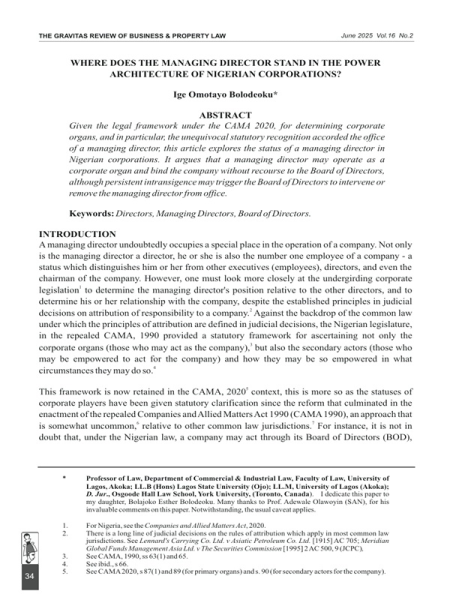
Where Does the Managing Director Stand in the Power Architecture of Nigerian Corporations?
0₦2,500.00Given the legal framework under the CAMA 2020, which determines corporate organs, and in particular, the unequivocal statutory recognition accorded to the office of a managing director, Professor Ige Bolodeoku, in his article Where Does the Managing Director Stand in the Power Architecture of Nigerian Corporations?, explores the status of a managing director in Nigerian corporations. Bolodeoku argues that a managing director may operate as a corporate organ and bind the company without recourse to the Board of Directors. However, persistent intransigence may trigger the Board of Directors to intervene or remove the managing director from office.
-
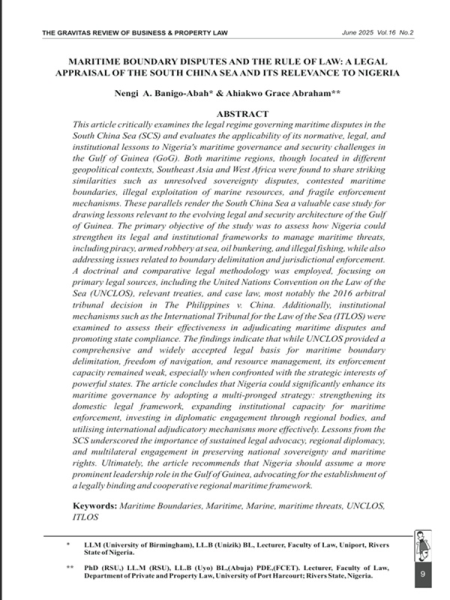
Maritime Boundary Disputes and the Rule of Law: A Legal Appraisal of the South China Sea and its Relevance to Nigeria
0₦2,500.00Nengi Banigo-Abah and Ahiakwo Abraham in their article, Maritime Boundary Disputes and the Rule of Law: A Legal Appraisal of the South China Sea and its Relevance to Nigeria, critically examine the legal regime governing maritime disputes in the South China Sea (SCS). Banigo-Abah and Abraham evaluate the applicability of its normative, legal, and institutional lessons to Nigeria’s maritime governance and security challenges in the Gulf of Guinea (GoG). Both maritime regions, though located in different geopolitical contexts, Southeast Asia and West Africa were found to share striking similarities such as unresolved sovereignty disputes, contested maritime boundaries, illegal exploitation of marine resources, and fragile enforcement mechanisms. These parallels render the South China Sea a valuable case study for drawing lessons relevant to the evolving legal and security architecture of the Gulf of Guinea. The primary objective of the study was to assess how Nigeria could strengthen its legal and institutional frameworks to manage maritime threats, including piracy, armed robbery at sea, oil bunkering, and illegal fishing, while also addressing issues related to boundary delimitation and jurisdictional enforcement. A doctrinal and comparative legal methodology was employed, focusing on primary legal sources, including the United Nations Convention on the Law of the Sea (UNCLOS), relevant treaties, and case law. The findings indicate that while UNCLOS provided a comprehensive and widely accepted legal basis for maritime boundary delimitation, freedom of navigation, and resource management, its enforcement capacity remained weak, especially when confronted with the strategic interests of powerful states. Banigo-Abah and Abraham conclude that Nigeria could significantly enhance its maritime governance by adopting a multi-pronged strategy: strengthening its domestic legal framework, expanding institutional capacity for maritime enforcement, investing in diplomatic engagement through regional bodies, and utilising international adjudicatory mechanisms more effectively.
-
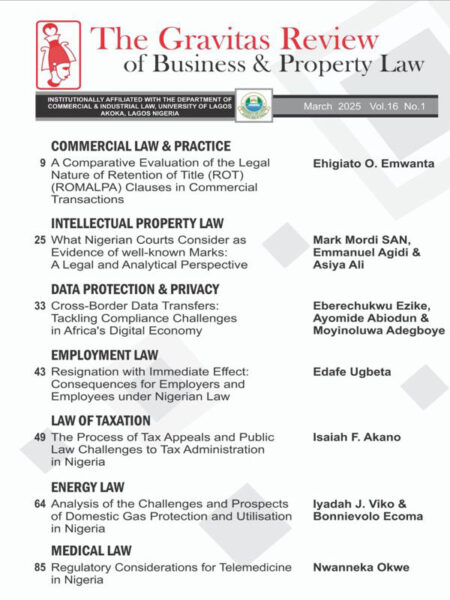
The Gravitas Review of Business & Property Law Vol.16 No.1 – E-Book
0₦5,000.00In this issue of The Gravitas Review of Business & Property Law Vol.16 No.1, there are well researched articles on:
- Commercial Law & Practice
- Intellectual Property Law
- Data Protection & Privacy
- Employment Law
- Taxation
- Energy Law
- Medical Law
-
The Gravitas Review of Business & Property Law Vol.16 No.1
0₦5,000.00In this issue of The Gravitas Review of Business & Property Law Vol.16 No.1, there are well researched articles on:
- Commercial Law & Practice
- Intellectual Property Law
- Data Protection & Privacy
- Employment Law
- Taxation
- Energy Law
- Medical Law
-
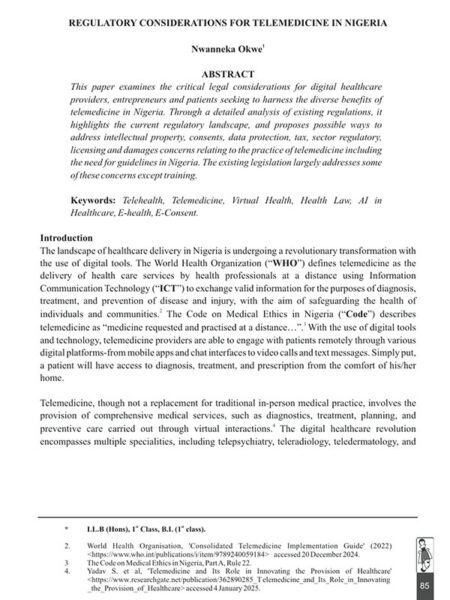
Regulatory Considerations for Telemedicine in Nigeria
0₦2,500.00Nwanneka Okwe, in her article, Regulatory Considerations for Telemedicine in Nigeria, examines the critical legal considerations for digital healthcare providers, entrepreneurs and patients seeking to harness the diverse benefits of telemedicine in Nigeria. Through a detailed analysis of existing regulations, Okwe highlights the current regulatory landscape, and proposes possible ways to address intellectual property, consents, data protection, tax, sector regulatory, licensing and damages concerns relating to the practice of telemedicine including the need for guidelines in Nigeria. The existing legislation largely addresses some of these concerns except training, damages and practice restrictions.
-
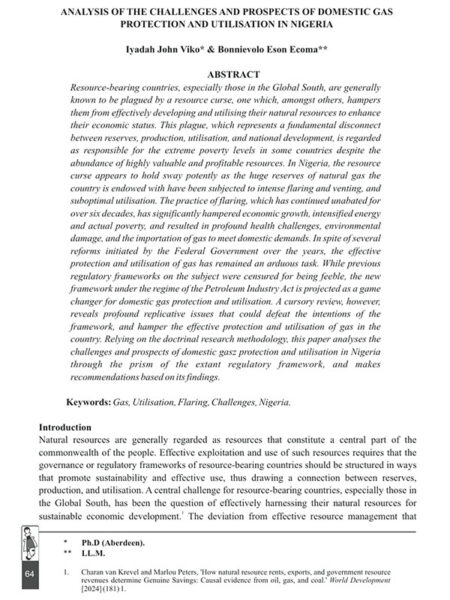
Analysis of the Challenges and Prospects of Domestic Gas Protection and Utilisation in Nigeria
0₦2,500.00Iyadah Viko & Bonnievolo Ecoma in their article, Analysis of the Challenges and Prospects of Domestic Gas Protection and Utilisation in Nigeria, analyse the challenges and prospects of domestic gas protection and utilisation in Nigeria through the prism of the extant regulatory framework, and makes recommendations based on its findings. Resource-bearing countries, especially those in the Global South, are generally known to be plagued by a resource curse, one which, amongst others, hampers them from effectively developing their natural resources to enhance their economic status. This plague, which represents a fundamental disconnect between reserves, production, utilisation, and national development, is regarded as responsible for the extreme poverty levels in some countries despite the abundance of highly valuable and profitable resources. In Nigeria, the resource curse appears to hold sway potently as the huge reserves of natural gas the country is endowed with have been subjected to intense flaring and venting, and suboptimal utilisation. The practice of flaring, which has continued unabated for over six decades, has significantly hampered economic growth, intensified energy and actual poverty, and resulted in profound health challenges, environmental damage, and the importation of gas to meet domestic demands. In spite of several reforms initiated by the Federal Government over the years, the effective protection and utilisation of gas has remained an arduous task. While previous regulatory frameworks on the subject were censured for being feeble, the new framework under the regime of the Petroleum Industry Act is projected as a game changer for domestic gas protection and utilisation. A cursory review, however, reveals profound replicative issues that could defeat the intentions of the framework, and hamper the effective protection and utilisation of gas in the country.
-
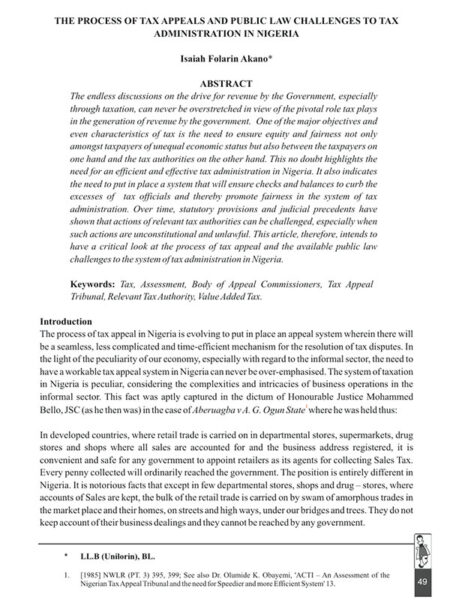
The Process of Tax Appeals and Public Law Challenges to Tax Administration in Nigeria
0₦2,500.00Isaiah Akano in his article, The Process of Tax Appeals and Public Law Challenges to Tax Administration in Nigeria, undertakes a critical look at the process of tax appeal and the available public law challenges to the system of tax administration in Nigeria. The endless discussions on the drive for revenue by the Government, especially through taxation, can never be overstretched in view of the pivotal role tax plays in the generation of revenue by the government. One of the major objectives and even characteristics of tax is the need to ensure equity and fairness not only amongst taxpayers of unequal economic status but also between the taxpayers on one hand and the tax authorities on the other hand. This no doubt highlights the need for an efficient and effective tax administration in Nigeria. It also indicates the need to put in place a system that will ensure checks and balances to curb the excesses of tax officials and thereby promote fairness in the system of tax administration. Over time, statutory provisions and judicial precedents have shown that actions of relevant tax authorities can be challenged, especially when such actions are unconstitutional and unlawful.
The Gravitas Review of Business & Property Law