
Description
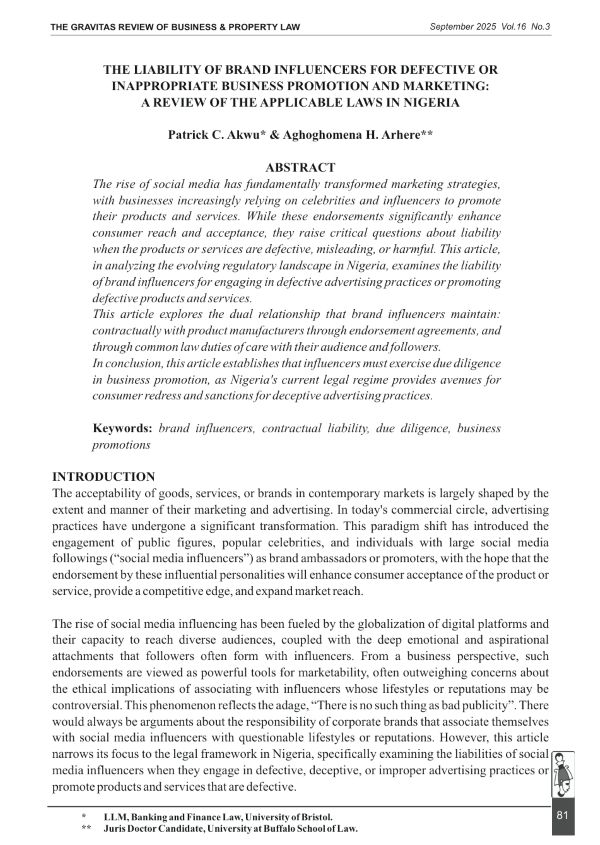
ABSTRACT
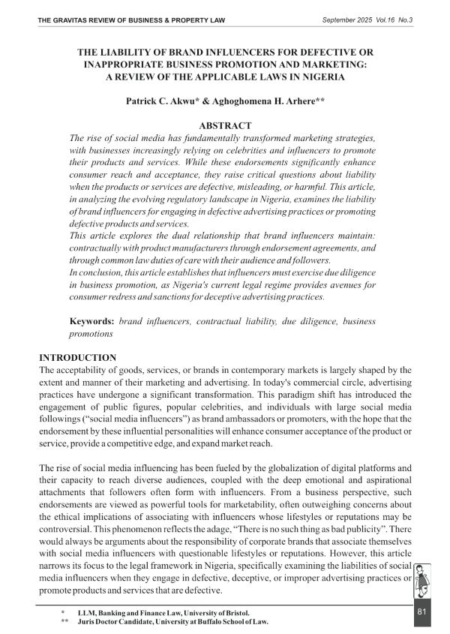
The Liability of Brand Influencing for Defective or Inappropriate Business Promotion and Marketing: A Review of the Applicable Laws in Nigeria
Patrick C. Akwu* & Aghoghomena H. Arhere**
The rise of social media has fundamentally transformed marketing strategies, with businesses increasingly relying on celebrities and influencers to promote their products and services. While these endorsements significantly enhance consumer reach and acceptance, they raise critical questions about liability when the products or services are defective, misleading, or harmful. This article, in analyzing the evolving regulatory landscape in Nigeria, examines the liability of brand influencers for engaging in defective advertising practices or promoting defective products and services.
This article explores the dual relationship that brand influencers maintain: contractually with product manufacturers through endorsement agreements, and through common law duties of care with their audience and followers. In conclusion, this article establishes that influencers must exercise due diligence in business promotion, as Nigeria’s current legal regime provides avenues for
consumer redress and sanctions for deceptive advertising practices.
Keywords: brand influencers, contractual liability, due diligence, business promotions
INTRODUCTION
The acceptability of goods, services, or brands in contemporary markets is largely shaped by the extent and manner of their marketing and advertising. In today’s commercial circle, advertising practices have undergone a significant transformation. This paradigm shift has introduced the engagement of public figures, popular celebrities, and individuals with large social media followings (“social media influencers”) as brand ambassadors or promoters, with the hope that the endorsement by these influential personalities will enhance consumer acceptance of the product or service, provide a competitive edge, and expand market reach.
The rise of social media influencing has been fueled by the globalization of digital platforms and their capacity to reach diverse audiences, coupled with the deep emotional and aspirational attachments that followers often form with influencers. From a business perspective, such endorsements are viewed as powerful tools for marketability, often outweighing concerns about the ethical implications of associating with influencers whose lifestyles or reputations may be controversial. This phenomenon reflects the adage, “There is no such thing as bad publicity”. There would always be arguments about the responsibility of corporate brands that associate themselves with social media influencers with questionable lifestyles or reputations. However, this article narrows its focus to the legal framework in Nigeria, specifically examining the liabilities of social media influencers when they engage in defective, deceptive, or improper advertising practices or promote products and services that are defective.
*LLM, Banking and Finance Law, University of Bristol.
**Juris Doctor Candidate, University at Buffalo School of Law.

Reviews
There are no reviews yet.