-
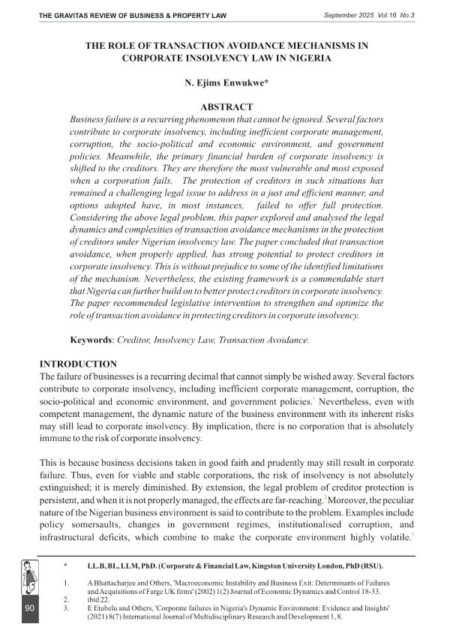
The Role of Transaction Avoidance Mechanisms in Corporate Insolvency Law in Nigeria
0₦2,500.00Business failure is a recurring phenomenon that cannot be ignored. Several factors contribute to corporate insolvency, including inefficient corporate management, corruption, the socio-political and economic environment, and government policies. Meanwhile, the primary financial burden of corporate insolvency is shifted to the creditors. They are therefore the most vulnerable and most exposed when a corporation fails. The protection of creditors in such situations has remained a challenging legal issue to address in a just and efficient manner, and options adopted have, in most instances, failed to offer full protection. Considering the above legal problem, Ejims Enwukwe, in his article, The Role of Transaction Avoidance Mechanisms in Corporate Insolvency Law in Nigeria, explores and analyzes the legal dynamics and complexities of transaction avoidance mechanisms in the protection of creditors under Nigerian insolvency law. Enwukwe concludes that transaction avoidance, when properly applied, has strong potential to protect creditors in corporate insolvency. This is without prejudice to some of the identified limitations of the mechanism. Nevertheless, the existing framework is a commendable start that Nigeria can further build on to better protect creditors in corporate insolvency. Enwukwe recommends legislative intervention to strengthen and optimize the role of transaction avoidance in protecting creditors in corporate insolvency.
-
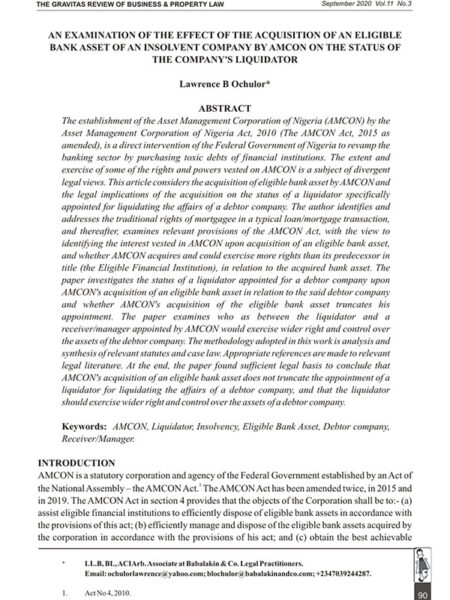
An Examination of the Effect of the Acquisition of An Eligible Bank Asset of an Insolvent Company by AMCON on the Status of the Company’s Liquidator
0₦2,500.00Lawrence Ochulor, Associate at Babalakin & Co. Lagos Nigeria, in his article, An Examination of the Effect of the Acquisition of An Eligible Bank Asset of an Insolvent Company by AMCON on the Status of the Company’s Liquidator, considers the acquisition of an eligible bank asset by AMCON and the legal implications of the acquisition on the status of a liquidator specifically appointed for liquidating the affairs of a debtor company. Lawrence interrogates the traditional rights of a mortgagee in a typical loan/mortgage transaction, the interest vested in AMCON on the acquisition of an eligible bank asset, whether AMCON acquires and could exercise more rights than its predecessor in title concerning the acquired bank asset, the status of a liquidator appointed for a debtor company, and whether AMCON’s acquisition of the eligible bank asset truncates the liquidator’s appointment
-
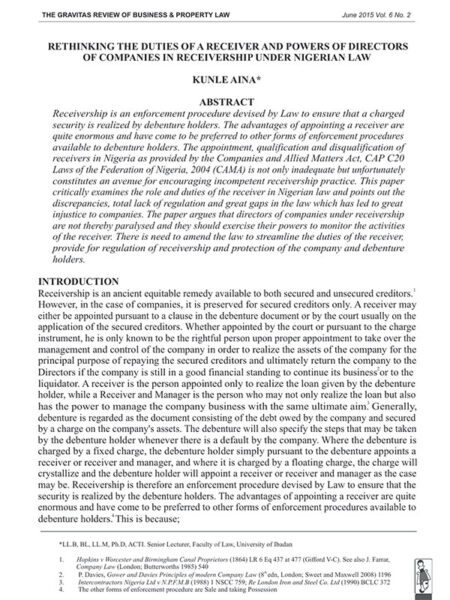
Rethinking the Duties of a Receiver and Powers of Directors of Companies in Receivership under Nigerian Law
0₦2,500.00Kunle Aina, Senior Lecturer, Faculty of Law, University of Ibadan, critically examines the role and duties of the receiver in Nigerian law and points out the discrepancies, total lack of regulation and great gaps in the law which has led to great injustice to companies. Rethinking the Duties of a Receiver and Powers of Directors of Companies in Receivership under Nigerian Law argues that directors of companies under receivership are not thereby paralysed and they should exercise their powers to monitor the activities of the receiver. There is need to amend the law to streamline the duties of the receiver, provide for regulation of receivership and protection of the company and debenture holders.
The Gravitas Review of Business & Property Law