-
Legal Profession in a Digital Era: Balancing Tradition and Transformation
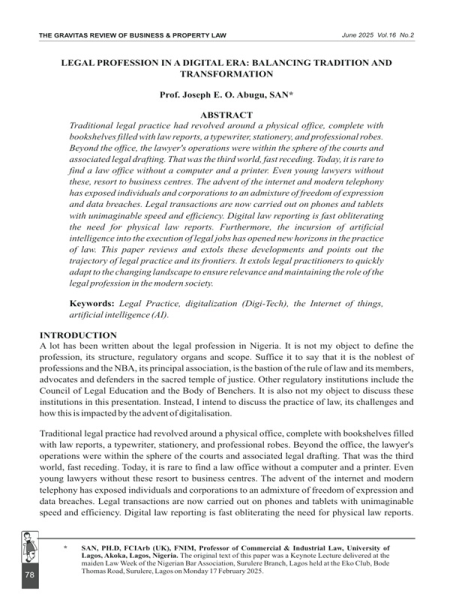
0₦2,500.00Traditional legal practice had revolved around a physical office, complete with bookshelves filled with law reports, a typewriter, stationery, and professional robes. Beyond the office, the lawyer’s operations were within the sphere of the courts and associated legal drafting. That was the third world, fast receding. Today, it is rare to find a law office without a computer and a printer. Even young lawyers without these, resort to business centres. The advent of the internet and modern telephony has exposed individuals and corporations to an admixture of freedom of expression and data breaches. Legal transactions are now carried out on phones and tablets with unimaginable speed and efficiency. Digital law reporting is fast obliterating the need for physical law reports. Furthermore, the incursion of artificial intelligence into the execution of legal jobs has opened new horizons in the practice of law. Professor Joseph Abugu, SAN, in his article, Legal Profession in a Digital Era: Balancing Tradition and Transformation, reviews and extols these developments and points out the trajectory of legal practice and its frontiers. Abugu extols legal practitioners to quickly adapt to the changing landscape to ensure relevance and maintaining the role of the legal profession in the modern society.
-
Protectionism in Legal Services, Treaty Obligations, and the Future of the Legal Profession in Nigeria
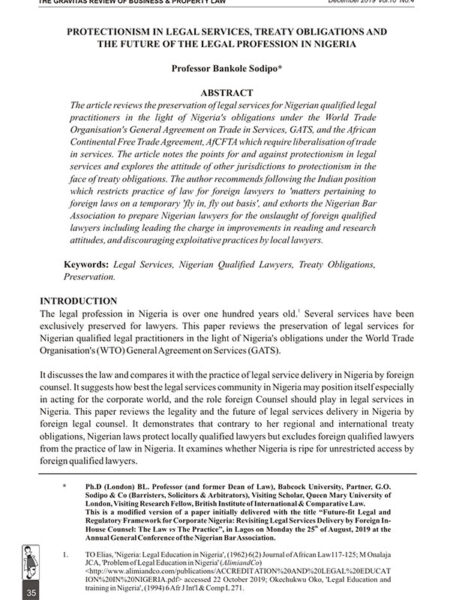
0₦2,500.00Professor Sodipo Bankole of Babcock University; Visiting Scholar, Queen Mary University of London and Partner GO Sodipo & Co in his article, Protectionism in Legal Services, Treaty Obligations and the Future of the Legal Profession in Nigeria, reviews the preservation of legal services for Nigerian qualified legal practitioners by the Legal Practitioners Act in the light of Nigeria’s obligations under the World Trade Organisation’s General Agreement on Trade in Services, GATS, and the African Continental Free Trade Agreement, AfCFTA, which require liberalisation of trade in services. He surmises that while the onslaught of foreign lawyers in Nigeria may only be a matter of time, Nigeria will do well to adopt the Indian position which restricts the practice of law for foreign lawyers to ‘matters pertaining to foreign laws on a temporary ‘fly in, fly out basis’. Professor Bankole exhorts the Nigerian Bar Association to prepare for the onslaught by leading the charge in improvements in reading and research attitudes and discouraging exploitative practices by local lawyers.
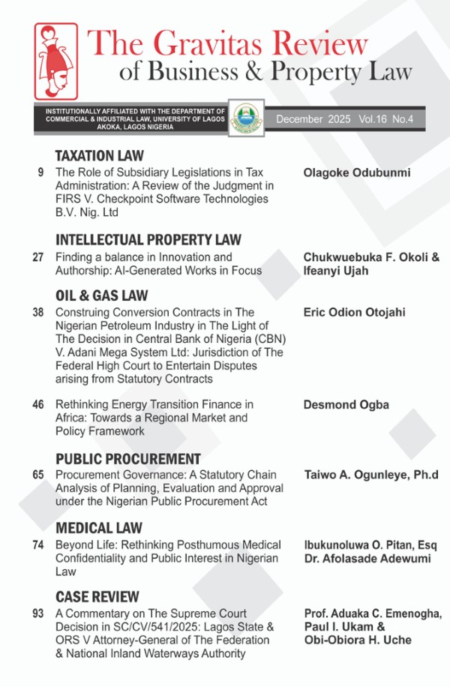
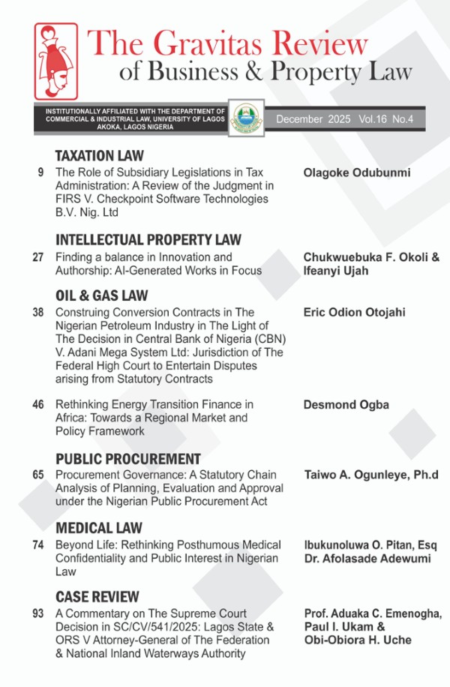
The Gravitas Review of Business & Property Law