-
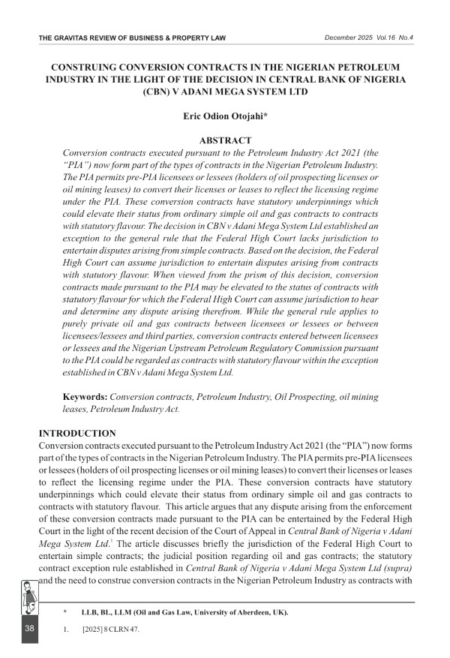
Construing Conversion Contracts in the Nigerian Petroleum Industry in the Light of the Decision in Central Bank of Nigeria (CBN) V. Adani Mega System Ltd: Jurisdiction of the Federal High Court to Entertain Disputes Arising From Statutory Contracts
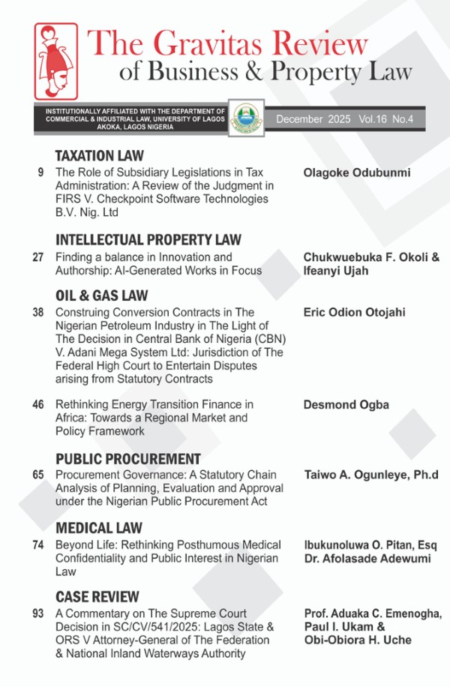
0₦2,500.00Conversion contracts executed pursuant to the Petroleum Industry Act 2021 (the “PIA”) now form part of the types of contracts in the Nigerian Petroleum Industry. The PIA permits pre-PIA licensees or lessees (holders of oil prospecting licenses or oil mining leases) to convert their licenses or leases to reflect the licensing regime under the PIA. These conversion contracts have statutory underpinnings which could elevate their status from ordinary simple oil and gas contracts to contracts with statutory flavour. The decision in CBN v Adani Mega System Ltd established an exception to the general rule that the Federal High Court lacks jurisdiction to entertain disputes arising from simple contracts. Based on the decision, the Federal High Court can assume jurisdiction to entertain disputes arising from contracts with statutory flavour. When viewed from the prism of this decision, Eric Otojahi, in his article, Construing Conversion Contracts in the Nigerian Petroleum Industry in the Light of the Decision in Central Bank of Nigeria (CBN) V. Adani Mega System Ltd: Jurisdiction of the Federal High Court to Entertain Disputes Arising From Statutory Contracts, submits that conversion contracts made pursuant to the PIA may be elevated to the status of contracts with statutory flavour for which the Federal High Court can assume jurisdiction to hear and determine any dispute arising therefrom. While the general rule applies to purely private oil and gas contracts between licensees or lessees or between licensees/lessees and third parties, conversion contracts entered into between licensees or lessees and the Nigerian Upstream Petroleum Regulatory Commission pursuant to the PIA could be regarded as contracts with statutory flavour within the exception established in CBN v Adani Mega System Ltd.
-
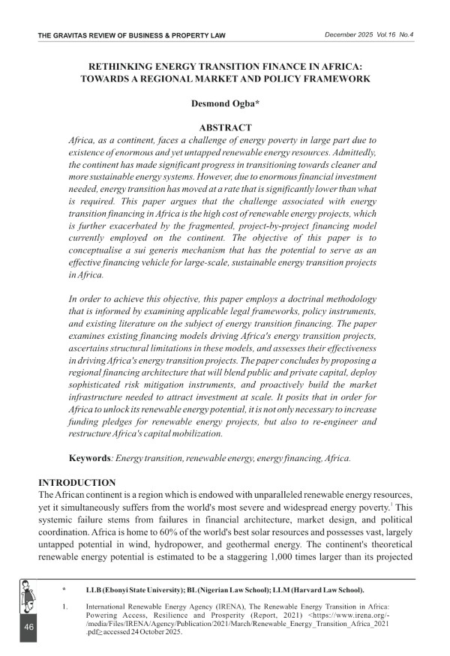
Rethinking Energy Transition Finance in Africa: Towards a Regional Market and Policy Framework
0₦2,500.00Africa, as a continent, faces a challenge of energy poverty in large part due to the existence of enormous and yet untapped renewable energy resources. Admittedly, the continent has made significant progress in transitioning towards cleaner and more sustainable energy systems. However, due to the enormous financial investment needed, energy transition has moved at a rate that is significantly lower than what is required. Desmond Ogba, in his article, Rethinking Energy Transition Finance in Africa: Towards a Regional Market and Policy Framework, argues that the challenge associated with energy transition financing in Africa is the high cost of renewable energy projects, which is further exacerbated by the fragmented, project-by-project financing model currently employed on the continent. Ogba conceptualises a sui generis mechanism that has the potential to serve as an effective financing vehicle for large-scale, sustainable energy transition projects in Africa. It employs a doctrinal methodology that is informed by examining applicable legal frameworks, policy instruments, and existing literature on the subject of energy transition financing. Ogba examines existing financing models driving Africa’s energy transition projects, ascertains structural limitations in these models, and assesses their effectiveness in driving Africa’s energy transition projects. Ogba concludes by proposing a regional financing architecture that will blend public and private capital, deploy sophisticated risk mitigation instruments, and proactively build the market infrastructure needed to attract investment at scale. It posits that for Africa to unlock its renewable energy potential, it is not only necessary to increase funding pledges for renewable energy projects but also to re-engineer and restructure Africa’s capital mobilization.
The Gravitas Review of Business & Property Law