-
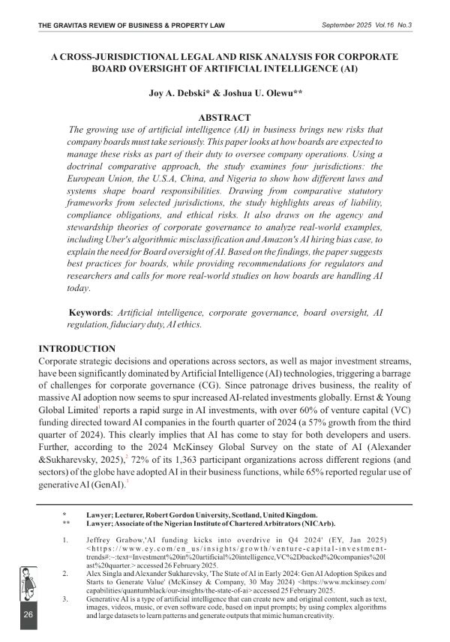
A Cross-Jurisdictional Legal and Risk Analysis for Corporate Board Oversight of Artificial Intelligence
0₦2,500.00The growing use of artificial intelligence (AI) in business brings new risks that company boards must take seriously. Joy Debski and Joshua Olewu, in their article, A Cross-Jurisdictional Legal and Risk Analysis for Corporate Board Oversight of Artificial Intelligence, look at how boards are expected to manage these risks as part of their duty to oversee company operations. Using a doctrinal comparative approach, Debski and Olewu examine four jurisdictions: the European Union, the U.S.A, China, and Nigeria to show how different laws and systems shape board responsibilities. Drawing from comparative statutory frameworks from selected jurisdictions, Debski and Olewu highlight areas of liability, compliance obligations, and ethical risks. They also draw on the agency and stewardship theories of corporate governance to analyze real-world examples, including Uber’s algorithmic misclassification and Amazon’s AI hiring bias case, to explain the need for Board oversight of AI. Based on the findings, Debski and Olewu suggest best practices for boards, provide recommendations for regulators and researchers, and call for more real-world studies on how boards are handling AI today.
-
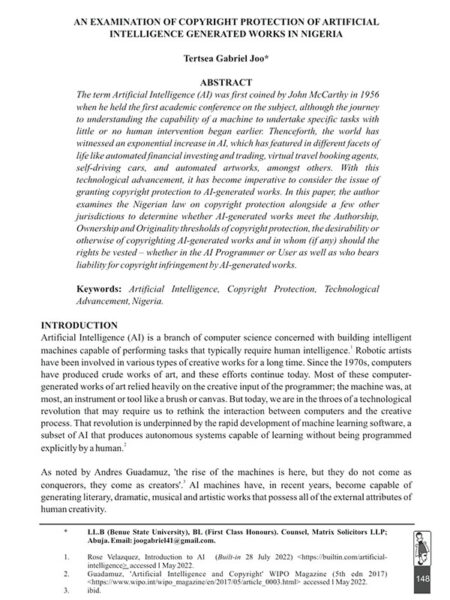
An Examination of Copyright Protection of Artificial Intelligence Generated Works in Nigeria
0₦2,500.00Tertsea Joo of Matrix Solicitors in his paper, An Examination of Copyright Protection of Artificial Intelligence Generated Works in Nigeria, notes that the world has witnessed an exponential increase in Artificial Intelligence (AI) which has featured in different facets of life like automated financial investing and trading, virtual travel booking agents, self-driving cars, and automated artworks, amongst others. With this technological advancement, it has become imperative to consider the issue of granting copyright protection to AI-generated works. Tertsea examines the Nigerian law on copyright protection alongside a few other jurisdictions to determine whether AI-generated works meet the Authorship, Ownership and Originality thresholds of copyright protection, the desirability or otherwise of copyrighting AI-generated works and in whom the rights should be vested – whether in the AI Programmer or User as well as who bears liability for copyright infringement by AI-generated works.
-
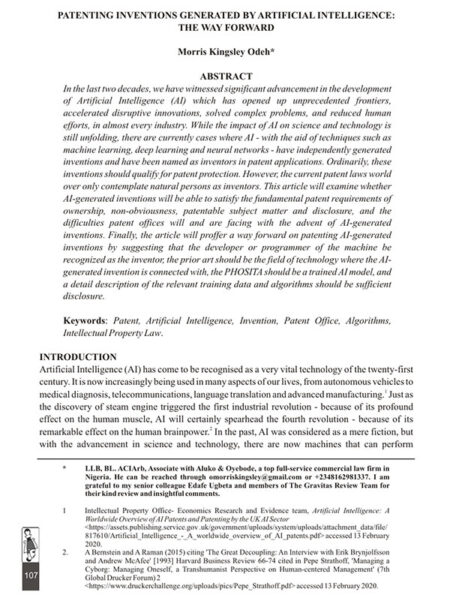
Patenting Inventions Generated by Artificial Intelligence: The Way Forward
0₦2,500.00Morris Odeh, Associate with Aluko & Oyebode in his article, Patenting Inventions Generated by Artificial Intelligence: The Way Forward, observes that the world has witnessed significant advancement in the development of Artificial Intelligence (AI) which has opened up unprecedented frontiers, accelerated disruptive innovations, solved complex problems, and reduced human efforts, in almost every industry. While the impact of AI on science and technology is still unfolding, there are currently cases where AI – with the aid of techniques such as machine learning, deep learning and neural networks-have independently generated inventions and have been named as inventors in patent applications. Ordinarily, these inventions should qualify for patent protection. However, the current patent laws only contemplate natural persons as inventors. Odeh examines whether AI-generated inventions will be able to satisfy the fundamental patent requirements of ownership, non-obviousness, patentable subject matter and disclosure, and the difficulties patent offices will and are facing with the advent of AI-generated inventions.
The Gravitas Review of Business & Property Law