-
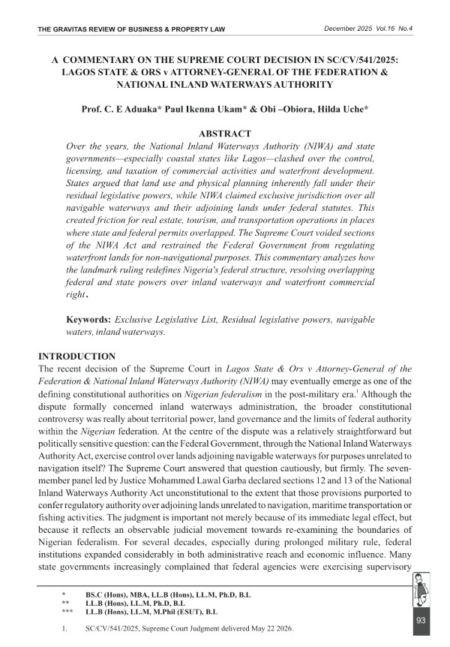
A Commentary on the Supreme court Decision in SC/CV/541/2025: Lagos State & Ors V. Attorney General of the Federation & National Inland Waterways Authority
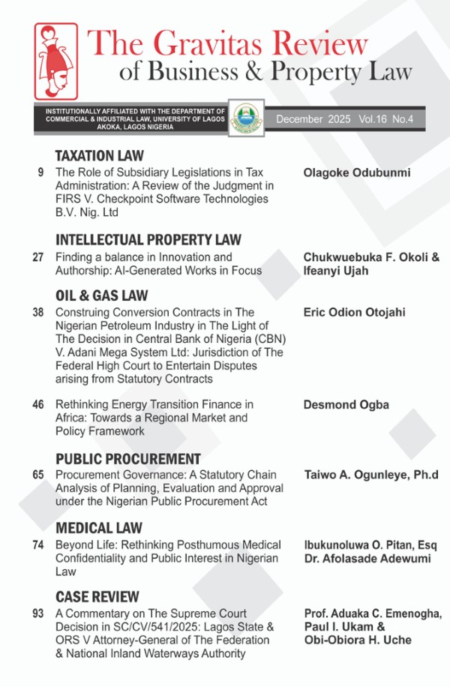
0₦2,500.00Over the years, the National Inland Waterways Authority (NIWA) and state governments—especially coastal states like Lagos—clashed over the control, licensing, and taxation of commercial activities and waterfront development. States argued that land use and physical planning inherently fall under their residual legislative powers, while NIWA claimed exclusive jurisdiction over all navigable waterways and their adjoining lands under federal statutes. This created friction for real estate, tourism, and transportation operations in places where state and federal permits overlapped. The Supreme Court voided sections of the NIWA Act and restrained the Federal Government from regulating waterfront lands for non-navigational purposes. Prof. Charles Aduaka, Paul Ukam, and Uche Hilda Obi Obiora, in their article, A Commentary on the Supreme court Decision in SC/CV/541/2025: Lagos State & Ors V. Attorney General of the Federation & National Inland Waterways Authority, analyze how the landmark ruling redefines Nigeria’s federal structure, resolving overlapping federal and state powers over inland waterways and waterfront commercial right.
-
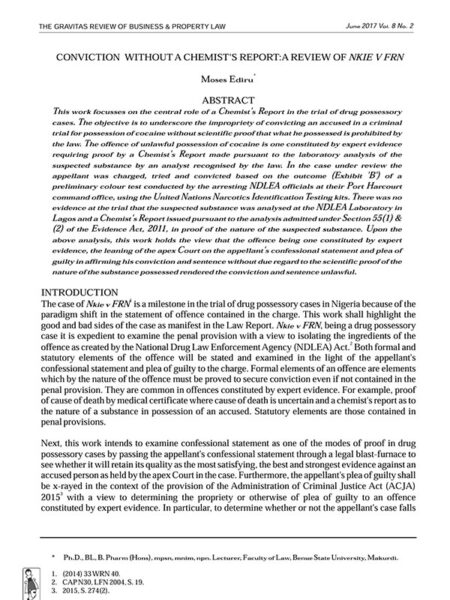
Conviction without a Chemist’s Report: A Review of Nkie v FRN
0₦2,500.00Dr Moses Ediru, of the Faculty of Law, Benue State University in his article “Conviction Without a Chemist’s Report: A Review of Nkie v FRN“, argues that in the trial of drug possessory cases, where the offence is one constituted by expert evidence, presentation of a Chemist’s Report is imperative. In the case under review, the appellant was charged, tried and convicted based on the outcome of a preliminary colour test conducted by the arresting NDLEA officials using the United Nations Narcotics Identification Testing kits. The suspected substance was not analysed at the NDLEA Laboratory and a Chemist’s Report issued pursuant to the analysis, in proof of the nature of the suspected substance. The article argues that the offence being one constituted by expert evidence according to the National Drug Law Enforcement Agency Act, the leaning of the Supreme Court on the appellant’s confessional statement and plea of guilty in affirming his conviction and sentence without due regard to the scientific proof of the nature of the substance possessed rendered the conviction and sentence unlawful.
The Gravitas Review of Business & Property Law