-
Rethinking Energy Transition Finance in Africa: Towards a Regional Market and Policy Framework
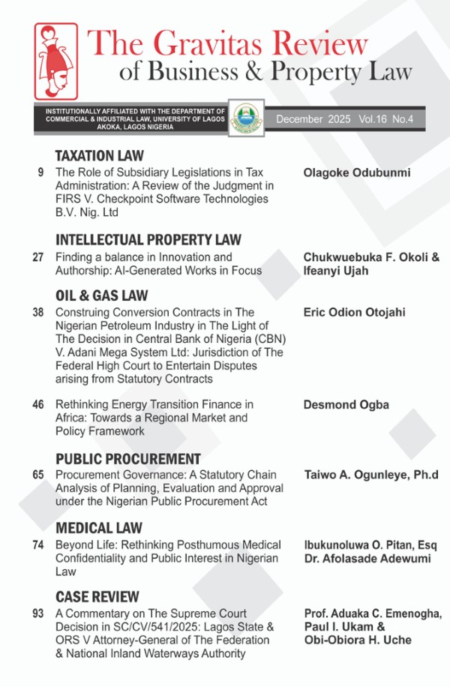
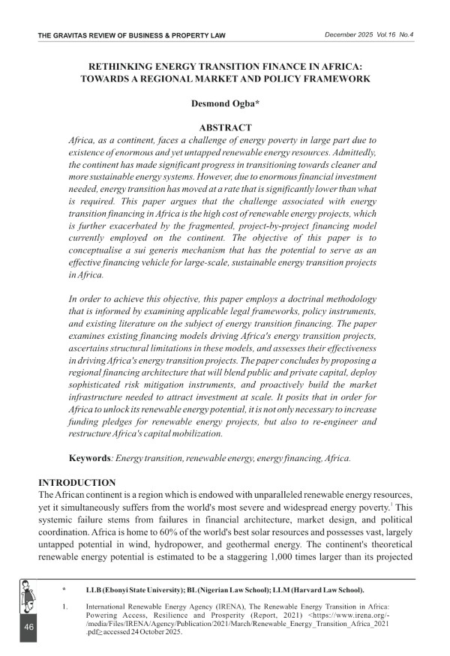
0₦2,500.00Africa, as a continent, faces a challenge of energy poverty in large part due to the existence of enormous and yet untapped renewable energy resources. Admittedly, the continent has made significant progress in transitioning towards cleaner and more sustainable energy systems. However, due to the enormous financial investment needed, energy transition has moved at a rate that is significantly lower than what is required. Desmond Ogba, in his article, Rethinking Energy Transition Finance in Africa: Towards a Regional Market and Policy Framework, argues that the challenge associated with energy transition financing in Africa is the high cost of renewable energy projects, which is further exacerbated by the fragmented, project-by-project financing model currently employed on the continent. Ogba conceptualises a sui generis mechanism that has the potential to serve as an effective financing vehicle for large-scale, sustainable energy transition projects in Africa. It employs a doctrinal methodology that is informed by examining applicable legal frameworks, policy instruments, and existing literature on the subject of energy transition financing. Ogba examines existing financing models driving Africa’s energy transition projects, ascertains structural limitations in these models, and assesses their effectiveness in driving Africa’s energy transition projects. Ogba concludes by proposing a regional financing architecture that will blend public and private capital, deploy sophisticated risk mitigation instruments, and proactively build the market infrastructure needed to attract investment at scale. It posits that for Africa to unlock its renewable energy potential, it is not only necessary to increase funding pledges for renewable energy projects but also to re-engineer and restructure Africa’s capital mobilization.
-
The Gravitas Review of Business & Property Law Vol.16 No.3 – Print
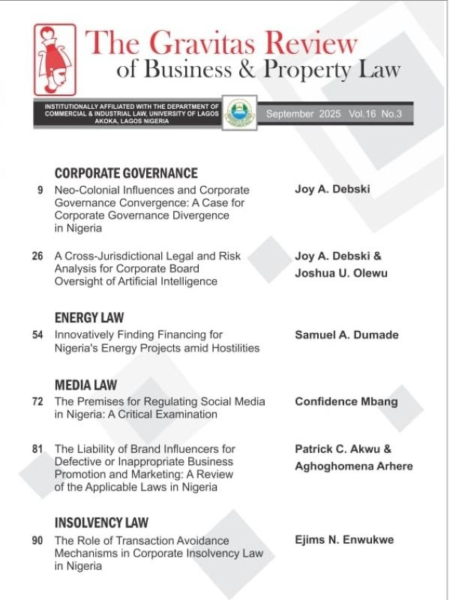
0₦5,000.00In this issue of The Gravitas Review of Business & Property Law Vol.16 No.3, there are well researched articles on:
- Corporate Governance
- Energy Law
- Media Law
- Insolvency Law
-
The Gravitas Review of Business & Property Law Vol.16 No.3 – E-Book
0₦5,000.00In this issue of The Gravitas Review of Business & Property Law Vol.16 No.3, there are well researched articles on:
- Corporate Governance
- Energy Law
- Media Law
- Insolvency Law
-
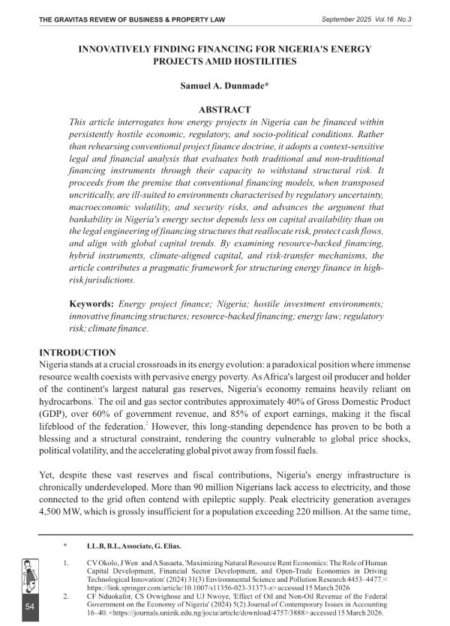
Innovatively Finding Financing For Nigeria’s Energy Projects and Hostilities
0₦2,500.00Samuel Dunmade, in his article, Innovatively Finding Financing For Nigeria’s Energy Projects and Hostilities, interrogates how energy projects in Nigeria can be financed within persistently hostile economic, regulatory, and socio-political conditions. Rather than rehearsing conventional project finance doctrine, it adopts a context-sensitive legal and financial analysis that evaluates both traditional and non-traditional financing instruments through their capacity to withstand structural risk. It proceeds from the premise that conventional financing models, when transposed uncritically, are ill-suited to environments characterised by regulatory uncertainty, macroeconomic volatility, and security risks, and advances the argument that bankability in Nigeria’s energy sector depends less on capital availability than on the legal engineering of financing structures that reallocate risk, protect cash flows, and align with global capital trends. By examining resource-backed financing, hybrid instruments, climate-aligned capital, and risk-transfer mechanisms, Dunmade contributes a pragmatic framework for structuring energy finance in high-risk jurisdictions.
-
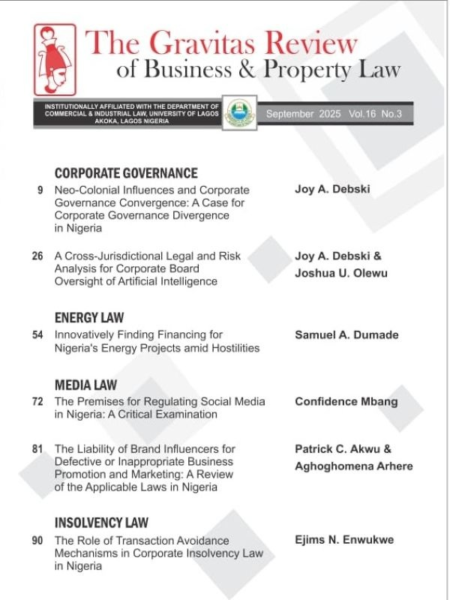
The Gravitas Review of Business & Property Law Vol.16 No.3
0₦5,000.00In this issue of The Gravitas Review of Business & Property Law Vol.16 No.3, there are well researched articles on:
- Corporate Governance
- Energy Law
- Media Law
- Insolvency Law
-
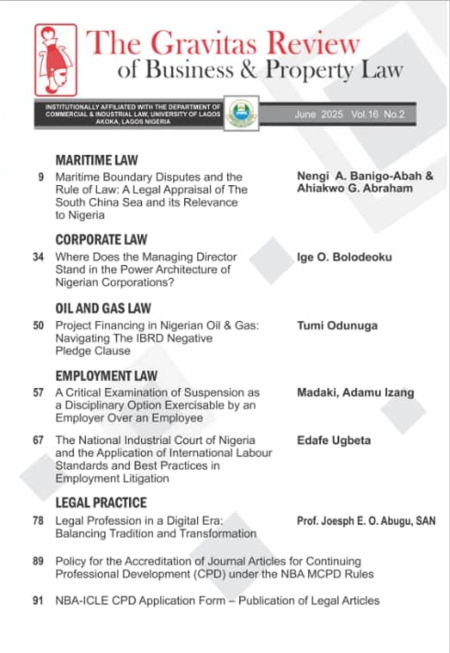
The Gravitas Review of Business & Property Law Vol.16 No.2 – Print
0₦5,000.00In this issue of The Gravitas Review of Business & Property Law Vol.16 No.2, there are well researched articles on:
- Maritime Law
- Corporate Law
- Energy Law
- Employment Law
- Legal Practice
-
The Gravitas Review of Business & Property Law Vol.16 No.2 – E-Book
0₦5,000.00In this issue of The Gravitas Review of Business & Property Law Vol.16 No.2, there are well researched articles on:
- Maritime Law
- Corporate Law
- Energy Law
- Employment Law
- Legal Practice
-
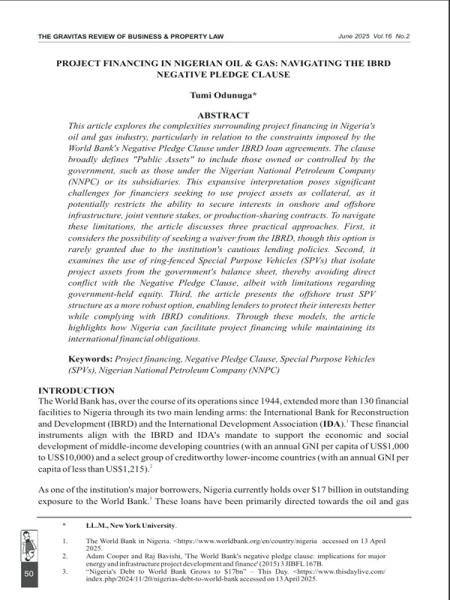
Project Financing in Nigerian Oil & Gas: Navigating the IBRD Clause
0₦2,500.00Tumi Odunuga in his article, Project Financing in Nigerian Oil & Gas: Navigating the IBRD Clause, explores the complexities surrounding project financing in Nigeria’s oil and gas industry, particularly in relation to the constraints imposed by the World Bank’s Negative Pledge Clause under IBRD loan agreements. The clause broadly defines “Public Assets” to include those owned or controlled by the government, such as those under the Nigerian National Petroleum Company (NNPC) or its subsidiaries. This expansive interpretation poses significant challenges for financiers seeking to use project assets as collateral, as it potentially restricts the ability to secure interests in onshore and offshore infrastructure, joint venture stakes, or production-sharing contracts. To navigate these limitations, Odunuga discusses three practical approaches. First, Odunuga considers the possibility of seeking a waiver from the IBRD, though this option is rarely granted due to the institution’s cautious lending policies. Second, Odunuga examines the use of ring-fenced Special Purpose Vehicles (SPVs) that isolate project assets from the government’s balance sheet, thereby avoiding direct conflict with the Negative Pledge Clause, albeit with limitations regarding government-held equity. Third, Odunuga presents the offshore trust SPV structure as a more robust option, enabling lenders to protect their interests better while complying with IBRD conditions. Through these models, Odunuga highlights how Nigeria can facilitate project financing while maintaining its international financial obligations.
-
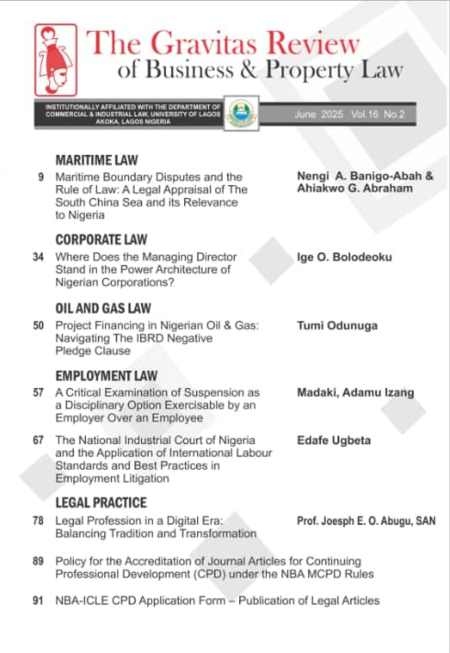
The Gravitas Review of Business & Property Law Vol.16 No.2
0₦5,000.00In this issue of The Gravitas Review of Business & Property Law Vol.16 No.2, there are well researched articles on:
- Maritime Law
- Corporate Law
- Energy Law
- Employment Law
- Legal Practice
-
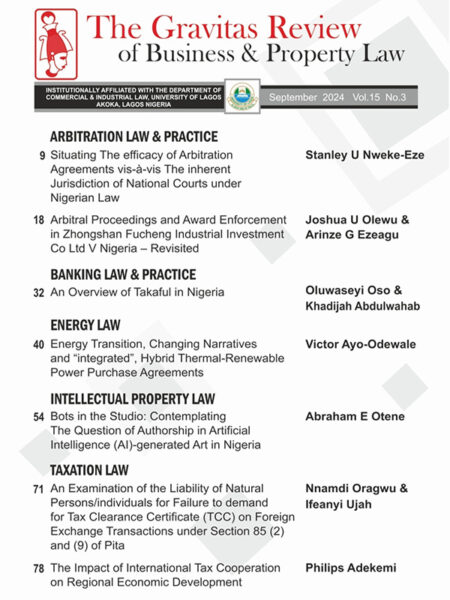
The Gravitas Review of Business & Property Law Vol.16 No.1 – Print
0₦5,000.00In this issue of The Gravitas Review of Business & Property Law Vol.16 No.1, there are well researched articles on:
- Commercial Law & Practice
- Intellectual Property Law
- Data Protection & Privacy
- Employment Law
- Taxation
- Energy Law
- Medical Law
-
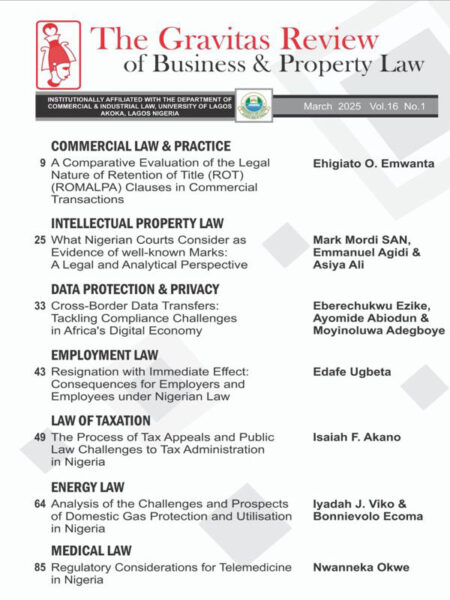
The Gravitas Review of Business & Property Law Vol.16 No.1 – E-Book
0₦5,000.00In this issue of The Gravitas Review of Business & Property Law Vol.16 No.1, there are well researched articles on:
- Commercial Law & Practice
- Intellectual Property Law
- Data Protection & Privacy
- Employment Law
- Taxation
- Energy Law
- Medical Law
-
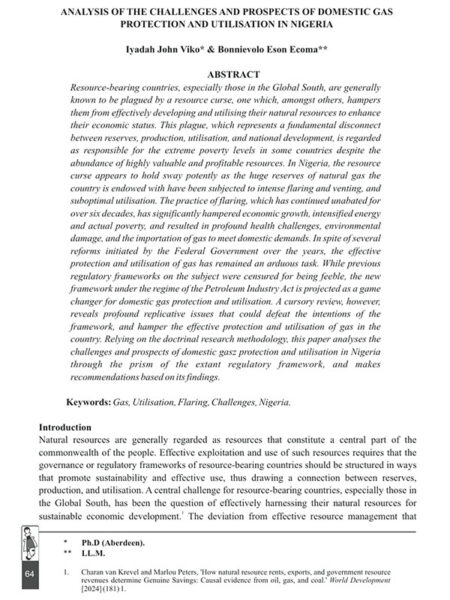
Analysis of the Challenges and Prospects of Domestic Gas Protection and Utilisation in Nigeria
0₦2,500.00Iyadah Viko & Bonnievolo Ecoma in their article, Analysis of the Challenges and Prospects of Domestic Gas Protection and Utilisation in Nigeria, analyse the challenges and prospects of domestic gas protection and utilisation in Nigeria through the prism of the extant regulatory framework, and makes recommendations based on its findings. Resource-bearing countries, especially those in the Global South, are generally known to be plagued by a resource curse, one which, amongst others, hampers them from effectively developing their natural resources to enhance their economic status. This plague, which represents a fundamental disconnect between reserves, production, utilisation, and national development, is regarded as responsible for the extreme poverty levels in some countries despite the abundance of highly valuable and profitable resources. In Nigeria, the resource curse appears to hold sway potently as the huge reserves of natural gas the country is endowed with have been subjected to intense flaring and venting, and suboptimal utilisation. The practice of flaring, which has continued unabated for over six decades, has significantly hampered economic growth, intensified energy and actual poverty, and resulted in profound health challenges, environmental damage, and the importation of gas to meet domestic demands. In spite of several reforms initiated by the Federal Government over the years, the effective protection and utilisation of gas has remained an arduous task. While previous regulatory frameworks on the subject were censured for being feeble, the new framework under the regime of the Petroleum Industry Act is projected as a game changer for domestic gas protection and utilisation. A cursory review, however, reveals profound replicative issues that could defeat the intentions of the framework, and hamper the effective protection and utilisation of gas in the country.
The Gravitas Review of Business & Property Law