-
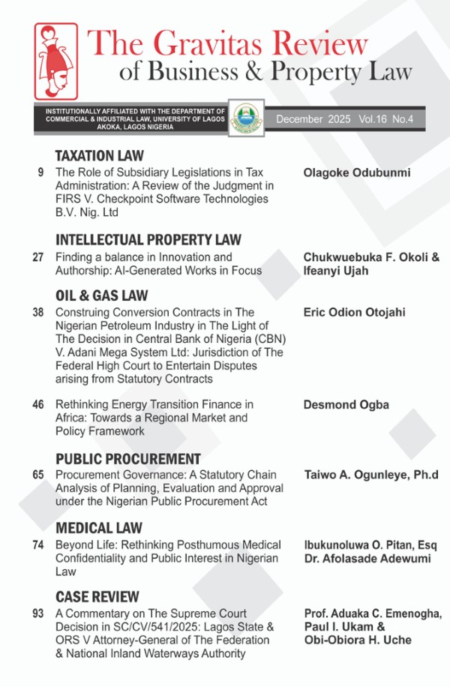
The Gravitas Review of Business & Property Law Vol.16 No.4 – Print
0₦5,000.00In this issue of The Gravitas Review of Business & Property Law Vol.16 No.4, there are well researched articles on:
- Taxation
- Intellectual Property
- Oli & Gas
- Public Procurement
- Medical Law
- Case Review
-
The Gravitas Review of Business & Property Law Vol.16 No.4 – E-Book
0₦5,000.00In this issue of The Gravitas Review of Business & Property Law Vol.16 No.4, there are well researched articles on:
- Taxation
- Intellectual Property
- Oli & Gas
- Public Procurement
- Medical Law
- Case Review
-
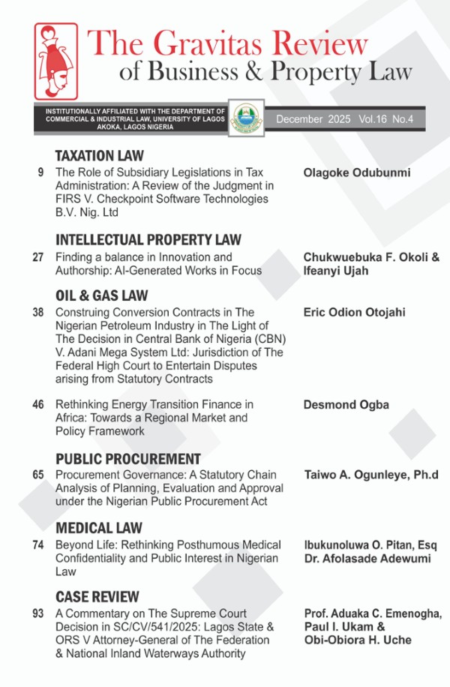
The Gravitas Review of Business & Property Law Vol.16 No.4
0₦5,000.00In this issue of The Gravitas Review of Business & Property Law Vol.16 No.4, there are well researched articles on:
- Taxation
- Intellectual Property
- Oli & Gas
- Public Procurement
- Medical Law
- Case Review
-
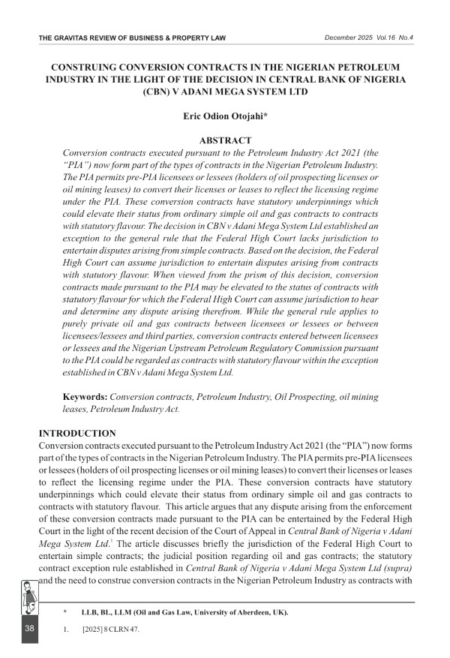
Construing Conversion Contracts in the Nigerian Petroleum Industry in the Light of the Decision in Central Bank of Nigeria (CBN) V. Adani Mega System Ltd: Jurisdiction of the Federal High Court to Entertain Disputes Arising From Statutory Contracts
0₦2,500.00Conversion contracts executed pursuant to the Petroleum Industry Act 2021 (the “PIA”) now form part of the types of contracts in the Nigerian Petroleum Industry. The PIA permits pre-PIA licensees or lessees (holders of oil prospecting licenses or oil mining leases) to convert their licenses or leases to reflect the licensing regime under the PIA. These conversion contracts have statutory underpinnings which could elevate their status from ordinary simple oil and gas contracts to contracts with statutory flavour. The decision in CBN v Adani Mega System Ltd established an exception to the general rule that the Federal High Court lacks jurisdiction to entertain disputes arising from simple contracts. Based on the decision, the Federal High Court can assume jurisdiction to entertain disputes arising from contracts with statutory flavour. When viewed from the prism of this decision, Eric Otojahi, in his article, Construing Conversion Contracts in the Nigerian Petroleum Industry in the Light of the Decision in Central Bank of Nigeria (CBN) V. Adani Mega System Ltd: Jurisdiction of the Federal High Court to Entertain Disputes Arising From Statutory Contracts, submits that conversion contracts made pursuant to the PIA may be elevated to the status of contracts with statutory flavour for which the Federal High Court can assume jurisdiction to hear and determine any dispute arising therefrom. While the general rule applies to purely private oil and gas contracts between licensees or lessees or between licensees/lessees and third parties, conversion contracts entered into between licensees or lessees and the Nigerian Upstream Petroleum Regulatory Commission pursuant to the PIA could be regarded as contracts with statutory flavour within the exception established in CBN v Adani Mega System Ltd.
-
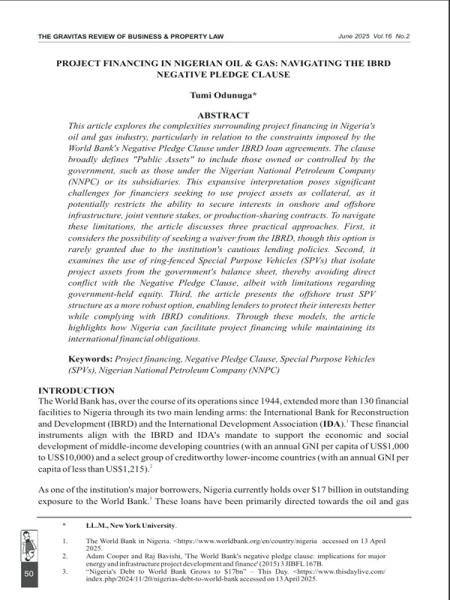
Project Financing in Nigerian Oil & Gas: Navigating the IBRD Clause
0₦2,500.00Tumi Odunuga in his article, Project Financing in Nigerian Oil & Gas: Navigating the IBRD Clause, explores the complexities surrounding project financing in Nigeria’s oil and gas industry, particularly in relation to the constraints imposed by the World Bank’s Negative Pledge Clause under IBRD loan agreements. The clause broadly defines “Public Assets” to include those owned or controlled by the government, such as those under the Nigerian National Petroleum Company (NNPC) or its subsidiaries. This expansive interpretation poses significant challenges for financiers seeking to use project assets as collateral, as it potentially restricts the ability to secure interests in onshore and offshore infrastructure, joint venture stakes, or production-sharing contracts. To navigate these limitations, Odunuga discusses three practical approaches. First, Odunuga considers the possibility of seeking a waiver from the IBRD, though this option is rarely granted due to the institution’s cautious lending policies. Second, Odunuga examines the use of ring-fenced Special Purpose Vehicles (SPVs) that isolate project assets from the government’s balance sheet, thereby avoiding direct conflict with the Negative Pledge Clause, albeit with limitations regarding government-held equity. Third, Odunuga presents the offshore trust SPV structure as a more robust option, enabling lenders to protect their interests better while complying with IBRD conditions. Through these models, Odunuga highlights how Nigeria can facilitate project financing while maintaining its international financial obligations.
-
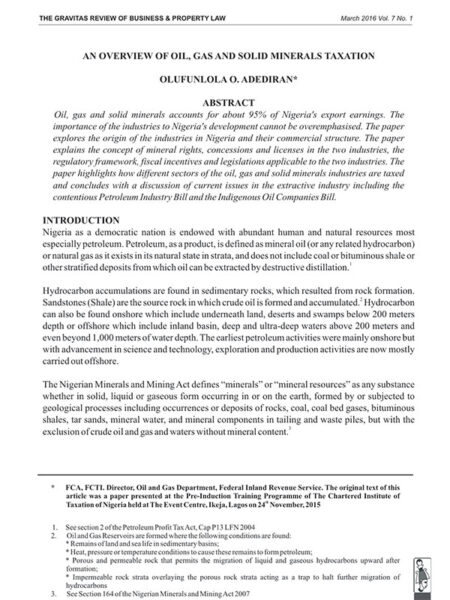
An Overview of Oil, Gas and Solid Minerals Taxation
0₦2,500.00Olufunlola Adediran, Director, Oil and Gas Department, Federal Inland Revenue Service in “An Overview of Oil, Gas and Solid Minerals Taxation” examines the commercial structure of the oil, gas and solid minerals industries. She explains the concept of mineral rights, concessions and licenses in the two industries, the regulatory framework, fiscal incentives and legislations applicable to them. She highlights how different sectors of the oil, gas and solid minerals industries are taxed and discusses current issues in the extractive industry including the contentious Petroleum Industry Bill and the Indigenous Oil Companies Bill.
The Gravitas Review of Business & Property Law