-
Finding a Balance in Innovation and Authorship: AI-Generated Works in Focus
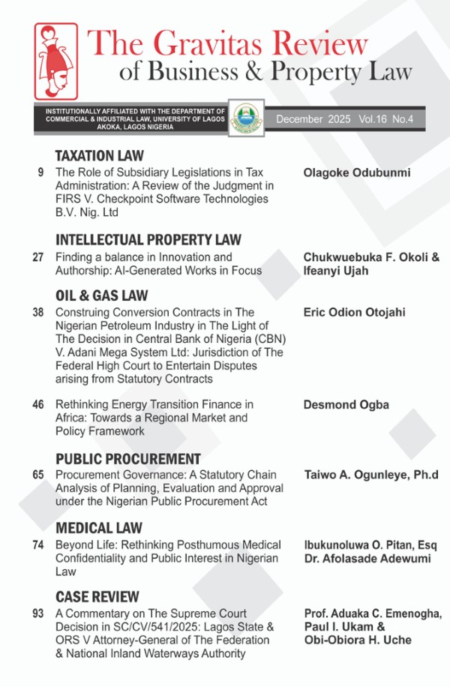
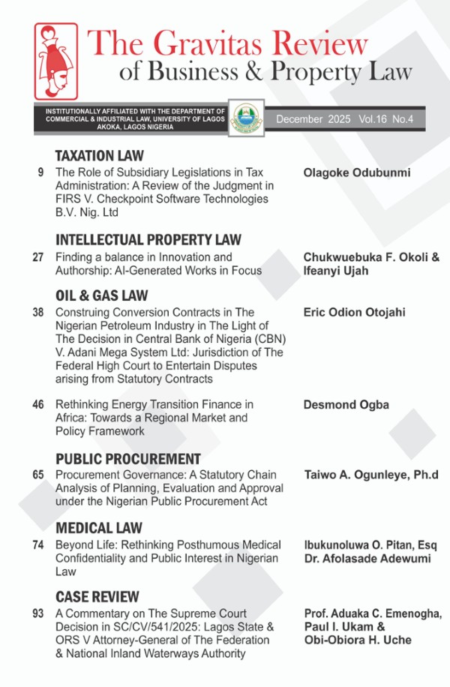
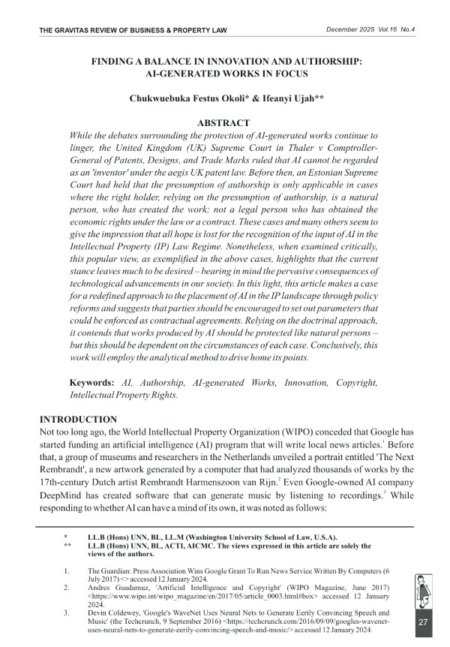
0₦2,500.00Chukwuebuka Okoli and Ifeanyi Ujah, in their article, Finding a Balance in Innovation and Authorship: AI-Generated Works in Focus, venture into the legal basis of protecting AI generated works. While the debates surrounding the protection of AI-generated works continue to linger, the United Kingdom (UK) Supreme Court in Thaler v Comptroller-General of Patents, Designs, and Trade Marks ruled that AI cannot be regarded as an ‘inventor’ under the aegis of UK patent law. Before then, the Estonian Supreme Court had held that the presumption of authorship applies only in cases where the right holder, relying on the presumption, is a natural person who created the work, not a legal person who has obtained economic rights under the law or by contract. These cases and many others seem to give the impression that all hope is lost for the recognition of the input of AI in the Intellectual Property (IP) Law Regime. Nonetheless, when examined critically, this popular view, as exemplified in the above cases, highlights that the current stance leaves much to be desired – bearing in mind the pervasive consequences of technological advancements in our society. In this light, Okoli and Ujah make a case for a redefined approach to the placement of AI in the IP landscape through policy reforms and suggest that parties should be encouraged to set out parameters that could be enforced as contractual agreements. Relying on the doctrinal approach, it contends that works produced by AI should be protected like natural persons – but this should be dependent on the circumstances of each case. Conclusively, this work will employ the analytical method to drive home its points.
-
What Nigerian Courts Consider as Evidence of Well-Known Marks: A Legal and Analytical Perspective
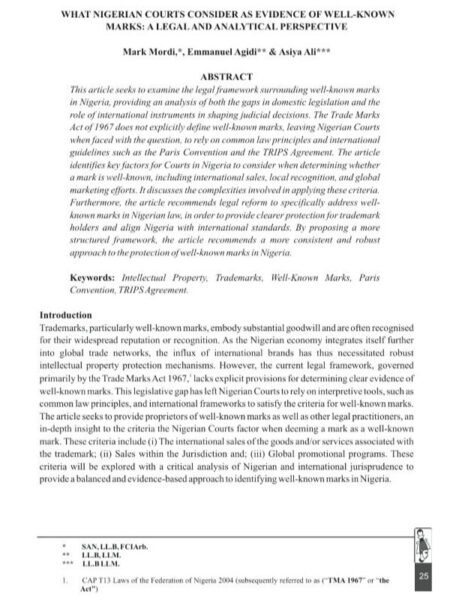
0₦2,500.00Mark Mordi SAN, Emmanuel Agidi & Asiya Ali in their article, What Nigerian Courts Consider as Evidence of Well-Known Marks: A Legal and Analytical Perspective, seek to examine the legal framework surrounding well-known marks in Nigeria, providing an analysis of both the gaps in domestic legislation and the role of international instruments in shaping judicial decisions. The Trade Marks Act of 1967 does not explicitly define well-known marks, leaving Nigerian Courts when faced with the question, to rely on common law principles and international guidelines such as the Paris Convention and the TRIPS Agreement. Mordi et al identify key factors for Courts in Nigeria to consider when determining whether a mark is well-known, including international sales, local recognition, and global marketing efforts. Mordi et al discuss the complexities involved in applying these criteria. Furthermore, the article recommends legal reform to specifically address well-known marks in Nigerian law, in order to provide clearer protection for trademark holders and align Nigeria with international standards. By proposing a more structured framework, Mordi et al recommend a more consistent and robust approach to the protection of well-known marks in Nigeria.
-
Exploring the Juridical Limits of Name Sharing in Trade Mark Law & Practice
0₦2,500.00Professor Adebambo Adewopo,in his article, Exploring the Juridical Limits of Name Sharing in Trade Mark Law & Practice explores the trend of sharing the same name by different undertakings in the rapidly growing and competitive Nigerian market environment. Prof Adewopo deconstructs the juridical bases for sharing the same name and posits that such use is not inconsistent with established tenets of trademark law and practice. Adewopo surveys the legal landscape of name-sharing in the key circumstances where entities may be permitted to use the same trademark in respect of the same or different products. The article situates and rests the existing law and jurisprudence of trademark-sharing on two pillars, namely the classical trademark function and the bona fide use principles.
-
Trademark Protection Under the Companies and Allied Matters Act 2020: An Evaluation of an Expanded Protective Framework in Nigeria
0₦2,500.00Richman Thommanuel, Associate, Aluko & Oyebode, in his article, Trademark Protection Under the Companies and Allied Matters Act 20202: An Evaluation of an Expanded Protective Framework in Nigeria, explains that in furtherance of the need to protect trademarks and prevent infringement, the Companies and Allied Matters Act (CAMA) stipulates as a precondition for the registration of a company, that where the proposed name of the company conflicts with or is likely to conflict with an existing trade mark registered in Nigeria, the name shall not be registered by the Corporate Affairs Commission (CAC). To give meaning to the provision, the CAMA 1990 empowered the CAC to issue directives for a company to voluntarily change its name if the same was inadvertently registered under a name that conflicts with an existing trademark. Despite the powers conferred on the CAC in this regard, the CAMA 1990 was flawed with shortcomings, including the absence of a mechanism to enforce the CAC’s directives for an infringing company to change its name. This lacuna has been addressed by CAMA 2020. Richman examines the expanded protective framework under the re-enacted CAMA.
-
A Discourse on the Quality of Distinctiveness and Statutory Requirements of Registration of Trademarks in Nigeria
0₦2,500.00Mark Mordi, Partner Aluko & Oyebode in, A Discourse on the Quality of Distinctiveness and Statutory Requirements of Registration of Trademarks in Nigeria, deconstructs the concept of distinctiveness which quality, serves as an alternative to the statutory requirements for registration. Mordi examines the responsibilities and duties the Trade Marks Act 1965 places on the Trademarks Registry, on a prospective trademark applicant seeking registration of his trademark, and a party desirous of opposing a trademark registration (typically a prior registrant).
-
Registration of Trademarks: Safeguarding Business Interests and Protecting Consumers against Confusion
0₦2,500.00Yahya Hambali, Deputy Director, Nigerian Law School and research student at the School of Law, Queen’s University, Belfast, Northern Ireland, examines the provisions of the Trade Marks Act through decided cases and gives a practical guide on registration of trademarks.
The Gravitas Review of Business & Property Law