-
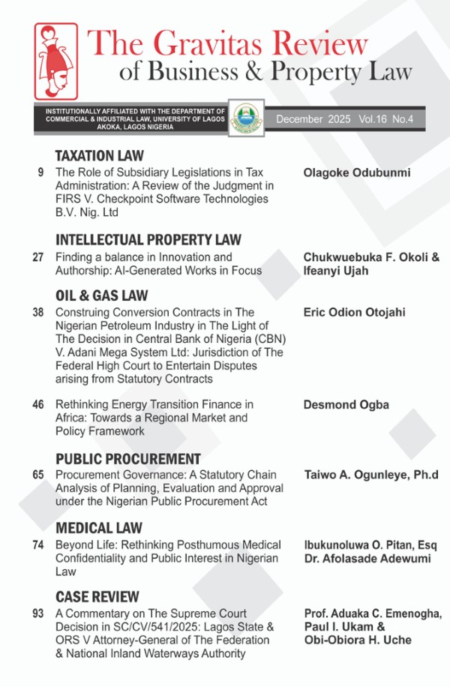
The Gravitas Review of Business & Property Law Vol.16 No.4 – Print
0₦5,000.00In this issue of The Gravitas Review of Business & Property Law Vol.16 No.4, there are well researched articles on:
- Taxation
- Intellectual Property
- Oli & Gas
- Public Procurement
- Medical Law
- Case Review
-
The Gravitas Review of Business & Property Law Vol.16 No.4 – E-Book
0₦5,000.00In this issue of The Gravitas Review of Business & Property Law Vol.16 No.4, there are well researched articles on:
- Taxation
- Intellectual Property
- Oli & Gas
- Public Procurement
- Medical Law
- Case Review
-
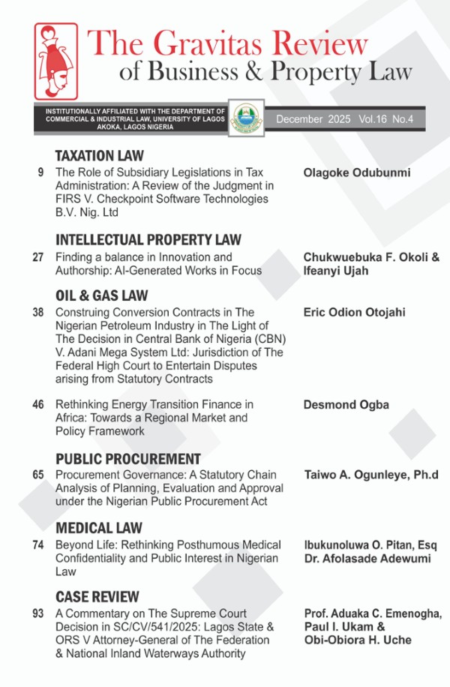
The Gravitas Review of Business & Property Law Vol.16 No.4
0₦5,000.00In this issue of The Gravitas Review of Business & Property Law Vol.16 No.4, there are well researched articles on:
- Taxation
- Intellectual Property
- Oli & Gas
- Public Procurement
- Medical Law
- Case Review
-
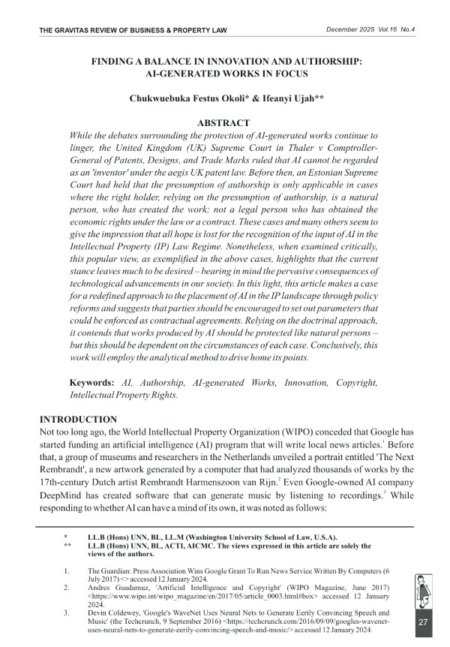
Finding a Balance in Innovation and Authorship: AI-Generated Works in Focus
0₦2,500.00Chukwuebuka Okoli and Ifeanyi Ujah, in their article, Finding a Balance in Innovation and Authorship: AI-Generated Works in Focus, venture into the legal basis of protecting AI generated works. While the debates surrounding the protection of AI-generated works continue to linger, the United Kingdom (UK) Supreme Court in Thaler v Comptroller-General of Patents, Designs, and Trade Marks ruled that AI cannot be regarded as an ‘inventor’ under the aegis of UK patent law. Before then, the Estonian Supreme Court had held that the presumption of authorship applies only in cases where the right holder, relying on the presumption, is a natural person who created the work, not a legal person who has obtained economic rights under the law or by contract. These cases and many others seem to give the impression that all hope is lost for the recognition of the input of AI in the Intellectual Property (IP) Law Regime. Nonetheless, when examined critically, this popular view, as exemplified in the above cases, highlights that the current stance leaves much to be desired – bearing in mind the pervasive consequences of technological advancements in our society. In this light, Okoli and Ujah make a case for a redefined approach to the placement of AI in the IP landscape through policy reforms and suggest that parties should be encouraged to set out parameters that could be enforced as contractual agreements. Relying on the doctrinal approach, it contends that works produced by AI should be protected like natural persons – but this should be dependent on the circumstances of each case. Conclusively, this work will employ the analytical method to drive home its points.
-
The Gravitas Review of Business & Property Law Vol.16 No.1 – Print
0₦5,000.00In this issue of The Gravitas Review of Business & Property Law Vol.16 No.1, there are well researched articles on:
- Commercial Law & Practice
- Intellectual Property Law
- Data Protection & Privacy
- Employment Law
- Taxation
- Energy Law
- Medical Law
-
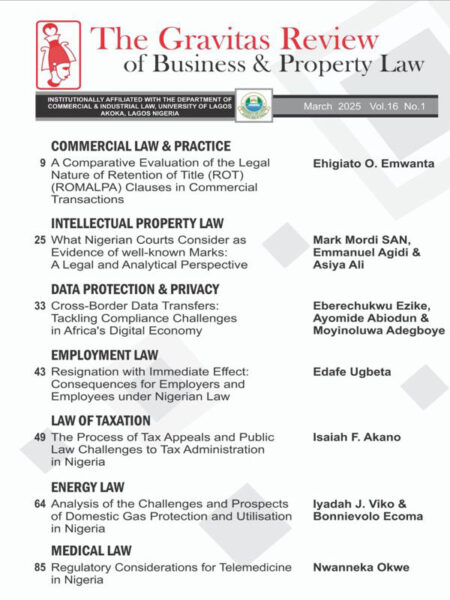
The Gravitas Review of Business & Property Law Vol.16 No.1 – E-Book
0₦5,000.00In this issue of The Gravitas Review of Business & Property Law Vol.16 No.1, there are well researched articles on:
- Commercial Law & Practice
- Intellectual Property Law
- Data Protection & Privacy
- Employment Law
- Taxation
- Energy Law
- Medical Law
-
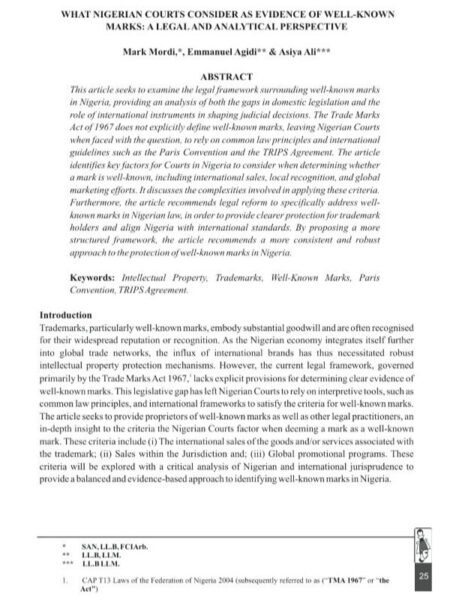
What Nigerian Courts Consider as Evidence of Well-Known Marks: A Legal and Analytical Perspective
0₦2,500.00Mark Mordi SAN, Emmanuel Agidi & Asiya Ali in their article, What Nigerian Courts Consider as Evidence of Well-Known Marks: A Legal and Analytical Perspective, seek to examine the legal framework surrounding well-known marks in Nigeria, providing an analysis of both the gaps in domestic legislation and the role of international instruments in shaping judicial decisions. The Trade Marks Act of 1967 does not explicitly define well-known marks, leaving Nigerian Courts when faced with the question, to rely on common law principles and international guidelines such as the Paris Convention and the TRIPS Agreement. Mordi et al identify key factors for Courts in Nigeria to consider when determining whether a mark is well-known, including international sales, local recognition, and global marketing efforts. Mordi et al discuss the complexities involved in applying these criteria. Furthermore, the article recommends legal reform to specifically address well-known marks in Nigerian law, in order to provide clearer protection for trademark holders and align Nigeria with international standards. By proposing a more structured framework, Mordi et al recommend a more consistent and robust approach to the protection of well-known marks in Nigeria.
-
The Gravitas Review of Business & Property Law Vol.16 No.1
0₦5,000.00In this issue of The Gravitas Review of Business & Property Law Vol.16 No.1, there are well researched articles on:
- Commercial Law & Practice
- Intellectual Property Law
- Data Protection & Privacy
- Employment Law
- Taxation
- Energy Law
- Medical Law
-
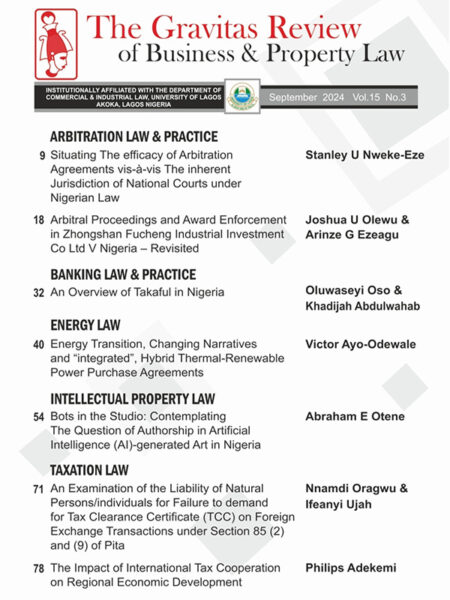
The Gravitas Review of Business & Property Law Vol.15 No.3 – Print
0₦5,000.00In this issue of The Gravitas Review of Business & Property Law Vol.15 No.3, there are well researched articles on:
- Arbitration Law & Practice
- Banking Law & Practice
- Energy Law
- Intellectual Property Law
- Taxation
-
The Gravitas Review of Business & Property Law Vol.15 No.3 – E-Book
0₦5,000.00In this issue of The Gravitas Review of Business & Property Law Vol.15 No.3, there are well researched articles on:
- Arbitration Law & Practice
- Banking Law & Practice
- Energy Law
- Intellectual Property Law
- Taxation
-
The Gravitas Review of Business & Property Law Vol.15 No.3
0₦5,000.00In this issue of The Gravitas Review of Business & Property Law Vol.15 No.3, there are well researched articles on:
- Arbitration Law & Practice
- Banking Law & Practice
- Energy Law
- Intellectual Property Law
- Taxation
-
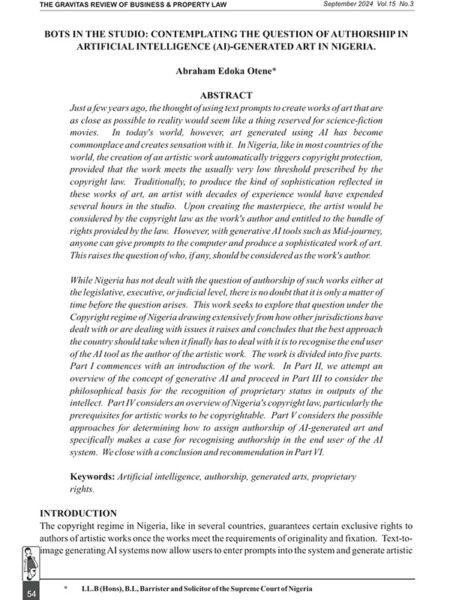
Bots in the Studio: Contemplating the Question of Authorship in Artificial Intelligence (AI)-Generated Art in Nigeria
0₦2,500.00Abraham Edoka Otene in his article, Bots in the Studio: Contemplating the Question of Authorship in Artificial Intelligence (AI)-Generated Art in Nigeria, explores the authorship of AI generated works under the Copyright regime of Nigeria drawing extensively from how other jurisdictions have dealt with or are dealing with issues it raises and concludes that the best approach the country should take when it finally has to deal with it is to recognize the end user of the AI tool as the author of the artistic work. Just a few years ago, the thought of using text prompts to create works of art that are as close as possible to reality would seem like a thing reserved for science-fiction movies. In today’s world, however, art generated using AI has not only become commonplace but is also creating sensation with it. While Nigeria has not dealt with the question of authorship of such works either at the legislative, executive, or judicial level, there is no doubt that it is only a matter of time before the question arises.
The Gravitas Review of Business & Property Law