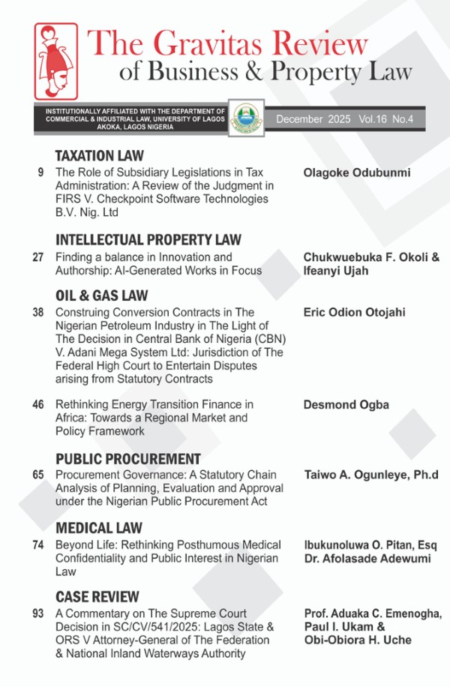
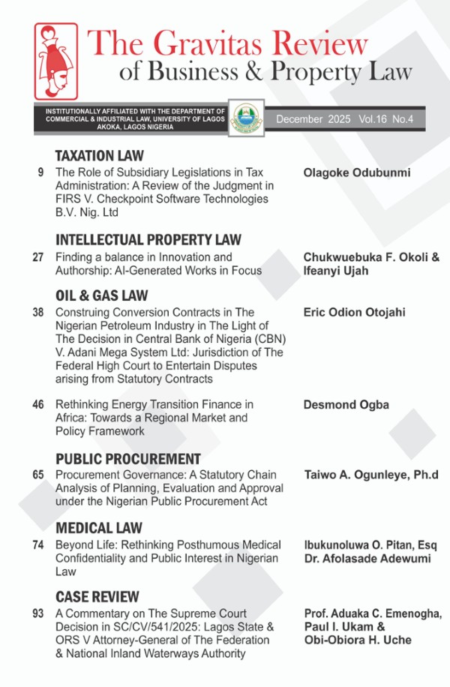
-
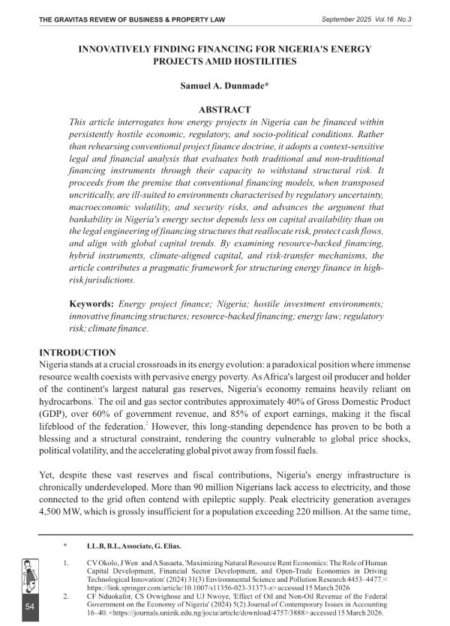
Innovatively Finding Financing For Nigeria’s Energy Projects and Hostilities
0₦2,500.00Samuel Dunmade, in his article, Innovatively Finding Financing For Nigeria’s Energy Projects and Hostilities, interrogates how energy projects in Nigeria can be financed within persistently hostile economic, regulatory, and socio-political conditions. Rather than rehearsing conventional project finance doctrine, it adopts a context-sensitive legal and financial analysis that evaluates both traditional and non-traditional financing instruments through their capacity to withstand structural risk. It proceeds from the premise that conventional financing models, when transposed uncritically, are ill-suited to environments characterised by regulatory uncertainty, macroeconomic volatility, and security risks, and advances the argument that bankability in Nigeria’s energy sector depends less on capital availability than on the legal engineering of financing structures that reallocate risk, protect cash flows, and align with global capital trends. By examining resource-backed financing, hybrid instruments, climate-aligned capital, and risk-transfer mechanisms, Dunmade contributes a pragmatic framework for structuring energy finance in high-risk jurisdictions.
-
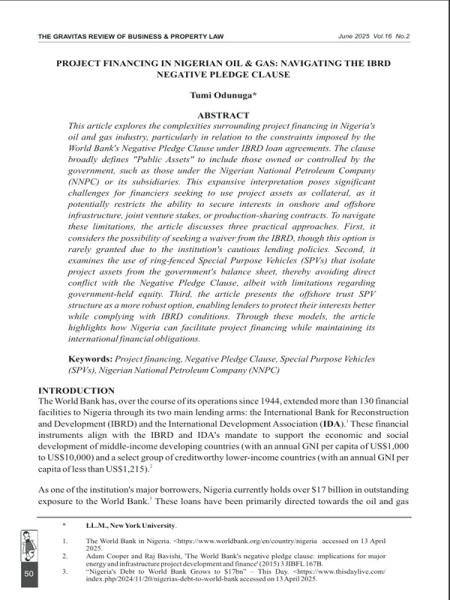
Project Financing in Nigerian Oil & Gas: Navigating the IBRD Clause
0₦2,500.00Tumi Odunuga in his article, Project Financing in Nigerian Oil & Gas: Navigating the IBRD Clause, explores the complexities surrounding project financing in Nigeria’s oil and gas industry, particularly in relation to the constraints imposed by the World Bank’s Negative Pledge Clause under IBRD loan agreements. The clause broadly defines “Public Assets” to include those owned or controlled by the government, such as those under the Nigerian National Petroleum Company (NNPC) or its subsidiaries. This expansive interpretation poses significant challenges for financiers seeking to use project assets as collateral, as it potentially restricts the ability to secure interests in onshore and offshore infrastructure, joint venture stakes, or production-sharing contracts. To navigate these limitations, Odunuga discusses three practical approaches. First, Odunuga considers the possibility of seeking a waiver from the IBRD, though this option is rarely granted due to the institution’s cautious lending policies. Second, Odunuga examines the use of ring-fenced Special Purpose Vehicles (SPVs) that isolate project assets from the government’s balance sheet, thereby avoiding direct conflict with the Negative Pledge Clause, albeit with limitations regarding government-held equity. Third, Odunuga presents the offshore trust SPV structure as a more robust option, enabling lenders to protect their interests better while complying with IBRD conditions. Through these models, Odunuga highlights how Nigeria can facilitate project financing while maintaining its international financial obligations.
-
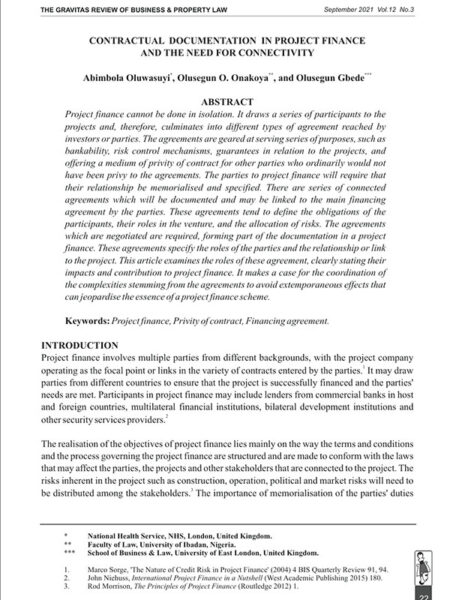
Contractual Documentation in Project Finance and the Need for Connectivity
0₦2,500.00Abimbola Oluwasuyi of NHS London United Kingdom, Olusegun Onakoya of the Faculty of Law University of Ibadan Nigeria, and Olusegun Gbede of the School of Business & Law, University of East London United Kingdom, in their article, Contractual Documentation in Project Finance and the Need for Connectivity, stress the importance of several contractual agreements to the success of a Project. They note that the agreements set out the duties and obligations of different parties at different stages of Project Finance. They examine the different types of agreements, their role, their impacts on project finance, and the importance of coordination among parties involved at all stages of the project to ensure its success.
-
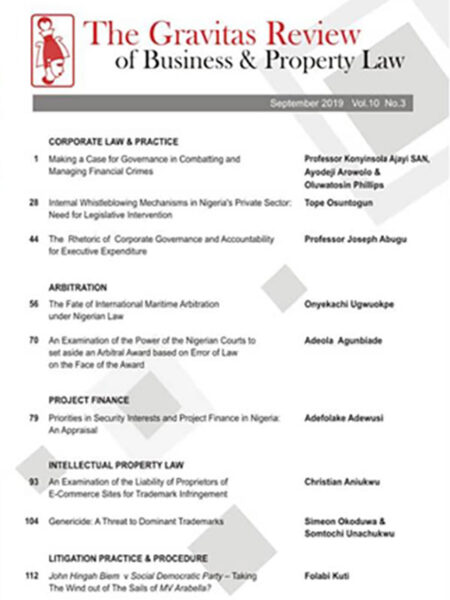
The Gravitas Review of Business & Property Law Vol.10 No.3 – Print
0₦5,000.00In this issue of The Gravitas Review of Business & Property Law Vol.10 No.3, there are well researched articles on:
- Corporate Law & Practice
- Arbitration Law
- Project Finance
- Intellectual Property
- Litigation Practice & Procedure
-
The Gravitas Review of Business & Property Law Vol.10 No.3 – E-Book
0₦5,000.00In this issue of The Gravitas Review of Business & Property Law Vol.10 No.3, there are well researched articles on:
- Corporate Law & Practice
- Arbitration Law
- Project Finance
- Intellectual Property
- Litigation Practice & Procedure
-
The Gravitas Review of Business & Property Law Vol.10 No.3
0₦5,000.00In this issue of The Gravitas Review of Business & Property Law Vol.10 No.3, there are well researched articles on:
- Corporate Law & Practice
- Arbitration Law
- Project Finance
- Intellectual Property
- Litigation Practice & Procedure
-
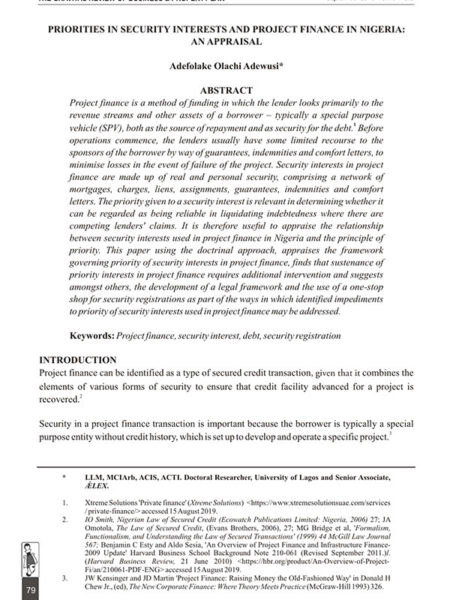
Priorities in Security Interests and Project Finance in Nigeria: An Appraisal
0₦2,500.00Adefolake Adewusi, Doctoral Researcher, University of Lagos and Senior Associate at ǼLEX in her article, Priorities in Security Interests and Project Finance in Nigeria: An Appraisal, posits that security interests in project finance are made up of real and personal security, comprising a network of mortgages, charges, liens, assignments, guarantees, indemnities and comfort letters. The priority given to a security interest is relevant in determining whether it can be regarded as being reliable in liquidating indebtedness where there are competing lenders’ claims. Adefolake appraises the framework governing priority of security interests in project finance, finds that sustenance of priority interests in project finance requires additional intervention and suggests the development of a legal framework and the use of a one-stop shop for security registrations as part of the ways in which identified impediments to priority of security interests used in project finance may be addressed.
-
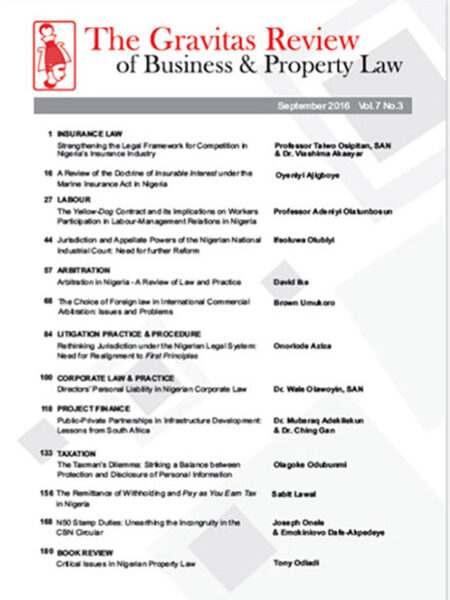
The Gravitas Review of Business & Property Law Vol.7 No.3 – Print
0₦5,000.00In this issue of The Gravitas Review of Business & Property Law Vol.7 No.3, there are well researched articles on:
- Mortgage Finance
- Insurance Law
- Labour
- Arbitration
- Litigation Practice & Procedure
- Corporate Law & Practice
- Project Finance
- Taxation
- Book Review
-
The Gravitas Review of Business & Property Law Vol.7 No.3 – E-Book
0₦5,000.00In this issue of The Gravitas Review of Business & Property Law Vol.7 No.3, there are well researched articles on:
- Mortgage Finance
- Insurance Law
- Labour
- Arbitration
- Litigation Practice & Procedure
- Corporate Law & Practice
- Project Finance
- Taxation
- Book Review
-
The Gravitas Review of Business & Property Law Vol.7 No.3
0₦5,000.00In this issue of The Gravitas Review of Business & Property Law Vol.7 No.3, there are well researched articles on:
- Mortgage Finance
- Insurance Law
- Labour
- Arbitration
- Litigation Practice & Procedure
- Corporate Law & Practice
- Project Finance
- Taxation
- Book Review
-
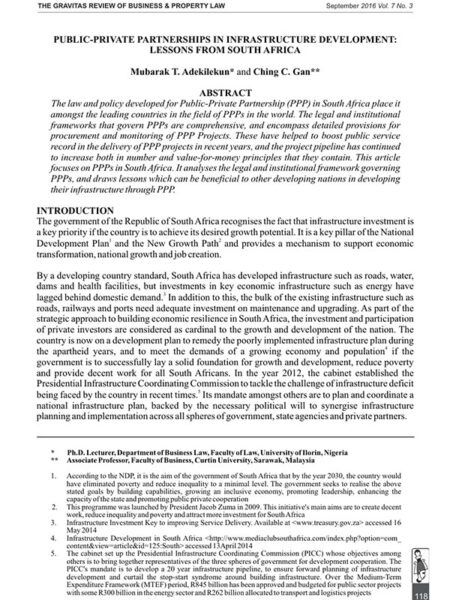
Public-Private Partnerships in Infrastructure Development: Lessons from South Africa
0₦2,500.00Dr. Mubarak Adekilekun of the Faculty of Law, University of Ilorin and Dr. Ching Gan, Associate Professor, Faculty of Business, Curtin University, Sarawak, Malaysia in their article,“Public-Private Partnerships in Infrastructure Development: Lessons from South Africa” explore the world of PPPs in South Africa analysing several legislations that have enabled a phenomenal growth of infrastructure development in the country. They contemplate several factors considered in evaluating PPP projects including Affordability, Value for Money and Risk Transfer.
The Gravitas Review of Business & Property Law