-
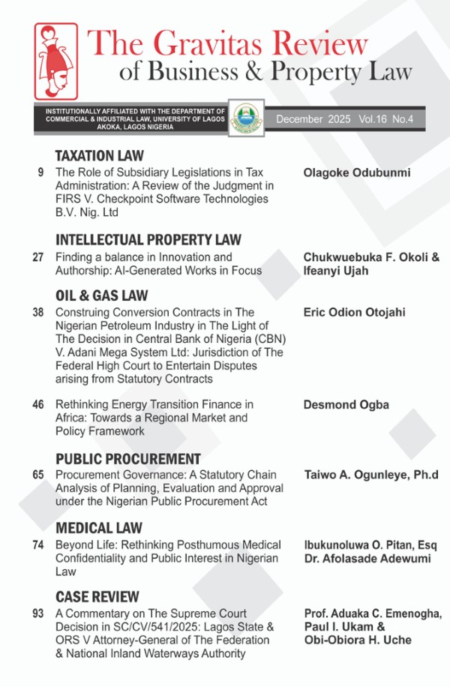
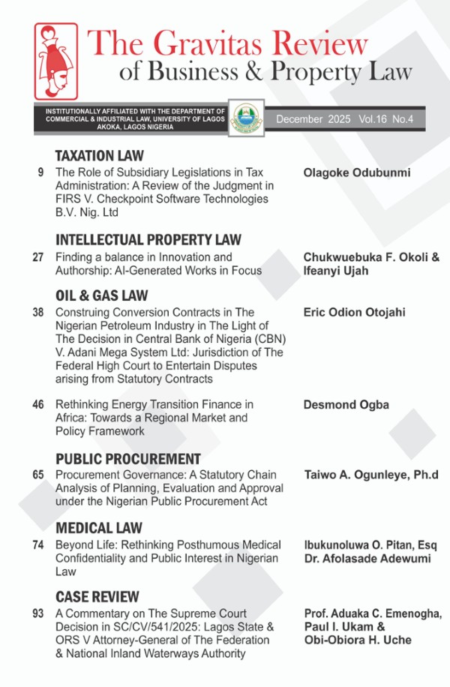
The Gravitas Review of Business & Property Law Vol.16 No.3 – Print
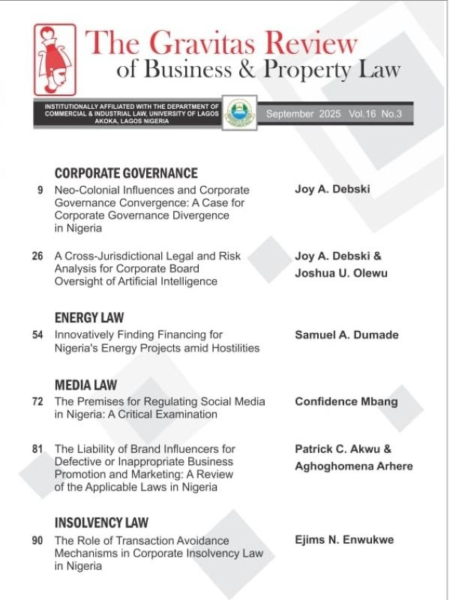
0₦5,000.00In this issue of The Gravitas Review of Business & Property Law Vol.16 No.3, there are well researched articles on:
- Corporate Governance
- Energy Law
- Media Law
- Insolvency Law
-
The Gravitas Review of Business & Property Law Vol.16 No.3 – E-Book
0₦5,000.00In this issue of The Gravitas Review of Business & Property Law Vol.16 No.3, there are well researched articles on:
- Corporate Governance
- Energy Law
- Media Law
- Insolvency Law
-
The Premises for Regulating Social Media in Nigeria: A Critical Examination
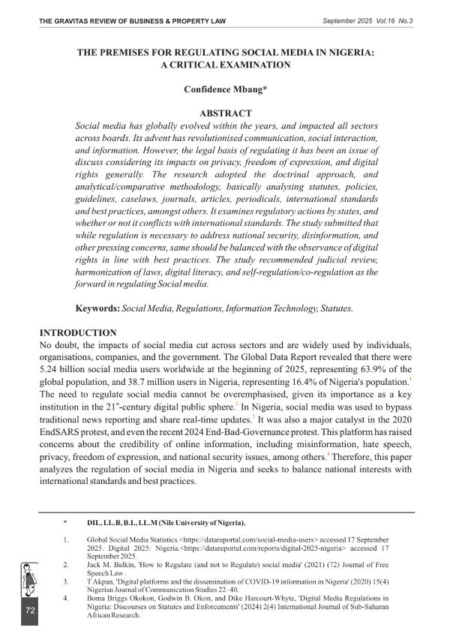
0₦2,500.00Social media has globally evolved over the years and impacted all sectors across boards. Its advent has revolutionised communication, social interaction, and information. However, the legal basis of regulating it has been an issue of discussion, considering its impacts on privacy, freedom of expression, and digital rights generally. Confidence Mbang, in his article, The Premises for Regulating Social Media in Nigeria: A Critical Examination, adopts the doctrinal approach and analytical/comparative methodology, basically analysing statutes, policies, guidelines, case laws, journals, articles, periodicals, international standards, and best practices, amongst others. Mbang examines regulatory actions by states and whether or not it conflicts with international standards. Mbang submits that while regulation is necessary to address national security, disinformation, and other pressing concerns, the same should be balanced with the observance of digital rights in line with best practices. Mbang recommends judicial review, harmonization of laws, digital literacy, and self-regulation/co-regulation as the way forward in regulating Social media.
-
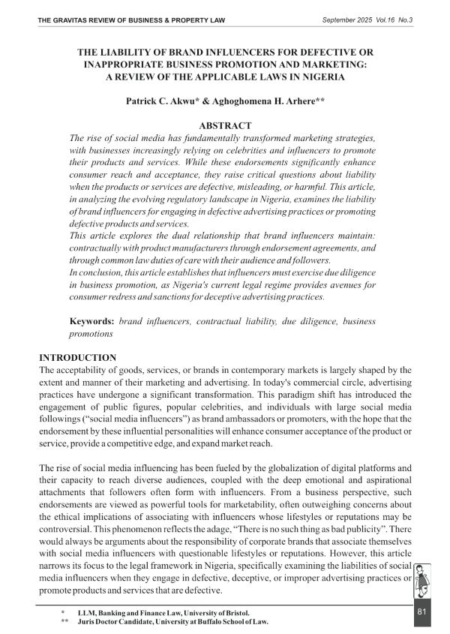
The Liability of Brand Influencing for Defective or Inappropriate Business Promotion and Marketing: A Review of the Applicable Laws in Nigeria
0₦2,500.00Patrick Akwu and Aghoghomena Arhere, in their article, The Liability of Brand Influencing for Defective or Inappropriate Business Promotion and Marketing: A Review of the Applicable Laws in Nigeria, interrogate how the rise of social media has fundamentally transformed marketing strategies, with businesses increasingly relying on celebrities and influencers to promote their products and services. While these endorsements significantly enhance consumer reach and acceptance, they raise critical questions about liability when the products or services are defective, misleading, or harmful. Akwu and Arhere analyze the evolving regulatory landscape in Nigeria and examine the liability of brand influencers for engaging in defective advertising practices or promoting defective products and services. Akwu and Arhere explore the dual relationship that brand influencers maintain: contractually with product manufacturers through endorsement agreements, and through common law duties of care with their audience and followers. In conclusion, Akwu and Arhere establish that influencers must exercise due diligence in business promotion, as Nigeria’s current legal regime provides avenues for consumer redress and sanctions for deceptive advertising practices.
-
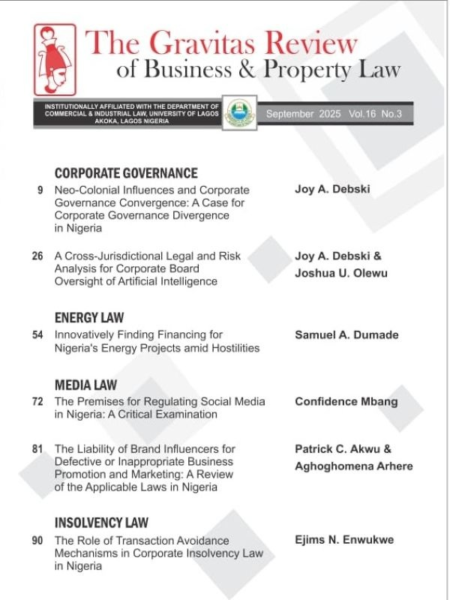
The Gravitas Review of Business & Property Law Vol.16 No.3
0₦5,000.00In this issue of The Gravitas Review of Business & Property Law Vol.16 No.3, there are well researched articles on:
- Corporate Governance
- Energy Law
- Media Law
- Insolvency Law
-
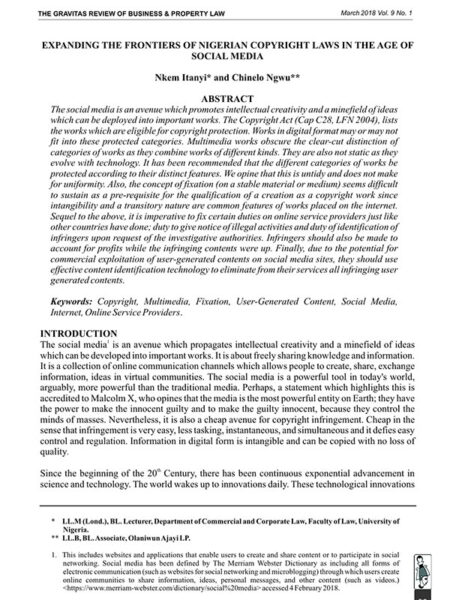
Expanding the Frontiers of Nigerian Copyright Laws in the Age of Social Media
0₦2,500.00Nkem Itanyi, Lecturer, Department of Commercial and Corporate Law, University of Nigeria, Nsukka and Chinelo Ngwu, Associate, Olaniwun Ajayi LP in their article, “Expanding the Frontiers of Nigerian Copyright Laws in the Age of Social Media, note that though social media promotes intellectual creativity, and is a minefield of ideas which can be deployed into important works, works in the digital formal may or may not be protected under the Nigerian Copyright Act. As the fixation concept has become obsolete with technology, it becomes difficult to sustain as a pre-requisite for the qualification of a creation as a copyright work since intangibility and a transitory nature are common features of works placed on the internet. To cope with new infringement mechanisms in the digital era and conflict of law problems, it may be necessary to fix certain duties, such as duty to give notice of illegal activities, and duty of identification of infringers, on online service providers just like other countries have done.
The Gravitas Review of Business & Property Law